09/05/2024.
Back in April, a few of us got into a discussion about the supposed Hively & Horn claim that the difference between the Newark Octagon and High Bank Octagon (with the 90° rotation) results from the difference in their latitudes. There is also a claim (sometimes mentioned in the Octagon tour of Brad Lepper, if I remember correctly) that the Newark Octagon would not work down near Chillicothe. I kind of disputed that, and gave examples of Newark-type Octagons that worked just fine near Chillicothe. This blew many minds.
So here's a careful look at that, and what Hively & Horn actually claimed in their paper (Hively/Horn 2006).
A copy of the original discussion is in the appendix, below.
Discussion
What Hively & Horn did in their paper was get a handle on just how likely it is that the alignments at the Octagon are just a fluke. They did so by producing a bunch of randon Octagons (subject to some reasonable constraints), and seeing how often 5 lunar (or sometimes solar) alignments showed up in those Octagons. Unsurprising, random alignments were very rare, confirming the hypothesis that the alignments we see really were designed into the Octagon by the Indigenous Peoples of the Hopewell Culture.
The catchphrase for this kind of randomizing statistical study is "Monte Carlo" (named after the gambling city along the Mediterranean).
Fun Fact: My thesis advisor in college was an expert on using Monte Carlo methods to evaluate infinite dimension integrals used to solve the equations of Quantum Chromo-Dynamics in order to calculate such things like the masses of the proton and neutron.
This picture (a reproduction of Figure 5 of of their paper) shows the kinds of symmetric octagons that Hively & Horn looked at.
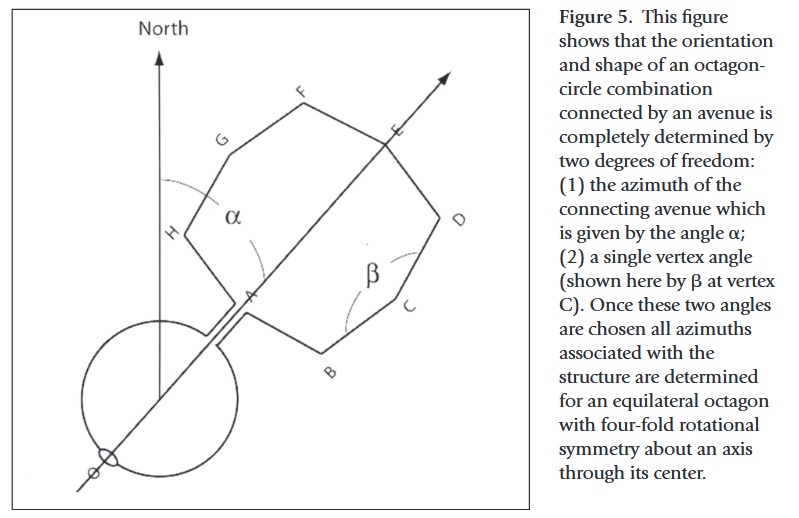
Based upon the high degree of symmetry, only two parameters are required to specify the whole class of octagons.
Let me discuss the symmetries of their octagon first.
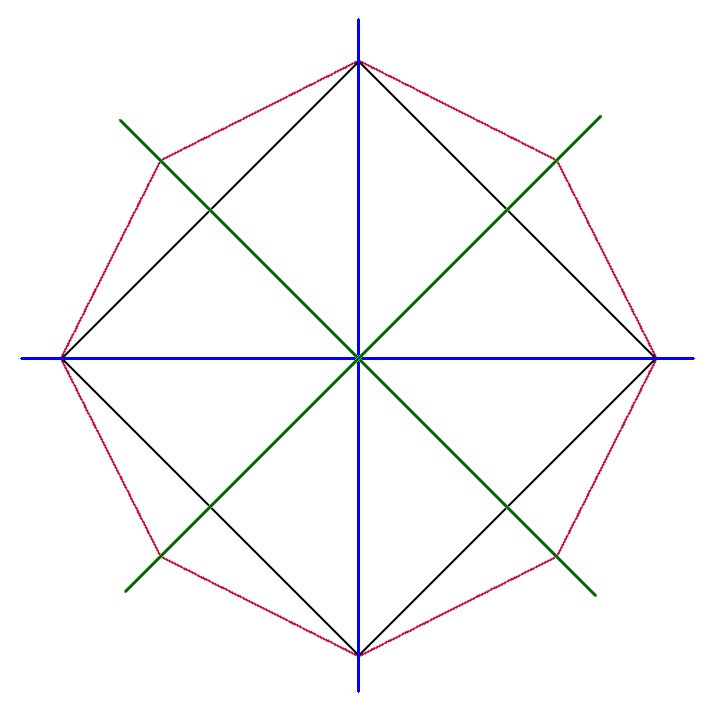
The black diamond (square) has each leg equal to the length of one OCD (Observatory Circle Diameter) (as is true of the Newark Octagon). The octagon is built by pushing out each black side by some same amount, giving the target octagon (red). The value of their angle, β, is determined by how far you push out the sides. This octagon has two perpendicular reflection symmetry axes (blue), and two more perpendicular reflection symmetry axes (green). The only kind of octagon more symmetric is a regular octagon (like a stop sign).
This kind of octagon is called an "isotoxal" octagon.
But then Hively & Horn note that there may be something even more special about the Newark Octagon, as shown in their Figure 2.
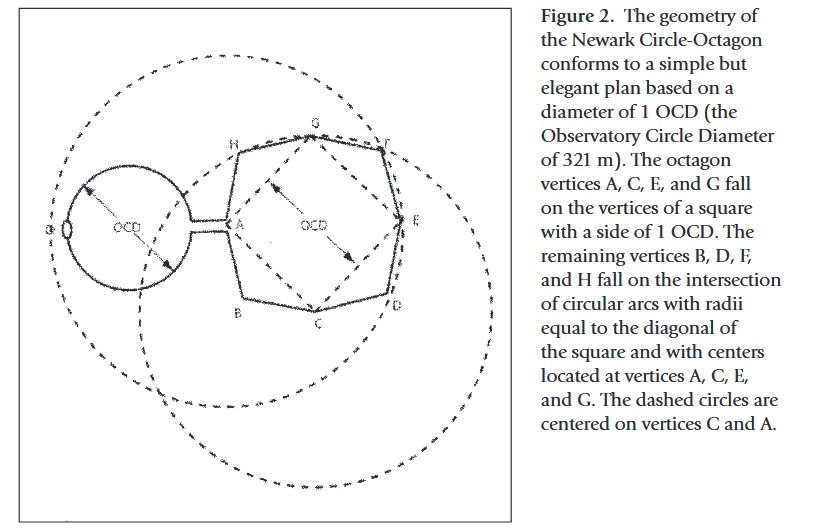
There are those two extra large circles—what are they depicting? It's not at all obvious from that particular Figure.
Keep in mind that the diagonal of the diamond/square is √2×OCD. What that figure shows is pushing out the black sides just enough so that the adjacent points of the octagon are also √2×OCD from that major point.
That is shown in this picture, with one cyan line being the diagonal and the other two showing how far out the black side it pushed out to the red corner.
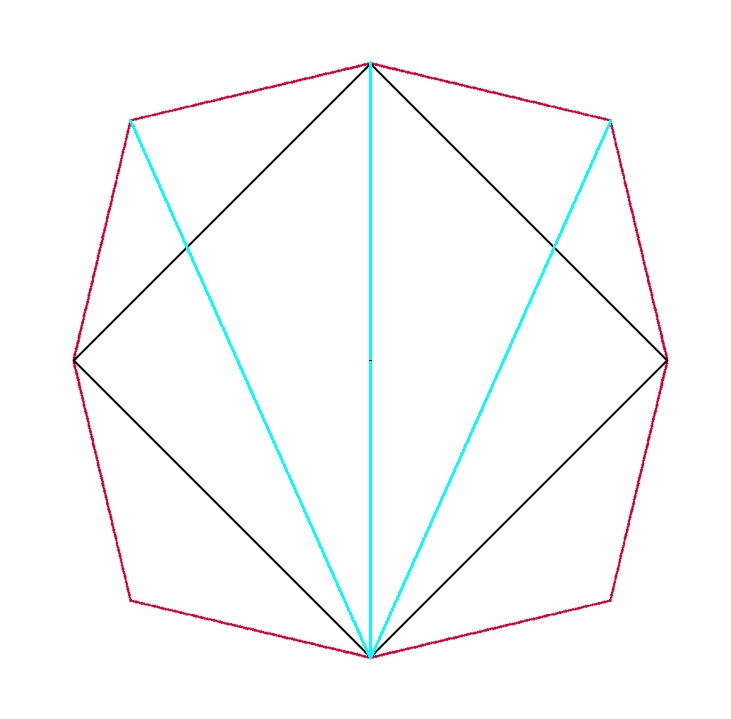
But, as already mentioned, the Octagon has a bunch of symmetries, so the full effect is given here:
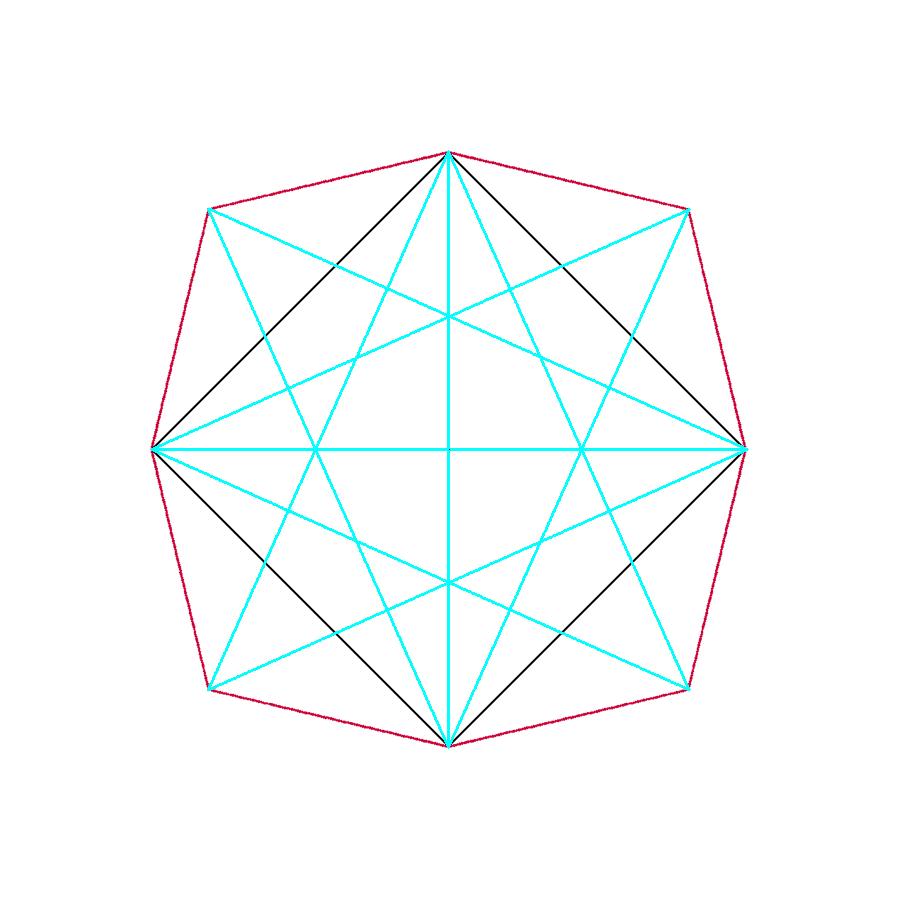
What we have here is a very special octagon, which I call an isochordal (since all those interior chords have the same length). It fixes Hively & Horn's β variable to one specifice value:

This is where the 155.7° in their paper comes from. [Sorry, I did the calculation and cannot resist showing off.]
But there is something more important happening—their main model (Figure 5) has two variables (α and β), which means two degrees of freedom. Using two degrees of freedom provides a large space of different possible Octagons to look through. By fixing β to 155.7°, we are now reduced to a single degree of freedom. All you can do with an isochordal octagon is orient (rotate) it.
Now, Hively & Horn did use both degrees of freedom for most of their work. For instance, in their list of models (p. 293), they do use the <α, β> set-up for Model A. But Models B and C use only the isochordal octagon. In fact, whenever you see the phrase "plan . . . in Figure 2" in the paper, they are restricting themselves to the isochordal octagon. And you need to look out for this when interpreting any of their results.
So, when we see their results for what would work at Newark, we see the one peak at 153.6°, for lunar alignments only, and another, more square-like peak at 165.5° if solar alignments are included.
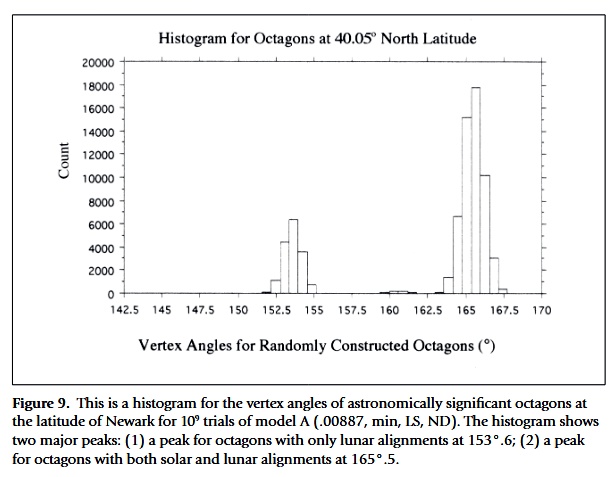
So, now let's cut to the chase: their section entitled "Unique Location of the Newark Octagon", page 306.
Here they end up concluding that the Newark Octagon only works within a narrow range of latitudes, between 40.0°N and 40.4°N.
Perhaps the most remarkable feature of the Newark Octagon is the fact that it simultaneously accurately aligns with five lunar standstills while closely conforming to the geometrical plan given in Figure 2. It should be noted that this dual geometrical and astronomical significance is only possible in a very narrow range of latitudes, which includes the Newark site. * * * It is of some interest to establish the range of latitudes for which the sum of these two angular deviations would be 1° or smaller.
Computation of these angular deviations for various latitudes reveals that their sum will be 1° or less only over the latitude range from 40.0° to 40.4°. This involves a north-south band of distances some 44.5 km (28 mi) wide. A computation of the sum of these angular differences (for an octagon with the same vertex angles as at Newark) for the latitude of High Bank (39°.3 N) reveals them to be 2.6°. This observation offers a possible explanation as to why the Newark Octagon geometry was not adopted at High Bank (even though the associated circles are of identical size): the same shape would not have had the same astronomical significance to the same accuracy. (Emphasis added.)
But look at their conditions! The main one is that the Octagon conform to "Figure 2". That is, the isochordal octagon, not the more general <α, β> Octagon (which, recall, has the full set of symmetries, but not that extra √2×OCD measurement). The other condition is rather narrow error bars on what constitutes a fit. That "happens" to include the 153.6° actual interior angle found in their Monte Carlo calculation.
It's not even clear to me that this isochordal octagon is actually deliberately implemented in the Newark Octagon. After all, I see the Indigenous Engineers of the Hopewell Culture designing the Octagon around the alignments, not this extra √2×OCD condition. It more-or-less falls out naturally; they would have had little to no choice in the matter. They may not even have noticed it. But they may have . . . after the fact of the main initial design. I haven't done the detailed analysis to see if there are any hints of such design. All I can say is that, if there, they would be subtle and difficult for us to reliably suss out due to various design and construction limitations regarding the Octagon.
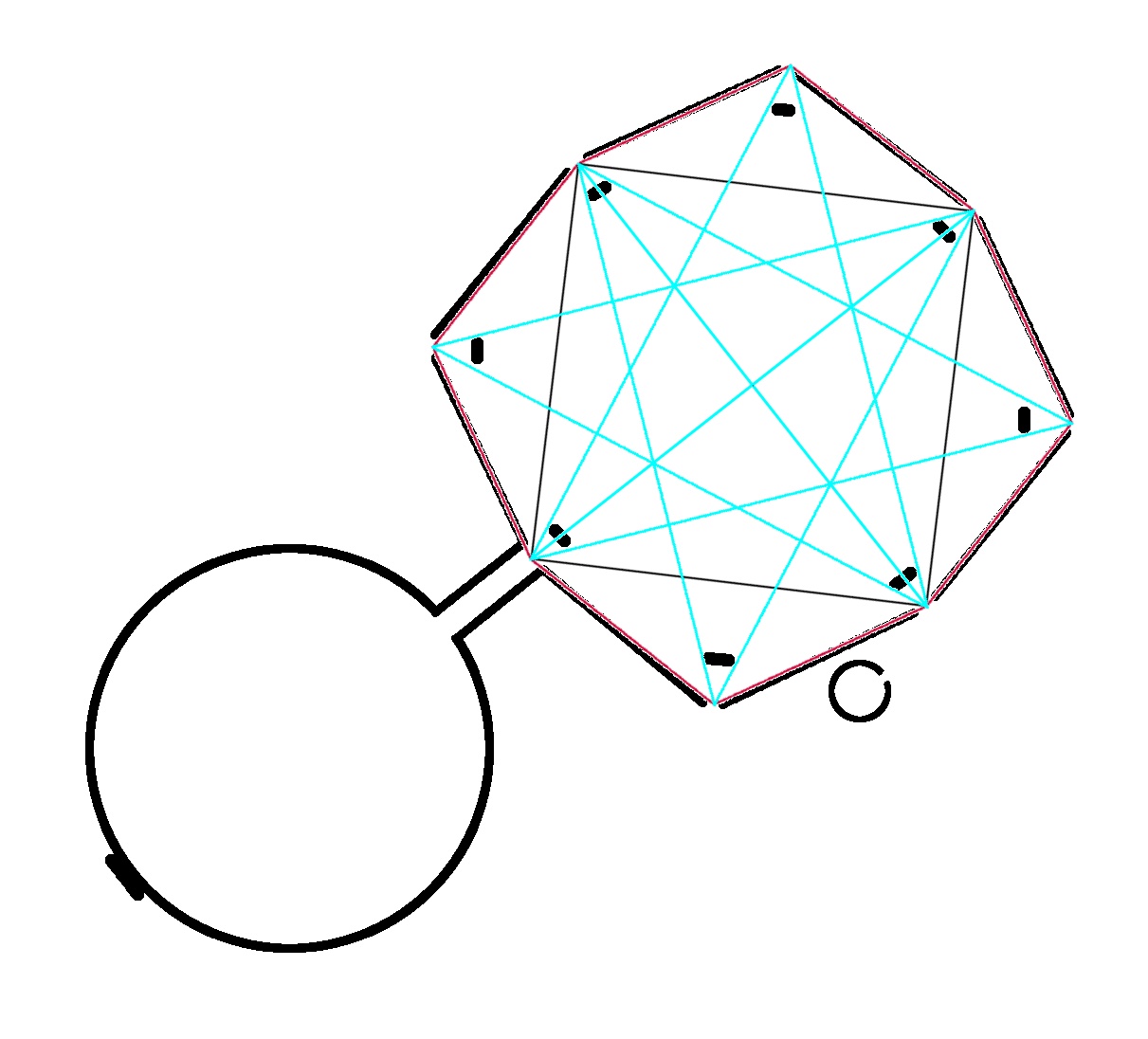
But the important fact to keep in mind is that, even if they noticed and designed on the basis of the uniqueness of this isochordal octagon, it does not preclude them in the least from pursuing other Newark-like <α, β> octagons down at High Bank.
In fact, their Figure 10 shows exactly how to make a copy of the Newark Octagon near Chillicothe.
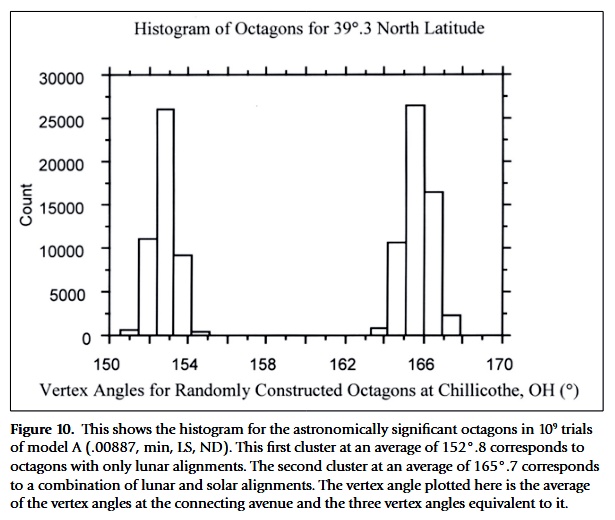
They just have to adjust their interior angles from 153.6° to 152.8° (for lunar only) or from 165.5° to 165.7° (for luni-solar).
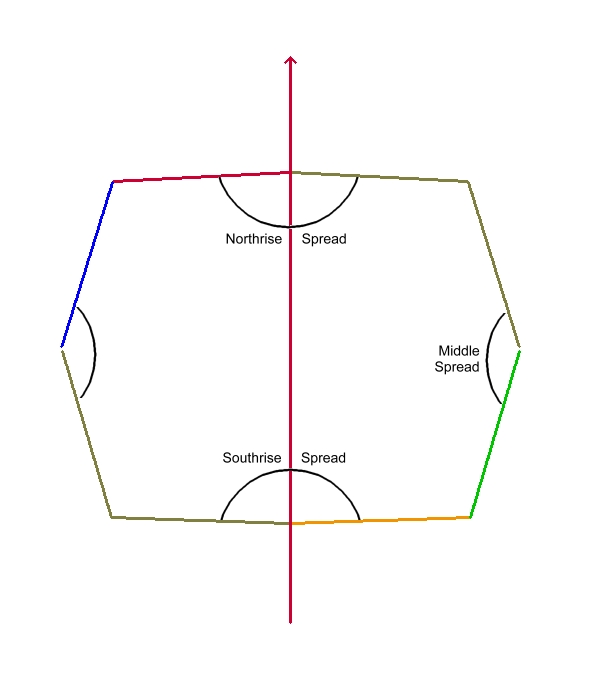
This is pretty much what I showed in Reflecting on Symmetries, which (broadly) showed that <α, β> octagons can be built between the latitudes of around Lexington to Marion. Beyond there, you cannot achieve full symmetry and have to resort to the "squished" octagon in this picture, which exhibits lessened symmetry.
[Note: the following two aragraphs and diagram were added September 18, 2025.]
In the following diagram, I "built" an isotoxal octagon based on the latitude of Chillicothe, using the appropriate moonrise and moonset parameters, and based on pushing out the sides of a square with sides of one OCD. It also uses a zero horizon like the Newark Octagon.
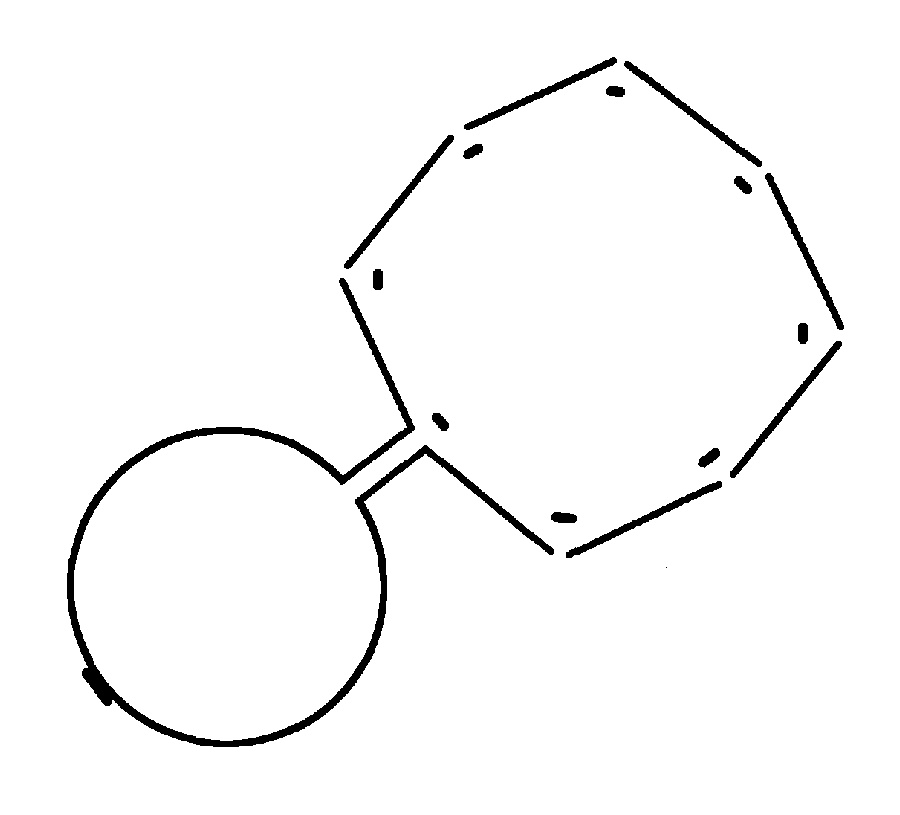
It look remarkably similar to the Newark Octagon. The main difference is that the non-diagonal chord is about 30 feet shorter than it is for the Newark Octagon, and what we have is now an isotoxal, not isochordal, octagon.
So, why is High Bank so different from Newark? Different goals.
The narrower width (~166°) suggests they really wanted to pull in solar alignments (which are there). But more importantly, they rotated it by around 90° because that aligns it with the direction of the Scioto River Valley just south of Chillicothe. The axis of the river valley is aligned at a right angle to the northernmost moonrise. This obviously had a special significance, as Hively & Horn recognized in a later paper (Hively/Horn 2020).
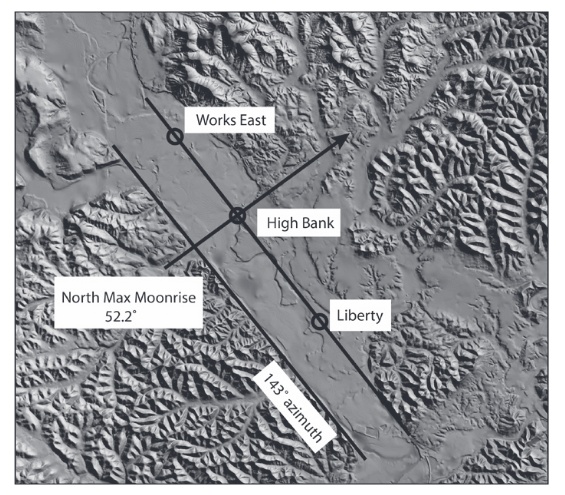
And again, I note that the line from the center of Newark's Observatory Circle to the peak of Salisbury Hill has this same 90°-rotated bearing. It emphasises the importance and really ties the two locations together.
Summary.
The Newark-type isotoxal Octagon translates well around southern Ohio. The uniqueness found by Hively & Horn is dependent on looking solely at an isochordal octagon. High Bank is different because the designers were trying to accomplish a different purpose.
References.
Hively/Horn 2006
A Statistical Study of Lunar Alignments at the Newark Earthworks, by Ray Hively and Robert Horn. Midcontinental Journal of Archaeology, Vol. 31, No. 2 (Fall 2006), pp. 281–322.
Hively/Horn 2020
Hopewell Topography, Geometry, and Astronomy in the Hopewell Core. by Ray Hively and Robert Horn. Encountering Hopewell in the Twenty-first Century, Ohio and Beyond (2020), Vol. 1 Ch. 5. Figure 7, page 133.
Appendix
This appendix contains the relevant portions of the April 4, 2024, discussion between Jeff Gill, Bret Ruby, and me. The original on facebook is here.
Jeff:
I like to point out the difference between the octagonal enclosures at Newark & Chillicothe could indicate awareness of a curved earth between those two points 60 miles apart in latitude. Which may in turn point to Native American awareness that the planet is a sphere 2,000 years ago, “but even that is supposition.” Beyond those nested qualifications, I’d love to find art or alignments to suggest they even tried to predict eclipses, but I’m less sure that’s in evidence . . . so I content myself with observing that they “could” have worked it out, but further study is needed.
Me:
Jeff, you know, I really don't get the bit about how the Highbank Octagon demonstrates the difference of latitudes and the curved earth (despite what H&H said). If I plopped the Newark Octagon there, no line would have to be adjusted more than 0.5°. In fact, if you even flipped it, it would work with even less. No, the reason it is different (as far as I can tell), is because it is rotated by 90° (so as to be parallel to the bluff-line along the Scioto there). Then you really do need to re-design it.
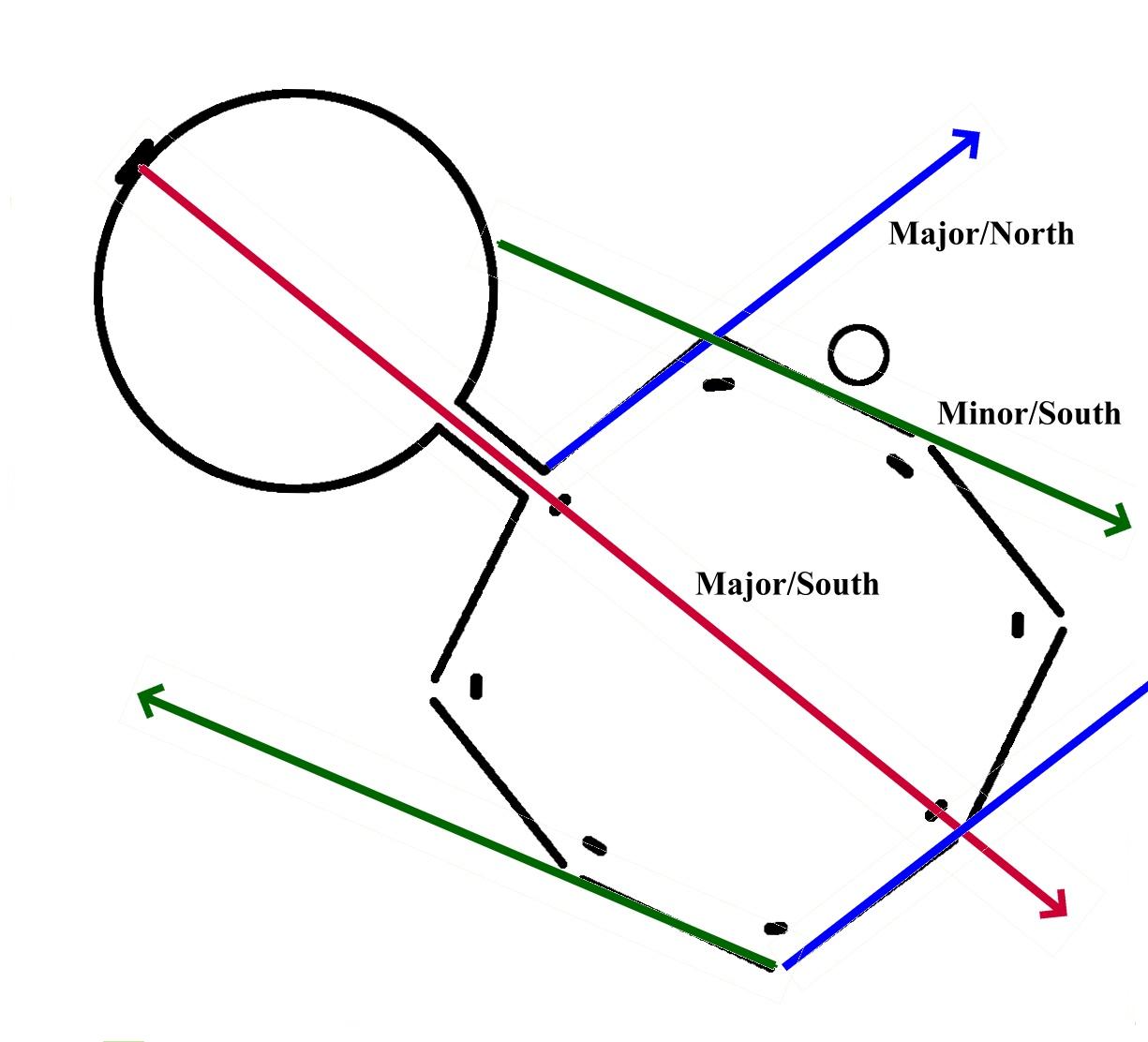
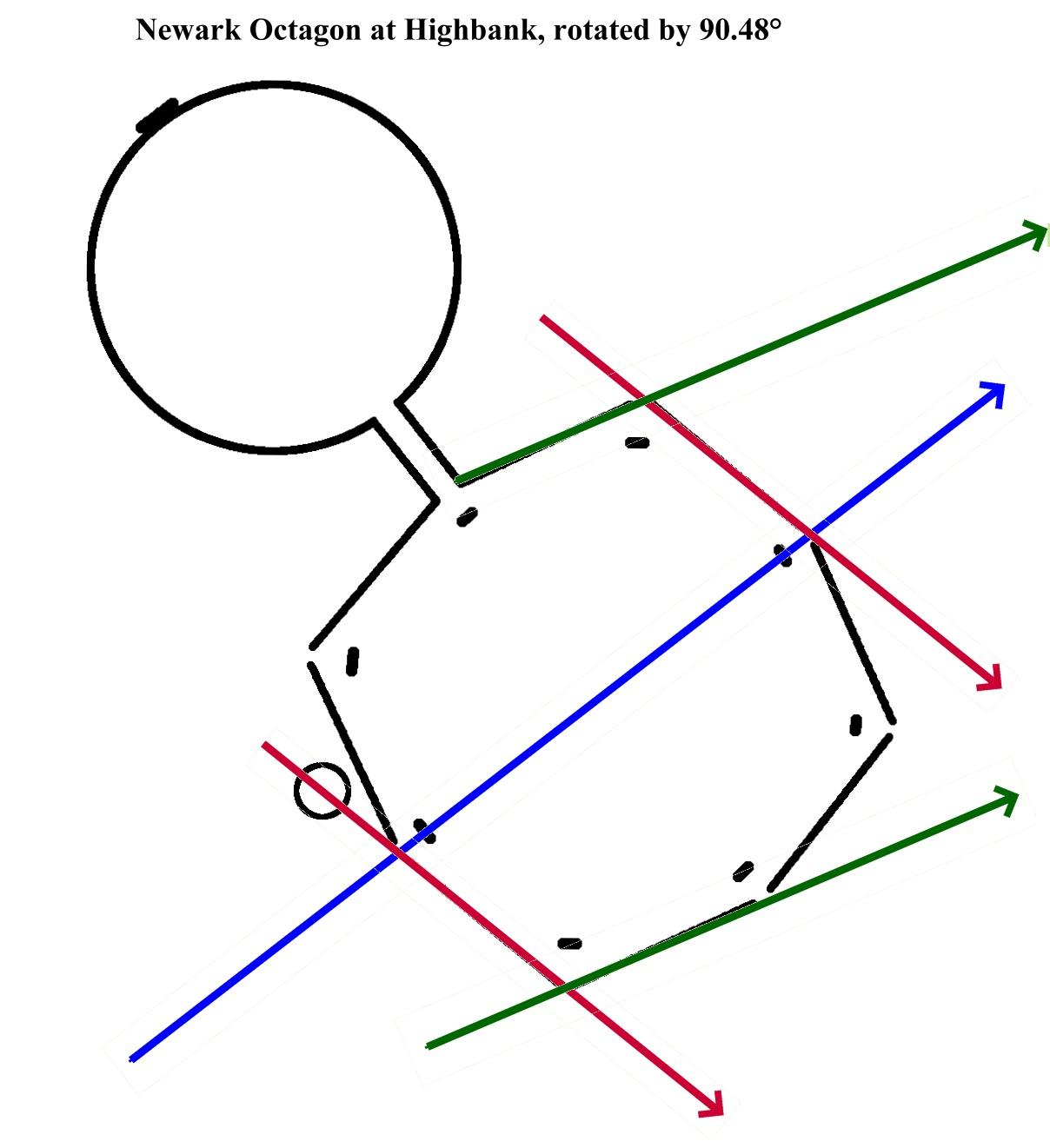
After I posted this, I looked to see more carefully if you could rotate the Newark Octagon and put it at High Bank and have it work. The answer is "yes". If you rotate it by 90.48° (the extra 0.48° compensates for the lower latitude of Chillicothe), this is what you get. It's a really good fit. (Blue: northernmost moonrise; red: southernmost moonrise; green: minimum northernmost moonrise at Minor Standstill.) Of course, this is NOT what High Bank looks like. Conclusion: The Indigenous Peoples of the Hopewell Culture had something different in mind! For one thing, they brought in some solar alignments, but there were probably other considerations we don't know enough about to fathom.
Bret:
I’m really surprised by that result, and a little bit annoyed . . .. I thought H&H had concluded the Newark Octagon wouldn’t work at High Bank. Now I’m gonna have to go back and read their 2006 paper again, and that is not a fun read.
Plus I’m probably going to have to go out and get some tracing paper, or spring for a CAD license. I’m way out of my depth here, but I suppose this means High Bank would work at Newark as well (and I’m sure Brad would prefer to look at it that way).
And I suppose you’re assuming a zero degree horizon at both Newark and High Bank.
*annoyed in a good way
Jeff:
Agreed. I've just echoed on interpretive walks what I've heard Hively & Horn say many times, but in fairness to Bob, I don't agree with H&H on everything, so that's no excuse! Just never thought to recheck those angles and need to hunt up where they said that in print (assuming they did). The local east horizon is far from zero, so there's room for checking in any case . . . and I can't recall what the western horizon looks like from High Bank. In any case, if it's not so, I will need to stop saying it; hat tip to Bob for the question!
Me:
Bret, yes, zero horizon. I know H&H have tended to go both directions on that, so maybe in their 1984 paper they used true horizon? Certainly High Bank has high true horizons since it is located where the valley narrows. So I guess my point would be that it's not the difference in latitude that matters. I've said before that it is coincidence that the Minor Standstills work—they only work between Portsmouth and Toledo. (And H&H more or less acknowledge that coincidence in their 2006 Monte Carlo paper, which I am just now getting around to reading—their model only has 2 degrees of freedom.)
Me:
Jeff and Bret, BTW, here's how to find a zero-horizon moonrise without sighting from atop distant hills as per H&H: First, find your zero horizon (red line). This is easily done by tying together branches into a 3, 4, 5 triangle at your observation point and using a plummet for the vertical and sighting along the perpendicular. Next, put up a fairly high crossbar in the distance. As the moon rises, use twine and plummets to mark the moon's locations as it rises (black lines and balls).
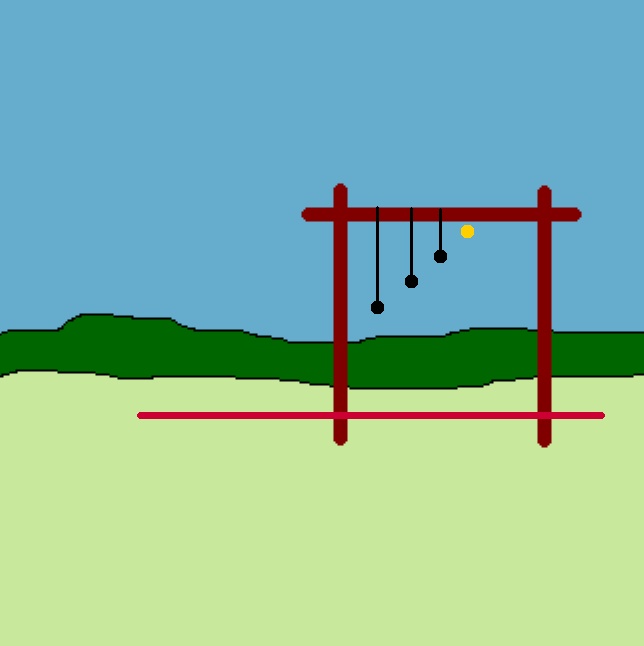
Yell at a partner to get some distance and accuracy. Once the moon is risen, look down the line of plummets to see the zero-horizon risepoint. Tim Black's photos are the inspiration for this.