06/08/2024.
Yesterday morning we had another boreal (northern) lunistice moonrise. But, as with all such moonrises around the summer solstice, it rose with the sun and will set with the sun*mdash;it's a new moon, and hence not much to see.
So I thought I'd write today about symmetries: the symmetries of the orbital dynamics of the moon, the symmetries of the Octagon, and how they tie together.
This shows is the classic Hively and Horn picture showing the eight lunar extreme rises and sets (Hively/Horn 1982).
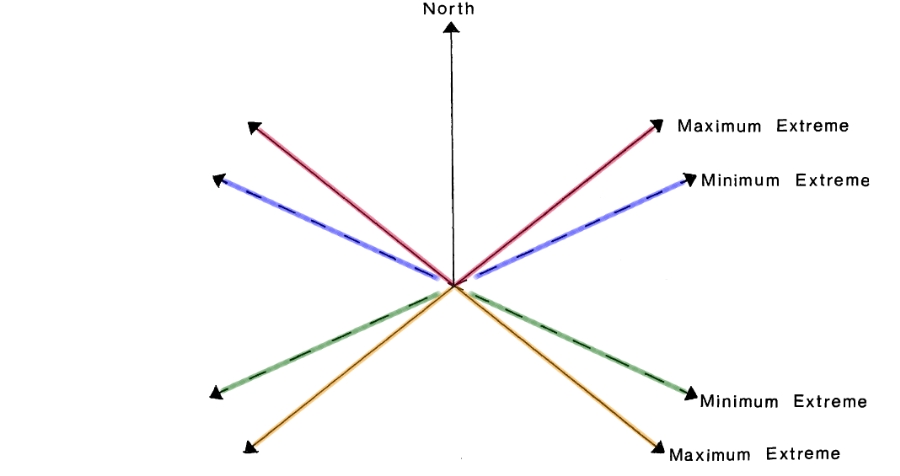
These are all (supposedly) encoded into the Octagon. I've color-coded them.
The first symmetry I'd like to discuss is the east/west (that is, rise/set) symmetry. For any extreme moonrise, there will be an extreme moonset found by reflecting the other around the north/south axis. This symmetry is not seen on any particular day (because moonrises/sets are discrete, not continuous events), but exhibits itself over the timespan of a Standstill. The events match within 0.05° or so. Thus, if the Indigenous Peoples of the Hopewell Culture accurately know one of them, they can get the other by such a reflection.
By looking at such a symmetry we can remove ourselves from worrying about whether the rise (or set) is using first light to define the rise/set, or zero horizon, or lower limb tangency, as long as the measurer was consistent. This symmetry would be broken, however, if they were to use a clear-the-local-horizon standard, since a nearby obstacle in one direction would delay the appearance of the moon.
The second symmetry is a north-south symmetry (reflection through an east/west axis). This is only close to a symmetry, and is due to the moon being relatively close (cosmologically) to the earth. More or less, the southern events will be further south due to the moon having to clear the bulge at the equator. (The official name for this is "parallax".)
In practical terms, this means that this north/south asymmetry (around the Newark area) is about 0.8° for the Major Standstill events and about 0.6° for the Minor Standstill events.
This picture shows the standard diagram of the Octagon, its alignments, and its resulting symmetry.
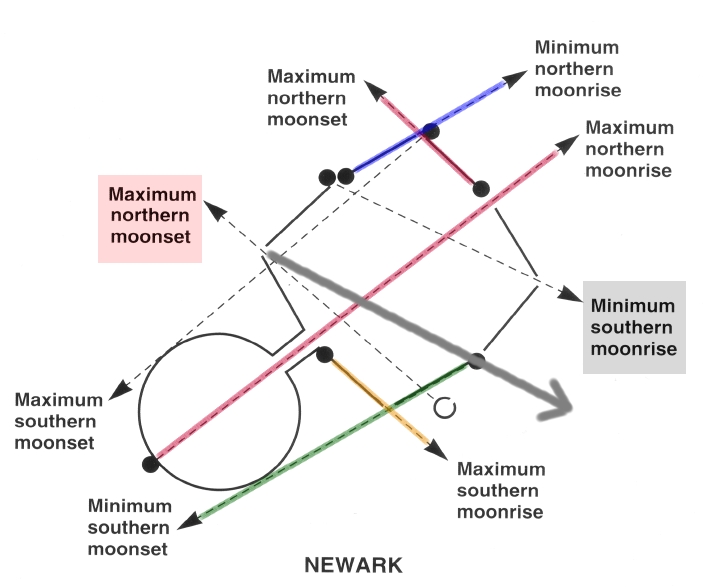
I have again color-coded those alignments (using the same coloring scheme as before). The main thing I'd like you to notice is the arrangement of determinative legs of the Octagon. Using the main axis, the northern events are encoded to the west of the axis (and towards the north) and the southern events are encoded to the east (and towards the south).
I'd also like to point out that the second "Maximum northern moonset" (highlighted in pink) does not rely on Octagon legs at all, but the placement of the small circle, and is thus independent of the symmetry of the Octagon.
I'm somewhat dubious of the "Maximum southern moonset", seeing it as a bit of a stretch, and Hively and Horn seem to have been dubious, too, since they have since moved that line to run near the main axis and get its alighment from Observatory Mound. [Note added September 19, 2025. Over time, I have come to like this alignement better, after having it pointed out to me that leg of the Octagon that it passes was originally much shorter and gave a clearer view.]
Finally, I really don't think the "Minimum southern moonrise" (highlighted in gray) lines up properly. I've added a second, equivalent line (in fuzzy gray) to the picture; it is equivalent due to the symmetry of the Octagon.
Let me discuss that fuzzy gray line next.
This is a picture that shows two of the figures in a single Hively and Horn paper (Hively/Horn 2013).
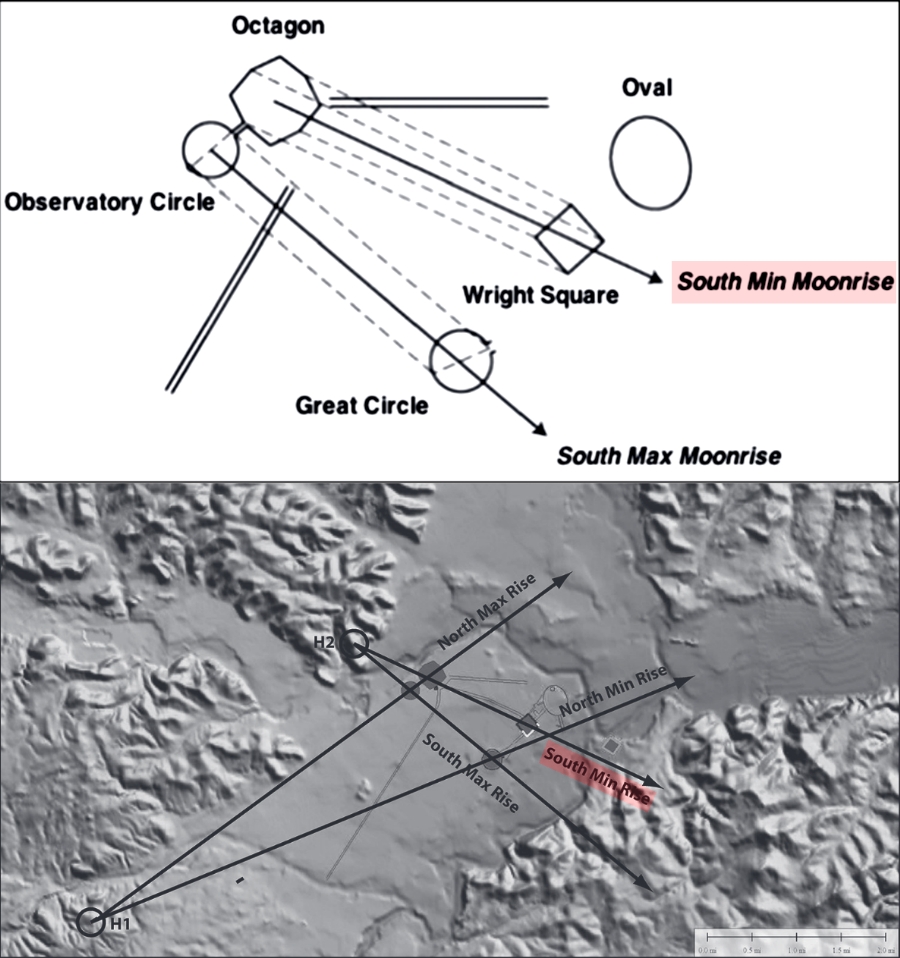
In the first figure (their Figure 3), it is claimed that the "South Min Moonrise" runs from the center of the Octagon to the center of Wright Square. In the second figure (their Figure 4), that line runs from H2 (a nearby hilltop) and through a gap of the Octagon (missing the center completely) before arriving at the center of Wright Square. It doesn't even agree with the previous picture, the standard diagram of the Octagon. So much for peer review.
To be fair, when one is trying to play with ("play with" meaning carefully trying to analyze the various possibilities over great distances of zero horizons and the like) what is going on, one has to keep testing, and one keeps revising one's hypotheses based upon newer data and newer ways of looking at things.
And that is where, I think, looking at symmetries adds to the conversation.
If the rise/set symmetry holds, we should be able to verify it.
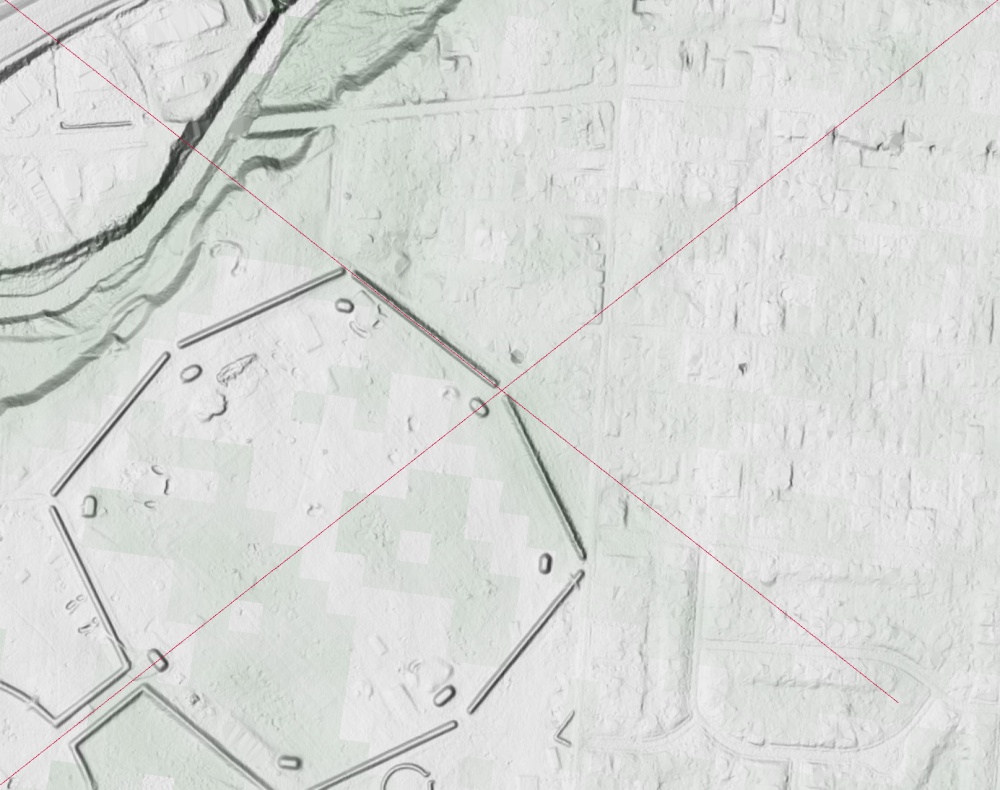
This picture takes a relief map, generated from LiDAR data, from the Licking County Auditor site, and draws the center line of the Octagon. It then reflects that line through a north/south axis. We see that it matches the appropriate leg almost exactly. Bingo.
In their first paper, Hively and Horn tested alignments using local horizons; this leg was the worst. It later led them to consider a zero horizon match instead (not the local horizon, but where the horizon would be if there were no obstacles, like nearby hills). This pretty much confirms that change (though, to be more precise, it just says that the same method was used by the Indigenous Peoples for both the moonrise and the moonset).
It also suggests more: it says that they accurately determined north and south, and knew how to reflect an angle through such a north/south axis.
We can now see whether the "Minimum southern moonrise" in the second picture passes this reflection test. If we reflect the Minimum southern moonset and place it in the Octagon, this is what we get.
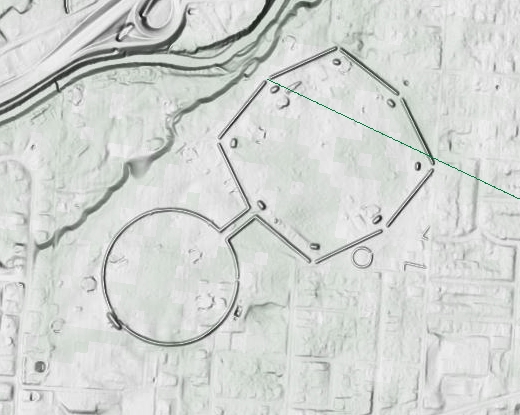
It really doesn't work very well, which is another reason I don't think that supposed alignment is correct. That angle is off by 2.65°.
However, we can also use the reflection principle to to see if the reflected "Minimum northern moonrise" and "Minimum southern moonset" (in their Figures 3 and 4) of the Octagon align with something after all. The reflections would be a "Minimum northern moonset" and a "Minimum southern moonrise", which point mostly in opposite directions.
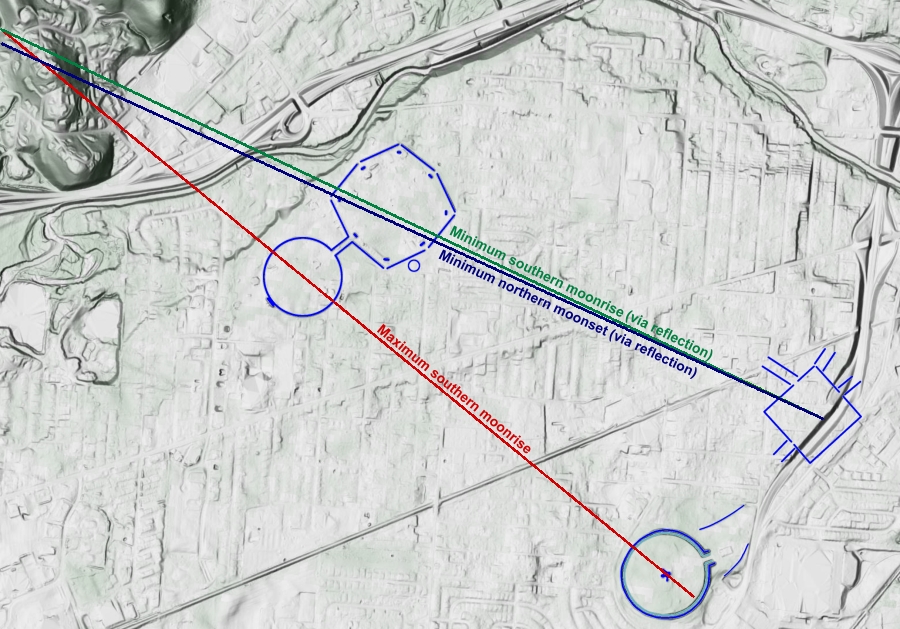
Here we see that it is the "Minimum northern moonset" that points at H2, where it intersects with the "Maximum southern moonrise". So maybe it was the moonset that was important for this, not the moonrise.
Let me now look at another symmetry—that of the Octagon itself.
The Octagon, while not a "regular octagon" (8 equal sides, 8 equal interior angles, like a stop sign), is still highly symmetrical.
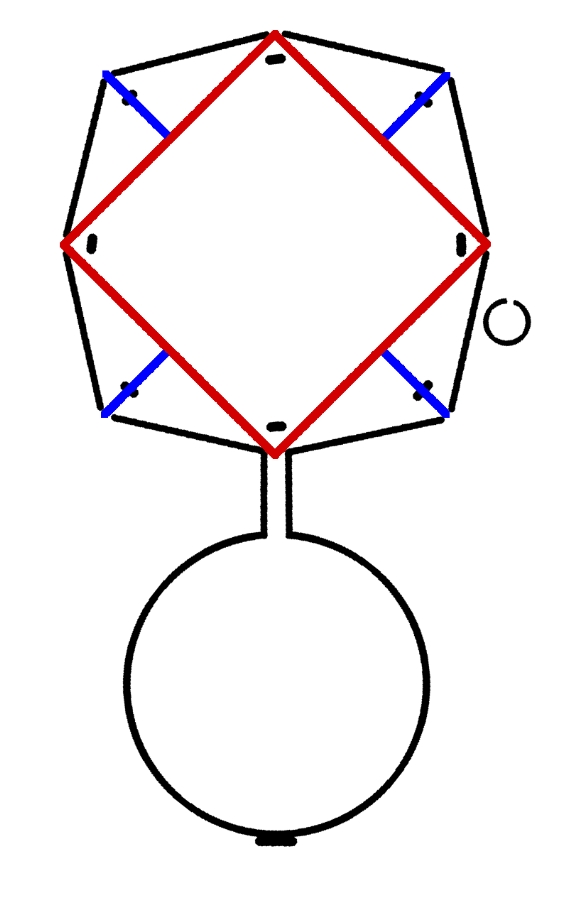
It takes a square (red), with sides the same as the diameter of Observatory Mound, and pushes out those sides (blue). While the result does not have 8-fold symmetry, it does have 4-fold symmetry (reflections and rotations). This kind of octagon is called an "isotoxal" octagon.
This "perfect" octagon is then rotated so that its main axis points at the Maximum northern moonrise. Such a "perfect" octagon does not, however, perfectly match the other moonrises or moonsets. The moon's orbit does not "know" about such octagons.
Instead, this was something that the Indigenous Peoples, with their intimate knowledge of the moon and of symmetries discovered and used to their advantage. And while the Newark Octagon is not perfect, they noticed that they could "nudge" the sides and angles to make everything align the way they wanted it to, to etch the heavens onto the earth.
I call this "symmetries with fine-tuning".
We can think about how amazing this is by asking ourselves, what if the Indigenous Peoples had lived somewhere else, like say, Mackinaw? (I am using "Mackinaw" for either "Mackinac Island" or "Mackinaw City".) What could they have done there?
This picture shows the kind of similar octagon they could have produced.
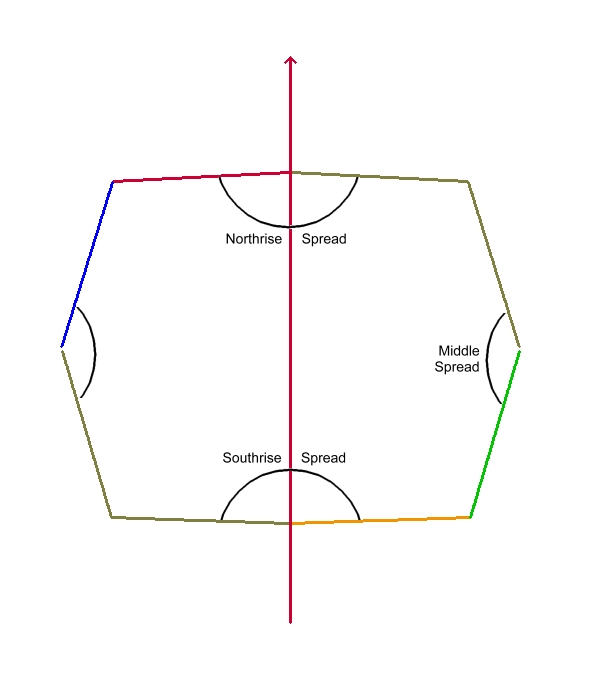
It's color-coded just like the earlier pictures. The gray sides (just as for the Newark Octagon) do not align with anything—instead they are placed symmetrically through the main axis. As far north as Mackinaw, the interior angles encompassed by the Northrise and Southrise Spreads would have been much greater, while the Middle Spreads would have been much less, leading to less symmetry.
By the way, the Northrise and Southrise Spreads (interior angles) are slightly different (173.67deg; and 175.67deg;) due to the north/south asymmetry mentioned earlier. The Middle Spread is substantially less: 146.87deg;.
For a fully symmetric octagon, all those spreads need to be equal. For a symmetric octagon with fine-tuning, they need to be somewhat close.
And now we come to the point of this whole post: how special is the Newark location? We can take the Mackinaw exercise and apply it to a broad range of latitudes. That is what this graph shows.
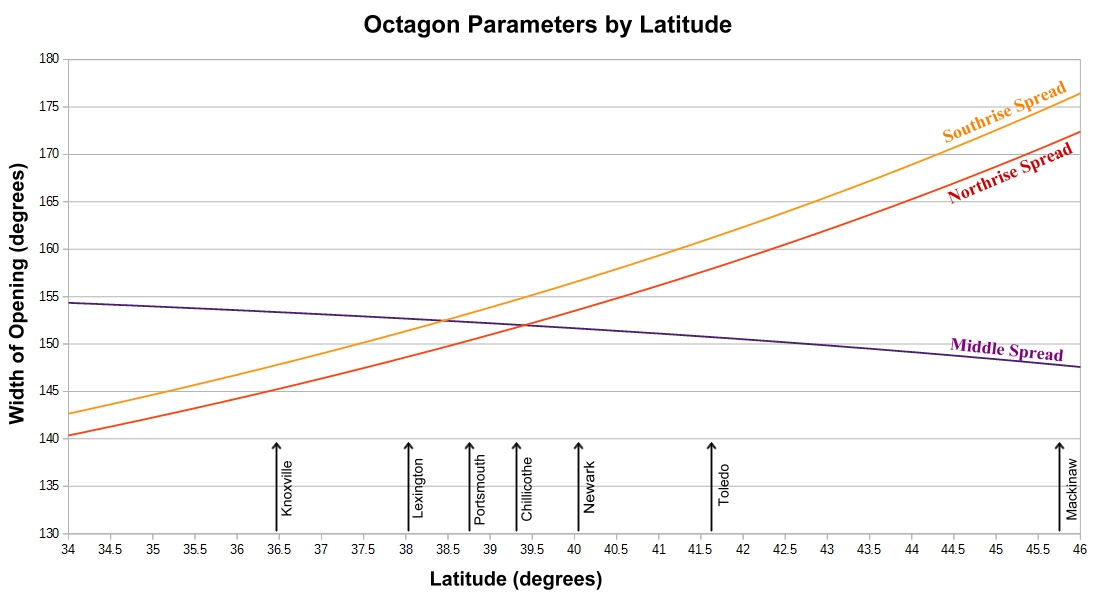
The first thing I notice is that Newark is not the "best" location. That is closer to Portsmouth and Chillicothe. But the fact that Newark also works (obviously!) gives us a feel for how much clever fine-tuning can accomplish.
We also see that the sweet spot is a spread of around 153°.
And while it is true that the Indigenous Peoples of the Hopewell Culture happened to live in the right place to take advantage of this ability to use the moon to build such a near-symmetric Octagon, we must also not forget that:
They Did So.
References:
Hively/Horn 1982
Geometry and Astronomy in Prehistoric Ohio, by Ray Hively and Robert Horn. Archaeoastronomy, No. 4 (1982).
Hively/Horn 2013
A New and Extended Case for Lunar (and Solar) Astronomy at the Newark Earthworks, by Ray Hively and Robert Horn. Midcontinental Journal of Archaeology, Vol. 38, No. 1 (Spring 2013), pp. 83–182.