Introduction
I'm going to try accomplish two things with this essay. The first thing is to describe just what the Indigenous peoples here in Newark saw the sun and the moon doing. But moreso, I'll be thinking of ancient peoples in general. This will be mostly hypothetical, but I've tried to put some chronilogical onto it to create a plausible progression. When I've done something similar to that in the past, I've interspersed the astronomy, like orbits, rotating, revolving, globe, and nutations. But I suspect that that detracts from getting the feel of what ancient peoples were seeing and thinking about what they were seeing. It is hard to put oneself in a frame of mind that does not presuppose astronomical knowledge that ancient peoples, all over the world, did not have.
Fair warning, to do that I will be deliberately trying to mess with your mind.
So, what were they seeing? When might they have noticed a particular phenomenon? What kinds of cycles would have stood out?
The second thing I will try to accomplish is to touch on the sacredness of this place; how it evokes the awe of sacredness. I believe there is also an inherent sacredness to this particular location, regardless of how you define that word. These earthworks really do "fit" here.
Start Over 20,000 years ago
The last peak of the ice age was something like 21,000 years ago. The ice sheets barely made it to the Licking/Raccoon Valleys, right to the edge of the eastern hills, before finally starting to recede. They strongly shaped the area.
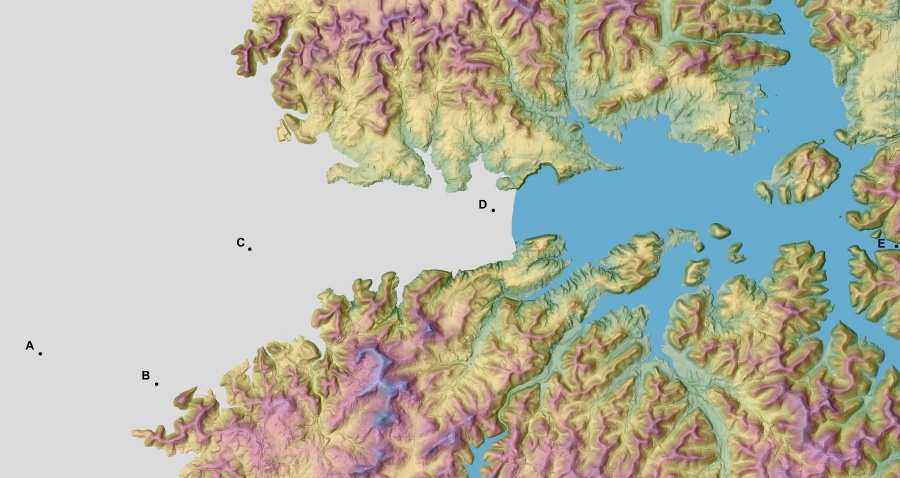
I've marked a few locations that would all have been under an ice sheet. See if you can find Geller Hill, Heath High School (with Salisbury Hill right behind it), the County Courthouse, the Longaberger Basket, and the entrance to Blackhand Gorge.
To the east, the river that flowed there used to flow in the other direction. A previous glaciation blocked that, so the Licking Creek headed west from its headwaters at Rocky Fork and Brushy Fork. The last glaciation blocked that exit, so we got Lake Licking, which finally got high enough to overtop a lower spot in the hills to the east. That started a small-scale Niagara Falls which cut a gorge through the relatively soft sandstone there.
The area would have been spruce forests and rather tundra-like. I would love to think that there were people there to watch those falls, but this is probably before any people had arrived.
What we do know is that the footprints at White Sands in New Mexico date to around that time period, and, just 100 miles away to the east of here is the Meadowcroft rockshelter. It is on the western edge of PA and has been dated to 15,000 years ago, with some disputed dates of maybe 19,000 years ago. So maybe having somebody watching the falls isn't completely far-fetched.
[Answers. A: Geller Hill. B: Heath High School. C: County Courthouse. D: The Longaberger Basket. E: Blackhand Gorge.]
13,000 Years Ago
By 13,000 years ago, the edges of the glaciers were just leaving Ohio to the northwest, and definitive occupation was occurring 11,000 years ago, with the finds at Munson Springs near Granville and the mastodon at Burning Tree golf course north of Hebron and Jacksontown excavated by a team led by Brad Lepper.
Let me point out some of what was left behind.
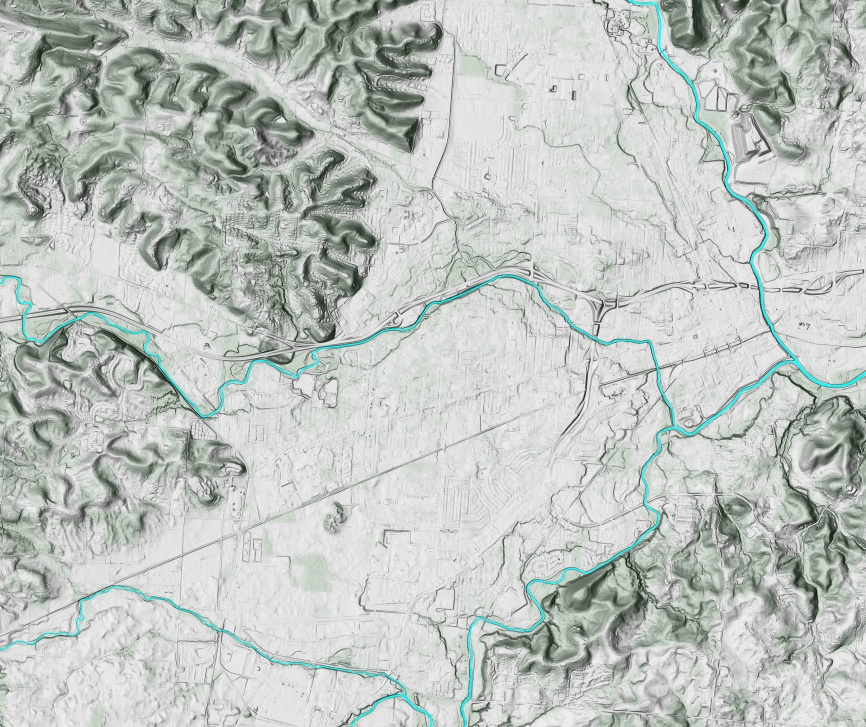
I've marked the rivers. The main body of the Licking heads to the east. You can see the North Fork and the South Fork and the West Fork (Raccoon Creek). Down in the lower left is Ramp Creek, which helps surrounds the location of the Earthworks with water.
You can also see Geller Hill, a glacial kame. Just to the southeast of South Fork is Salisbury Hill. (The original name was Cochran Hill, after an early settler, but we've appropriated it.) To the north you can see a bit of Horns Hill above the North Fork.
And to the west is the Raccoon Creek valley. All of earlier maps I've seen show it running mostly east-west, but you can see it really heads west-north-west. We'll get back to that. Granville is off the map on the left, but near the edge of the map you can see that hill that Alligator Mound sits on. Note how it sticks out, capping the main flow of the valley.
Much of this was probably managed grassland. "Managed" almost certainly involved the use of fire. Also, there are grass pollens underneath the Great Circle that help confirm the grassland.
The Newark-Chillicothe Connection
Here's a quick look at the broader area, post-glacial.
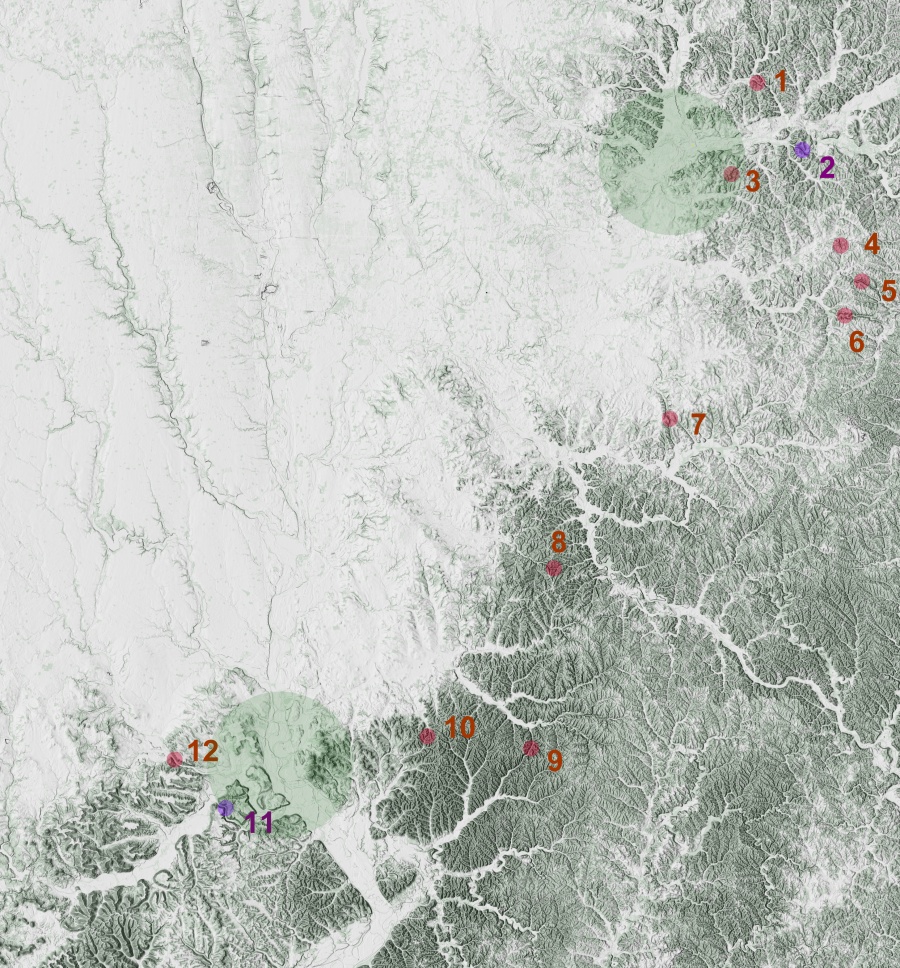
The entire flattish area is glacial till or similar remains of the glacier that extended to the edge of the hills. The Newark area is indicated (in green) in the upper right and the Chillicothe area (similarly) is indicated in the lower left. One thing that is quite obvious is how similar they are: right on the edge of the glacier with large intersecting river valleys leaving the plain and heading into the hills and ridges. They were destined at the start to become the two ends of their main culture.
There's another feature I find pretty interesting. This is a land of gorgous gorges. All of the numbered locations are river or creek gorges. These are places where the edge of the glacier backed up the flow of western-flowing creeks and rivers. Eventually, they overtopped their topography to the east, carving their gorge, and reversing the flow of the old rivers. I've mentioned the Licking River—that carved Blackhand Gorge. Equally impressive is the Paint Creek Gorge south of Chillicothe. Twins.
Lesser gorges include the one along Claylick Creek, Clear Creek, the one along Jonathan Creek near Glenford Fort, Salt Creek as it heads right towards Ash Cave in Hocking Hills and then suddenly veers south to eventually empty into the Scioto, and the North Fork of Paint Creek.
Sacred Earth and Sacred Sky
Let me move from talking about the Sacred Earth to the Sacred Sky.
I don't think anybody will argue with idea that the two main objects any ancient culture will see in the sky are the two shiners: the Day Shiner and the Night Shiner.
The Day Shiner
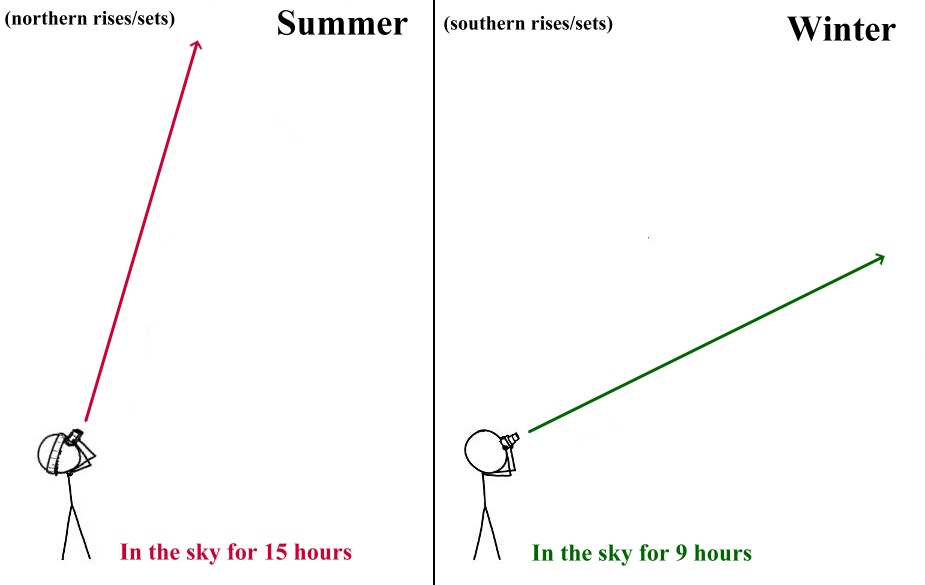
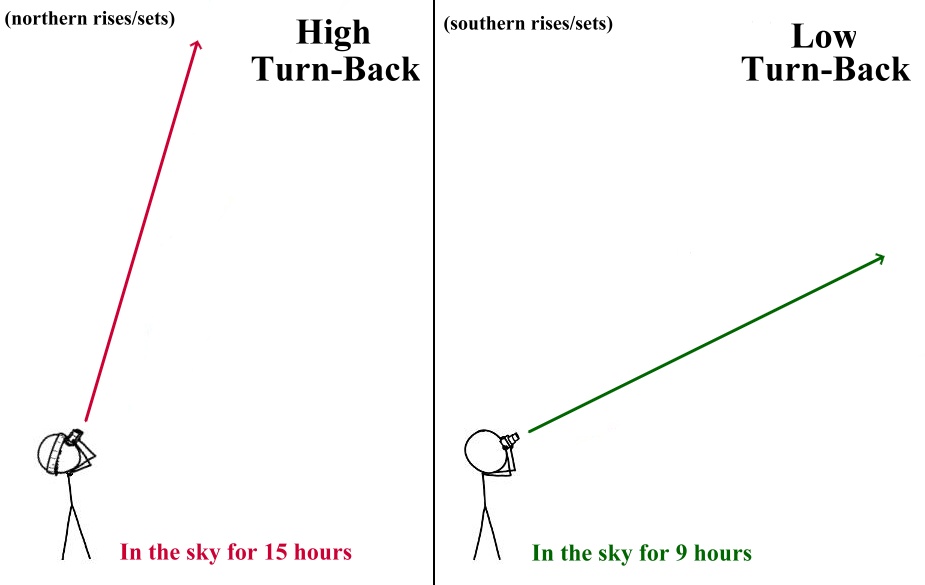
The two main things about the Day Shiner is its light and its heat. I don't think it would take very long for any culture to notice how it relates to the difference between summer and winter. For one thing, in the summer the Day Shiner gets high in the sky: nearly overhead in the middle of the day, while in the winter . . . not so much. But the other really noticeable thing is that in the summer the Day Shiner is in the sky for nearly 15 hours, while for winter it is in the sky for only about 9 hours.
The other pretty obvious thing about the Day Shiner is the way that its rises and sets vary throughout the year. Let me show you that. Let me start by showing a horizon near Newark.
First note that Newark itself has a difficult horizon for viewing, and marking, the full span of the Day Shiner. Looking east down the Licking River the terrain is quite flat. So, I've chosen a location just a little south of where Ramp Creek meets South Fork.

Since this faces east, north is to the left and south is to the right. That will be true on all my horizon pictures.
A few caveats: I've exaggerated the vertical relief (by three times). In real life, our eyes are pretty good at spotting horizon relief, so I've mimicked that here. This assumes there are not too many trees from the viewing site to the view of the horizon. As I said before, this may have been managed grasslands. Also, while this does assume no trees on the hillsides, those trees would not have prevented there being a distinctive horizon.
Each of those variations on the horizon can mark a date where the sun rises on that day.
Here are the rise points of the Day Shiner over a year, starting near the end of winter (early February).
There are two things I'd like to point out. In the middle there, the Shiner moves by one Shiner width every day. And it does this for much of its journey. (Note that a Shiner width is about the width of your pinky finger held as far from your nose as you can.)
The other thing is at each end, the Shiner turns back.
Let me point out that I could have created a similar animation for when the Shiner sets.
Let's take a closer look at that Turn-Back. Here I show 29 days of rises around the Shiner Turn-Back. (I've added that black ticker to highlight the days.) Notice how long it sits there at the Turn-Back before actually turning back.
Concentrating, the way we do, on one particular day, seems to be ahistorical—one particular day is just not visible without modern instruments. For Native tribes, it would seem that this would have been a multi-day event, waiting for (and maybe encouraging) the Shiner to turn around the way it is supposed to. This also applies to the events at Serpent Mound and Fort Ancient. This Shiner Turn-Back is a period of time, not a sharp event.
That said, if anybody wanted the "exact" center, it could be found by noticing the Shiner's position about 10 days before the peak, and then see when that position was reached on returning.
The Night Shiner
Let us now turn to the Night Shiner. The Night Shiner contrasts with the Day Shiner by being cooler, even though it appears in the sky the same size as the Day Shiner. But the main obvious difference is the different faces (or phases—I love this pun) of the Night Shiner, and the fact that those phases change with a period of 29 to 30 days, not a full year.
I'm not going to say a whole lot about the specific phases, assuming you are well-aware of them.
That said, let me concentrate right now instead on how useful those phases are for time-keeping, that is, a calendar.
You can think about how every 29 to 30 days there is a "New" Shiner. In Western Culture, what is referred to as "New" is really "No". There is really nothing that can be seen. At that time, the pattern to be observed is really "No Shiner" followed closely by a "Sprouting Shiner". That Night Shiner progresses through its phases for a "Shiner" period of time, to become a "Perishing Shiner". Then there is the period (2-4 days) of "No".
This is how a Perishing Shiner appears:

You can see the Perishing Shiner at dawn, just ahead of the rising Day Shiner. There is a clearly recognizable pattern. In the picture, I show where the umber-colored Day Shiner is, below the horizon. The blue line shows the rise path of the Night Shiner. The curl points back towards the hidden Day Shiner, but not necessarily at the exact same angle as its rise.
We can also note that when either Shiner rises, it rises "Half-Sky", halfway between straight up and along the horizon. They do this all the time, though not exactly half.
After this is when to start looking at the setting Day Shiner. Within two to four days, the Sprouting Shiner will appear at dusk shortly after the Day Shiner sets, and then the crescent Night Shiner will itself set.

We have records about how Tribes would keep track of this. They often had special members who would be responsible for creating and keeping "Calendar Sticks" over the periods of the Shiners, from one Sprouting Shiner to the next. This is an illustration of one from the Winnebago (or Ho-Chunk) in the early 1800s.
You start at the right-hand side, where there are only stars. Then the Sprouting Shiner appears. The Fully (or near-Fully) shiner was then marked, followed by its decline until it perished. Things would then start over.
There is a less elaborate Adena tablet that suggests something similar may have been happening way back then.

Calendars
Unsurprisingly, these Shiners were used as the basis for a calendar. A Shiner period would start at a Sprouting Shiner, and last until the Shiner perished. Let me introduce my "Calendar Clock".
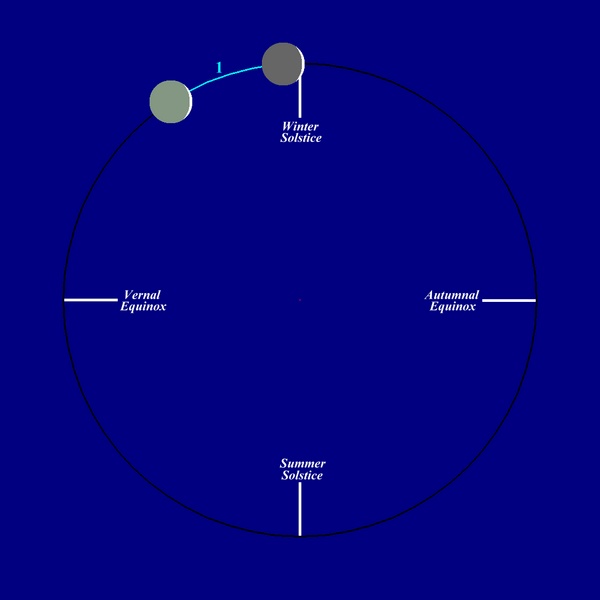
Here, we show a Shiner period starting just after a winter Day-Shiner Turn-Back. It's a little off since they might have had to wait a day or so to be sure that the Turn-Back had actually started. And of course, they might also wait a day or so to see the Sprouted Shiner. Let me also note that different Tribes might start at different seasons.
This Shiner might be called the Shiner of Long Nights, the Shiner of Extreme Cold, the Shiner of Slipping on Snow, the Shiner when Tree Branches Crack, or the Squirrel Shiner. All of these are different names have been used by different bands of Tribes. A name, like "Strawberry Shiner" applies to the entire 29 to 30 day period, not just that one night Full Shiner phase—that seems to be a modern invention.
In this animation, time flows counter-clockwise. Each subsequent sprouting Shiner occurs about 29 and a half days later.
OK, so now let's look at a full seasonal (that is, Day-Shiner) year. In this animation you'll see each new Sprouting Moon arrive—I'll keep showing the previous ones.
As you notice, 12 Shiners come up short and do not complete the Day-Shiner seasonal year. It misses by about 11 days. While any seasonal year has parts of 13 Shiners, it only has 12 complete ones. But if your calendar only considers 12 Shiners in a year, after a while, the Shiner of Extreme Cold will have backed up to when trees have their fall foliage. Or the Strawberry Shiner will occur with snow on the ground.
The Shiners drift.
There are two ways to handle this: Many Tribes just didn't keep track and mostly ignored it. They'd name the Shiner based upon the conditions they saw around them as they went along. There are stories of neighboring bands who could not even agree which Shiner it was at a given time.
But for Tribes that felt it was important to carefully keeping track, and I assume that applies to those in the Newark Valley, they would officially add a thirteenth Shiner. They could, among other things, add that Shiner depending what they saw at the Day-Shiner seasonal Turn-Back. This is what that would look like:
You just watched how the Jewish Calendar works. And the Chinese, and Vietnamese, and Hindu, and a host of others. Interestingly, the Muslim Calendar is purely liturgical and never adds a 13th, so it rotates around the year.
Regarding North American Tribes, many early ethnographers reported on only 12 named Shiners. Some of those may have been the tribes that didn't care, but I also suspect that some of those ethnographers themselves did not have a sophisticated understanding of what the Shiner does. And those that reported 13 Shiners didn't understand that the 13th was only added occasionally. Because if you regularly put 13 Shiners in a year instead of 12, the seasons get out of sync in the other direction. And if you try to add a shortened period (let's 20 days long), then your Shiners suddenly won't start with a Sprouting Shiner.
Again, if they kept track, they'd have to deal with drifting.
The Myaamia Calendar
Here I'd like to make a Shout Out to the Myaamia Calendar. This was reconstituted by the Miami Tribe of Oklahoma working with Miami University. So much was culturally lost at the forced exile and what followed. The calendar is beautiful (wonderful pictures), and captures everything such a calendar could wish for.
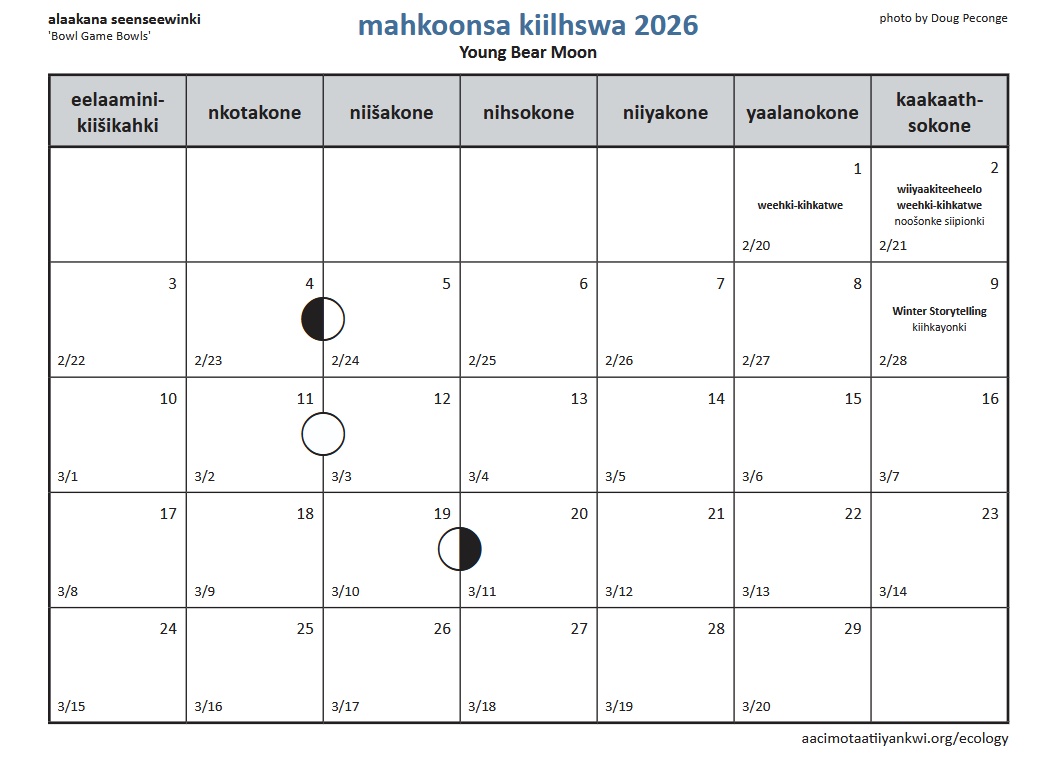
Here are a few features to look at:
- It is an ecological calendar. (That is, each Kiilhswa describes what is important that time of year.)
- The new year, weehki-kihkatwe, starts out with the Mahkoonswa (young bear) Kiilhswa, sometime in late January to early February.
- Each Kiilhswa starts at the Sprouting Kiilhswa. There is no "No Kiilhswa" symbol, but you can see where it might go, and then see the wait for the end of the Kiilhswa and the Sprouting Kiilhswa.
- At the end of the year, if needed, they add a 13th Kiilhswa, the Waawiita (or Lost) Kiilhswa.
- Lower left has Gregorian date.
I encourage you all to go to their web page showing the calendar and how it works:
https://aacimotaatiiyankwi.org/2025/12/19/a-look-at-lunar-calendar-system.
The Abenaki start their year at the Sprouting Shiner before Christmas, but that is recent (1800s). They default to 13 Shiners, and handle years with 12 Shiners by removing one mid-summer if needed. That Shiner is Abonamwikizoos, "Let this Shiner go". The Ofo started their new year with the first sprouting moon after Autumn Equinox.
A Word on Language
You have undoubtedly noticed that I keep talking about Shiners, and avoiding the English words sun, moon, and month. Or solstice. Here is why.
Speakers of English, and Indo-European languages in general, are used to having different words for the Sun, the Moon, and a Month. Or le Soleil, la Lune, et un mois (French). Or Helios, Selene, kai minas (Greek).
That is not the case for the 4 large language families in the eastern part of North America 2,000 years ago: Algonquian, Siouian, Iroquoian, and Muskogean. They all used the same word for the sun, the moon, and month, and with the exception of northern Iroquoian languages, still do. Cherokee, in the southern branch, has retained it (and some others have traces).
Using the same word for sun, moon, and month is a shared cultural feature, just as moundbuilding is a shared cultural feature. While this linguistic feature is scattered throughout the Americas, it is particularly concentrated right here.
Note that these are not primitive terms I am using. Speaking English, you are used to have fancy Latinate words along-side everyday words. It is part of your mindset; it is part of your perspective. "Mindset" is two everyday Anglo-Saxon words; "perspective" is from French/Latin. If not for the Norman Invasion of 1066, "mindset" would be equally prestigious.
Also note that these everyday words do not preclude additional special or poetic terms. In Lenape and Ojibwe, "nipaham", which is also used for moon, literally breaks down as "night voyageur", or "night canoe-paddler".
Linguistically, we don't know which came first. Maybe the Proto-Proto-Americas language did this (but then how was it lost in so many other languages, like Uto-Aztecan?). Or maybe it spread from a shared world-view? We just do not know.
So how did they distinguish between sun, moon, and month when talking? If need be, they added the word "day" for the sun, and "night" for the moon. But they could be omitted in context. You can omit the word "night" if you are talking about the phase of a Shiner. You can omit the word "day" if you are talking about the heat of the Shiner. If you are talking about time (and sometimes there was a special marker for that), that's a month.
By the way, you know how in Hollywood westerns, they have the Indians say something happened so many moons ago? As far as I have been able to find out, it was done to make Indians sound exotic (or maybe there was racism involved). But we see here that "moons" for "months" really was a feature of many Native languages.
I've also been avoiding terms like solstice and lunistice, which emphasize the Shiners standing still. I suspect it was the Turn-Back that was considered important. In fact, in many of the Tribal languages, that is what the solstice is called: "turn-back", or "return", or "recline".
"Sprouting" and "Perishing" were also taken from a Native language. Other Native languages did call a moon "new", but that was almost assuredly meant the "sprouting" kind, not the "no" kind. (I could find no documentation for a "lunistice" equivalent, but I doubt the ethnologists would even think to ask.)
The Night-Shiner Turn-Back
So, the Tribal world-view use of language emphasizes just how similar the two Shiners are. But what about the Day-Shiner Turn-Back (that's the solstice, in case that hadn't yet hit you). What about the Night-Shiner? Might the similarities of the language for the Shiners prompted them to have watched the Night-Shiners rise and set points more carefully?
So, what happens if you decide to start watching the risepoints of the Night-Shiner? Here is one year's worth (the year 214). Note that this animation ignores the phases of the Night-Shiner, or the fact that half the rises occur during daytime.
As you can see, it does just what the Day-Shiner does, but way faster (both the Day-Shiner and Night-Shiner animations run at the same rate). Both kinds of Shiners have their Turn-Backs, but the Night-Shiner just doesn't sit there like the Day-Shiner does.
Here is an enlarged and slowed Night-Shiner Turn-Back:
The official term for that is "lunistice", the moon standing still (modeled after "solstice", the sun standing still). It sure doesn't stand still, does it? By the way, the word "lunistice" was invented in the 1760s by French astronomers.
But there can be a bit of a pause at the Turn-Back. I this a Twin Turn-Back.
This is why, at the moonrise programs here at the Earthworks, the Ohio History Connection would arrange an alignment event two nights in a row, with one of them reserved specifically for a visiting Tribe or for the employees.
This is something that I really think the Indigenous Peoples in the valley would not have missed.
There is another similarity. This picture should look very familiar.
Patterns, Patterns, Patterns
Once they noticed these Night-Shiner Turn-Backs, curious Tribes undoubtedly noticed additional patterns.
One pattern is that, while there are 12 or 13 Shiners in a year, there are 13 or 14 High (northern) Turn-Backs in a year. The period of Night-Shiners is about 29 and a half days (2 periods take almost exactly 59 days). The period of Night-Shiner Turn-Backs is about 27 and a third days (3 periods take almost 82 days).
As far as I can tell, they had no particular word for this Night Turn-Back Period. Dick Shiels whimsically called them "moonths". If there was a word, it maybe got lost in time from disuse, or maybe it was a word that only shamans knew and did not divulge, and it got lost that way. Or maybe the ethnologists were not sophisticated enough to even ask.
Three Cycles
OK, so now we have 3 different cycles in the sky.
-
We have the Day-Shiner cycle that lasts a year, determines the weather, and has 2 Turn-Backs.
-
We have the Night-Shiner phases that last 29-30 days. They start with a sprouting Shiner, pass through to a Full Shiner, and perish before repeating.
-
We have the Night-Shiner Turn-Back cycle that mimics the Day-Shiner cycle and lasts 27-28 days, with 2 Turn-Backs.
These cycles interact with each other in ways that present patterns. Anybody seriously interested in watching the Shiners could not help but notice them.
Full Moon Only
Tim Pauketat, of the University of Illinois, tends to look only at what full moon rises do at such places as the Emerald Acropolis, 15 miles east of Cahokia, This is what they saw, again using the year 214, if they concentrated solely on watching Full Shiners.
One thing that this recognizes is that the winter solstice is an important time for full-Shiner Turn-Backs. In addition, the pattern culminates with the winter solstice and the Night-Shiner Turn-Backs coincide with a full-Shiner, after which the rises occur less spectacularly during daylight hours. This pattern occurs year after year after year.
Strong Moon; Weak Sun
A more immersive pattern is related to the yearly interaction between phases and Turn-Backs.
Let me re-introduce a version of my "Calendar Clock".
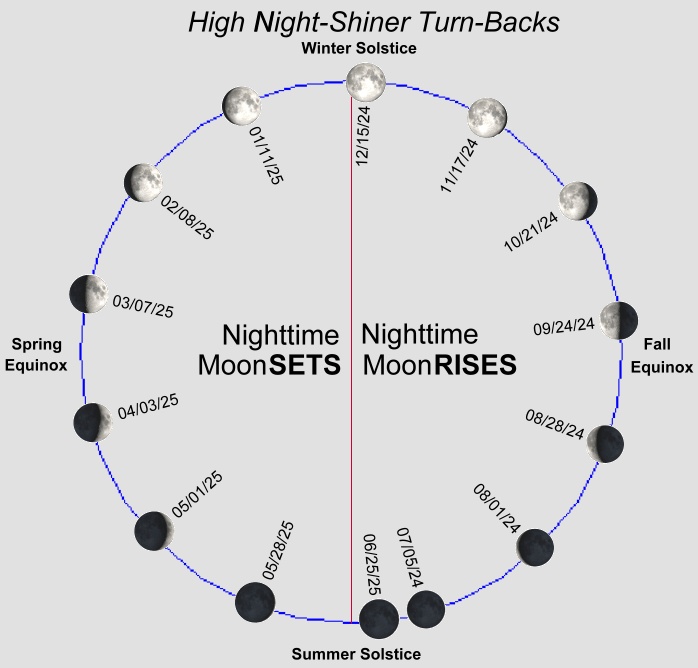
For this one, we'll start at the bottom of the picture.
Around the time of the summer solstice, the High (northern) Night-Shiner Turn-Back occurs during a No Shiner. Every year. As summer progresses into fall, the phase at the Turn-Back makes it more and more visible (but it does it backwards, waning → 3rd quarter → full). By the time of the winter solstice, the Turn-Back occurs at the Full Night-Shiner (okay, within a day or two). Every. Single. Year.
Also note that, all those rises occur at night, right up to the winter solstice Turn-Back. They build to the climax of a Full Shiner, and then the rises switch to daytime when they are very hard to see (and not very spectacular). They stay that way until summer. It's almost as if it is a longer version of the Perishing/Sprouting Shiner.
This is a culmination event. The Night-Shiner starts in the summer as a No Shiner. Its phase gradually increases and culminates as a Full-Shiner. And then the night-time rises disappear for six Shiner Periods, and the phases increase again to yet another culmination.
Now, the Full Night-Shiner doesn't always hit the winter solstice. My earlier calendar clock showed how any particular phase moves around a bit. But the Full Shiner and Turn-Back always occurs within 15 days of the solstice, and within two days of each other.
What we have at the winter solstice for any High Turn-Back is a Strong Moon (Full, High in the Sky) while also having a Weak Sun (Cold, Low in the Sky).
Here is this picture again:
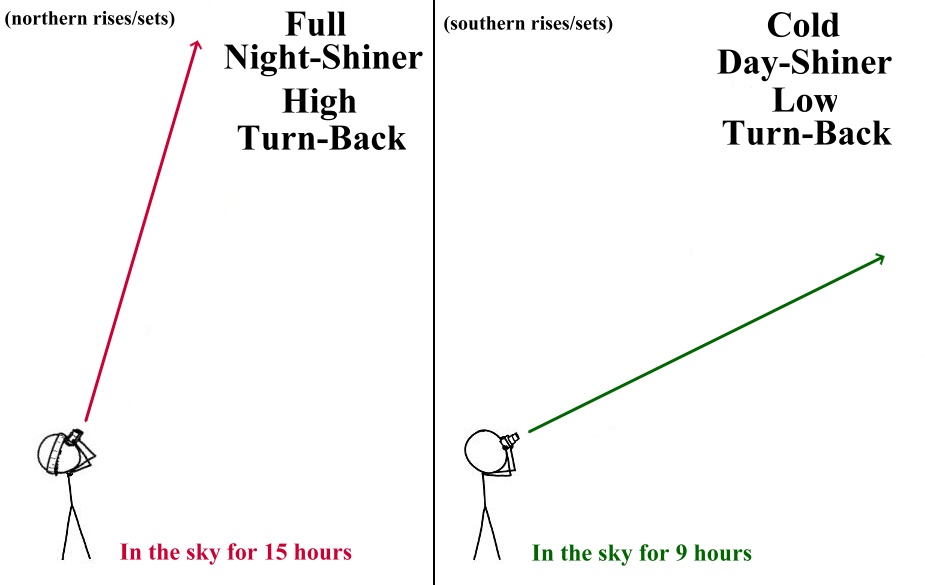
The Night-Shiner is full and high; the Day-Shiner is cold and low. And the 15 hours of darkness matches the 15 hours the Night-Shiner is in the sky. As the weak Day-Shiner sets on one side of the sky, the strong (full Turning-Back) Night-Shiner rises on the other.
The rises of the Full Shiner also occur during Twilight. Even into January, though we have daytime rises, they occur on the edge of Twilight. These are very special coordinated rises and sets.
Then, as the year progresses, the Night-Shiner rises during the day (but sets at night), and the phase fades to a No Moon for the summer solstice.
The Zuni saw a duality in this. Winter: strong moon with weak sun. Summer: Strong sun with weak moon. Similarly, in the summer, while we have the Strong summer sun, for the High Night-Shiner Turn-Back we have weak (perishing, no, or sprouting) moons. Furthermore, there is evidence that this same duality was important at Chaco Canyon.
The Lower Night-Shiner Turn-Back
There is another duality, related to the southern Night-Shiner Turn-Back. This is the Turn-Back that is low in the sky (southern).
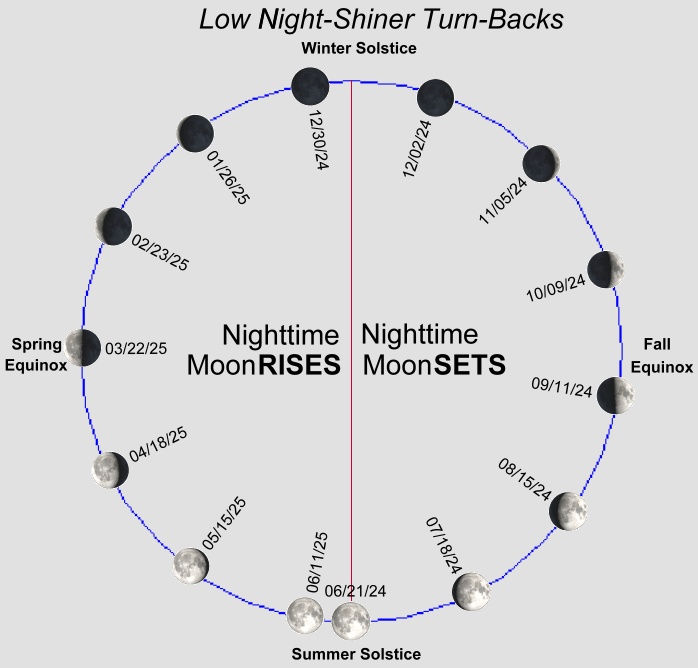
Here we have the Strong (summer) Day-Shiner with a Mixed (Full, though low in the sky) Night-Shiner within 2 days of the summer solstice. As we progress around the year, it fades away until winter, when we have the No-Shiner within 2 days of the solstice.
Because this is a a Lower Turn-Back, the Night-Shiner stays low in the sky and is only there for about 9 hours, which matches how long the nights are.
This is the event that Bret Ruby has shown a few times down at the Hopeton Works in Chillicothe. There we got to see the sun set in the west followed by the full moon rise in the east.
Pattern Summary
What I'd like to stress here is that these are Night-Shiner Turn-Back patterns based on the Day-Shiner year. They are yearly patterns, with the same kinds of offsets that we see in the calendars. There is a good chance that the knowledge of these patterns was deeply appreciated by those who watched the Night-Shiner long before they noticed anything else.
But wait, there's more.
Once the local Tribes started paying attention to where the Night-Shiner rose and set over longer periods, they could not fail to notice something else.
Here is an animation showing 19 years of moonrises. Again, I'm ignoring phases and daytime. This starts in the year 214 and runs through the year 233. I've shortened the time between rises to 1/30 of a second—otherwise we'd be here forever.
This, of course, is why we are all here.
While this is running, let me say a few things.
The widest spread occurs here at 0:50, and then the Turn-Backs turn back. As you probably know, this is know as the "Major Standstill". I hate that name, mainly because to me it obscures understanding. But that's the scientific jargon. But what we've seen is the "Time of Widest Turn-Backs", which lasts about three years. I suspect that this is somewhat close to how Tribal communities might have described it in their native languages.
As we keep watching, in the middle, at about 1:40, we are back to the width we started with, and it is continuing to narrow. At 2:20, we are at the "Time of the Narrowest Turn-Backs", which again lasts about three years. This is officially the "Minor Standstill".
I am trying to describe what is being seen. But I also want to make sure that when you hear words like "lunistice", "Major Standstill" and "Minor Standstill", you will know what people are talking about. I hope my descriptions will give you more of a flavor of what is going on.
But not much is "standing still", is it?
The animation will end at 3:20—exactly 19 years after starting. And it will end in exactly the same position. And repeat.
You see, there is this miraculous quirk: 235 Shiners (months) takes almost (almost) exactly as much time as 254 Night-Shiner Turn-Backs (moonths), which is (almost exactly) 19 years, within a couple of hours. This is called a Metonic cycle.
These Times of Wide and Narrow Turn-Backs overlay themselves on top of the yearly Culmination cycles that we've already seen. And the exact 19 year pattern means that if, for instance, somebody watched the Widest Full Moon Culmination in the year 219, 13 days before the winter solstice, they would see another Widest Full Moon Culmination 19 years later in the year 238, again 13 days before the winter solstice.
At this point, you should all be screaming at me inside your heads: "But what about 18.613 years?"
Yes, the underlying astronomical phenomenon has a period of about 18.6 years. But, as we've seen, to non-astronomical observers, it manifests itself over a 19 year pattern because of the way that the Culminations work. And just like the fractional part of months do not fit exactly into years, as we saw with the calendar, the match between 19 and 18.6 drifts. After a bit, the Time of the Widest Turn-Backs drifts, just as a Strawberry Shiner drifts. The widest Culmination can hang on for about three to five Times of Wide/Narrow Turn-Backs (57-95 years), but it drifts away, so that a specific date (as determined by when it occurs relative to the winter solstice) that occurred near the beginning of the three-year Time of Widest Turn-Backs drifts towards the end of the Time of Widest Turn-Backs 57-95 years later. Eventually, it no longer appears near the Time of Widest Turn-Backs.
As an example, the Full Moon Culmination Turn-Back on December 19, 238 is 0.009° farther north than the one on December 19, 219. And the one on December 19, 257 is 0.228° farther south than the one in 238. No generation of people will notice this drift.
Again, to those watching the Full-Shiner Culminations at the winter solstice, there will be a three year Time of Widest (or Narrowest) Turn-Backs every 19 years, with a slight drift that takes around 60-100 years to notice. The "drift" means that whatever year had the most northerly moonrise at one Widest Turn-Back, might be a bit lower at the next (until if finally drifts away from being included).
These Times of Wide and Narrow Turn-Backs also affect how high the Night-Shiner gets in the sky, and for how long:
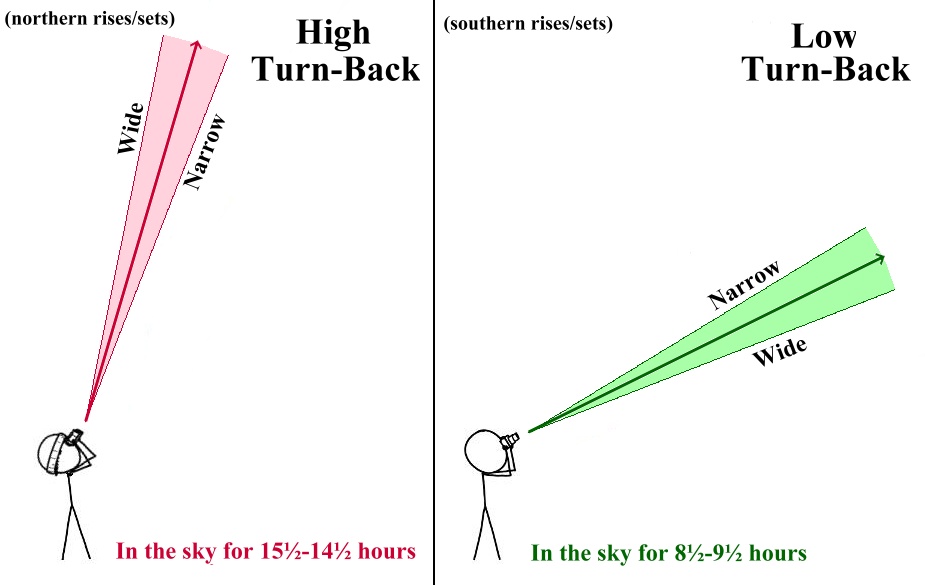
And It's Jittery
There is one more thing that the Native Peoples may have noticed. It's a bit subtle, and we have no way of knowing if they were aware of it, or not.
Here is a video of all the northernmost Turn-Back moonrises from the year 197 to the year 204. It's jittery.
First, the apparent width of the Shiner is to scale with the gap at the end of the Octagon, as seen from Observatory Mound. Next, you'll notice how it advances, and then retreats, around the time of the equinoxes.
You can see that more easily on this slowed down, enhanced version that runs from July 107 through December 107. Don't forget that this is the time of the culmination of a half-year of night-time rises going from a Sprouting Shiner to a Full Shiner.
What is the Octagon Aligned With?
You may have noticed two videos back that the Night-Shiner rose to the left of the gap. But in the last one, it went only to the middle. This was a deliberate choice on my part. Two back, I had it align based upon the winter Turn-Back; in the last one, I had it align with the absolute maximum.
(Either one is consistent with the data; since the Shiners rise half-sky, one can get different answers by concentrating on whether you care about first light, or its center, or when the complete Shiner is visible.)
This does lead to the question of whether the Octagon was "aimed" at the culmination rise of the Night-Shiner (in the winter), or the absolute northern one (in the fall).
We can take a closer look. Let me set the stage for this next animation, which tries to be more detailed.
This is the view of the tip of the Octagon. This covers two periods. The first is summer of 2020 to summer of 2021, which is between both the Widest and Narrowest Turn-Backs. It shows that the culmination applies every single year. The second one is the summer of 2024 to the summer of 2025. You probably recall that this was the time of the Widest Turn-Backs.
This will show the phase of the Shiner, and I am using the color of the sky to show whether it rose in the daytime or nighttime. (And you get a feel for how hard it is to see a daytime rise—this enhances visibility.)
I have also arranged it so that the middle of the gap is the average between the equinox peak and the winter Turn-Back dip. That difference between the two is very close to one Shiner Width (your pinky finger.) In addition, averaging is very similar in effect to the way Hively and Horn were doing their original analyses. so it's not that large of a stretch.
When Hively and Horn first looked at the Octagon (1982), calculating the positions of the rises was done using tables and interpolating. This is when and how they showed the maximum rises and that is what people concentrated on.
When 2006 came around, we could now do detailed computer calculations for specific days, so at that time people concentrated on highlighting the specific one maximum (September 14, 2006), while also watching the others. Something similar happened again in 2015 for the Narrowest Turn-Backs. As 2024/5 rolled around, the interest in the absolute maximum was still the same and programs were planned around that (again, while not neglecting the lesser ones).
But once the rises were computed for every single day for 2,000 years, this additional detail related to the equinoxes showed up. I even suggested at the time that this meant that the maximum was celebrated as a "fall event". But I now suspect that the importance of the Culmination year after year, regardless of the Widest and Narrowest Turn-Backs, was more important because it was most like part of the culture long before the spread of the Turn-Backs and an alignment became important.
These would have been seen as manifestations of the cycles of time, not a competition for the biggest or greatest. These Widest and Narrowest Turn-Backs would fit into the existing culmination periods, just as the Periods of Night-Shiner Phases are fit into the yearly seasons.
[I'd like to add that the phenomenon itself is not "extremely" precise, so the precision of the Octagon is consequently limited by that imprecision, at best.]
Chimney Rock
I'd like to switch gears for now to Chimney Rock. Chimney Rock was part of the Chaco Canyon culture from a thousand years ago, located in southwestern Colorado. Here's what the importance of Chimney Rock shows us.
Chimney Rock sits on a ridge. From the side it looks like this:
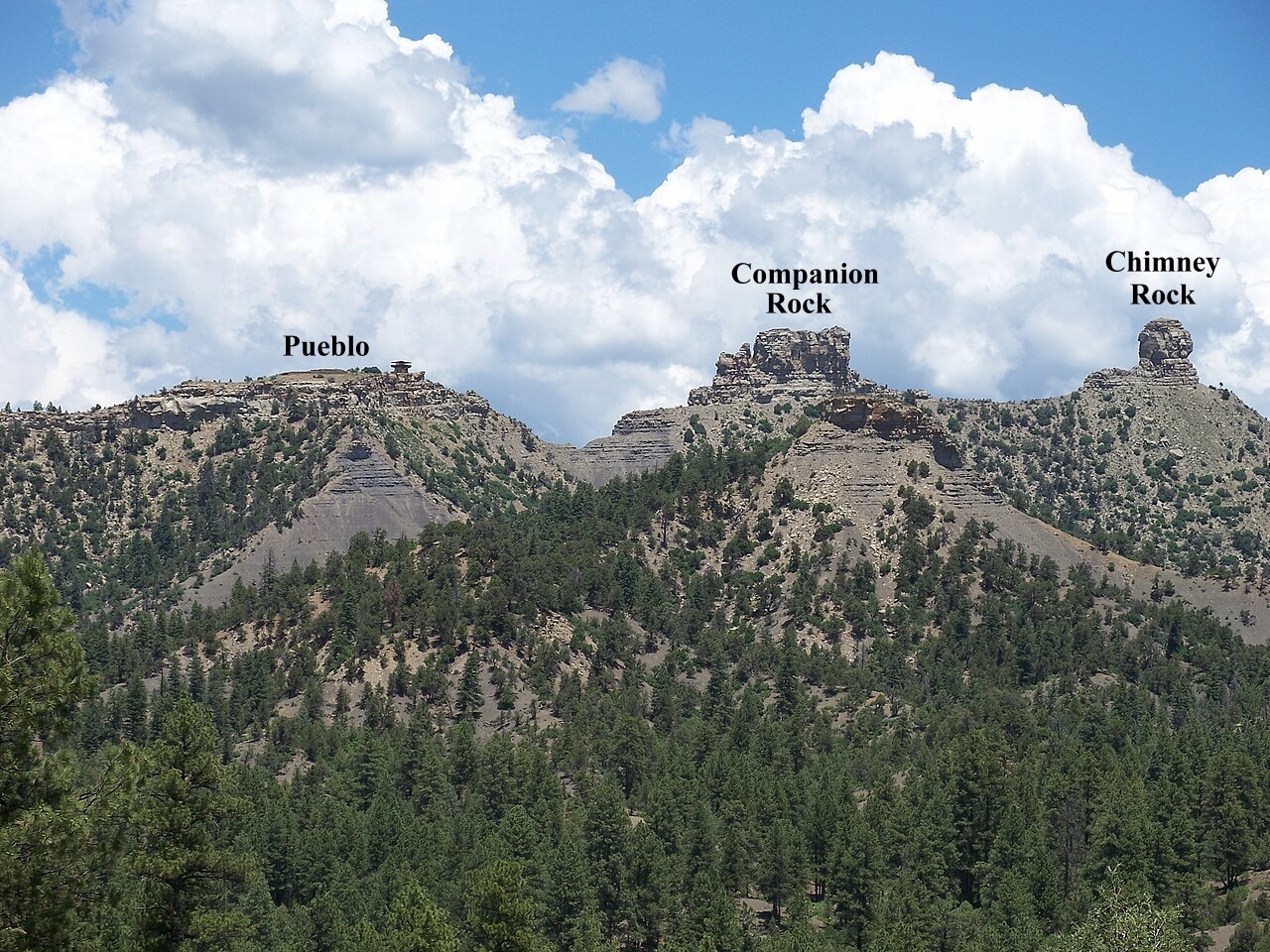
And here's the view from the Pueblo looking right down the ridge:
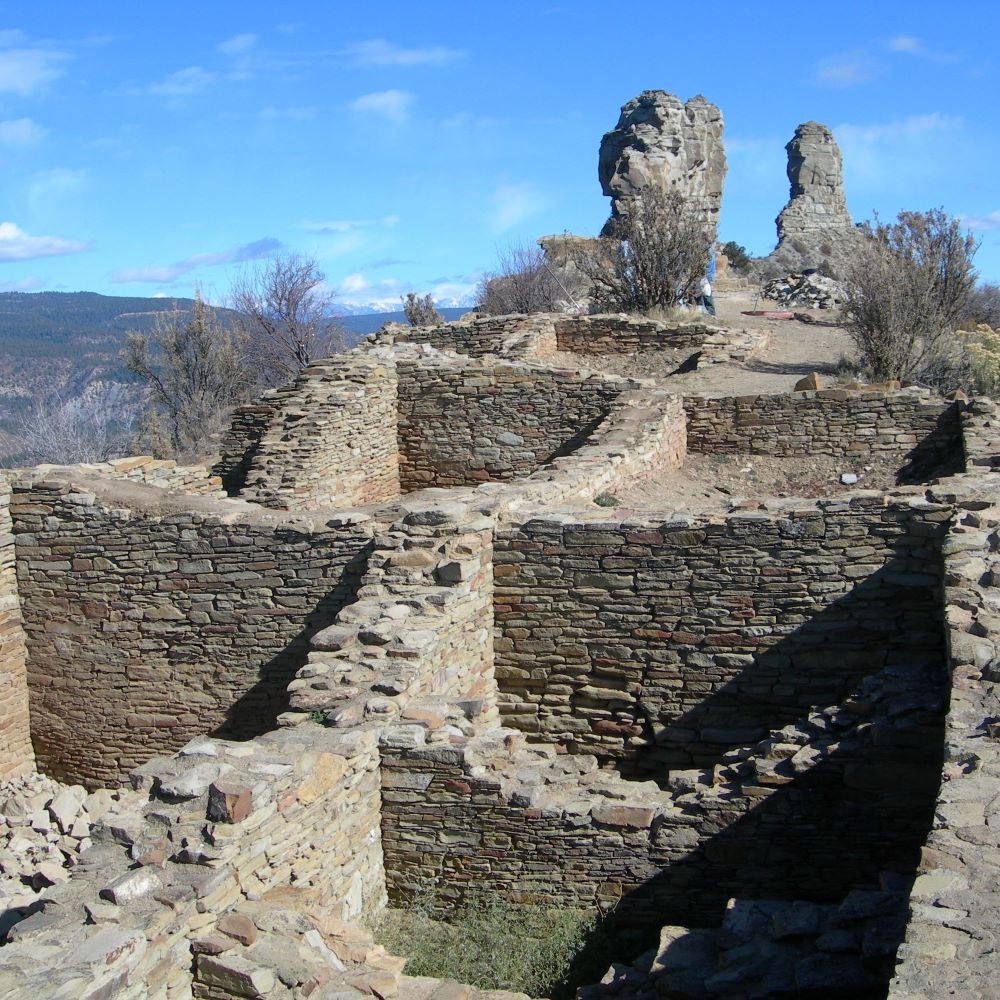
And here's the view on the evening of October 21, 2004, during the culmination of the Turn-Back Turn-Back:
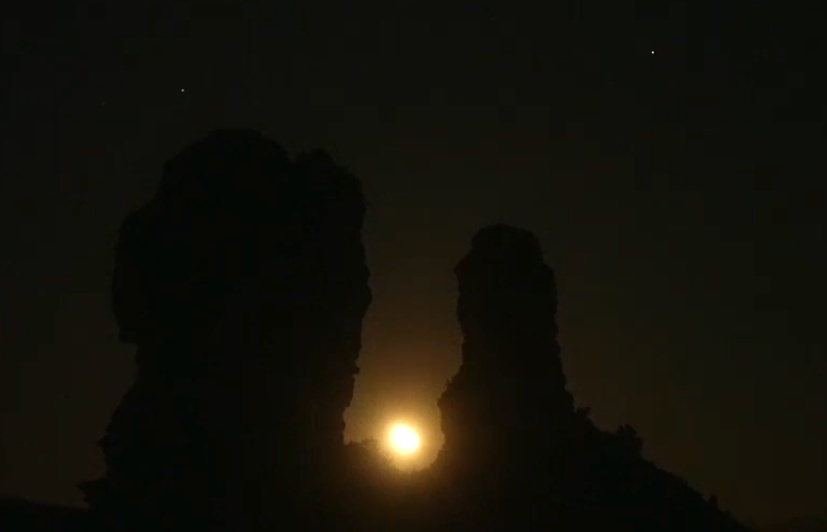
This is a geographical/astronomical coincidence. I think this demonstrates just how familiar native Tribes get with the area that they live in, including topographic features. And we know just how familiar with it they were.
At the Taos Pueblo, the Day People have their oral history telling us that their homeland was at Chimney Rock, and that it was a shrine to their Twin War Gods. In addition, we know that its alignment was used during Chacoan times, since at that time tree ring data shows there was construction at the Pueblo during two of the Widest Turn-Backs.
The Tribes at Newark
What about the tribes at Newark? Might they have had something similar?
We start here at Chimney Rock, where you can see the line from the Pueblo, to the right of Companion Rock, and ending to the left of Chimney Rock.
They did. I've mentioned Salisbury Hill before, sitting there just southeast of Heath High School since the glaciers receded. We also know that it was used by the local tribes 2,000 years ago—they built a hilltop enclosure on it. If any of them were up on top of the hill doing anything related to the Night-Shiner, they would have noticed what it was doing, either the rise or the set, or both. They would have seen how it aligned with the hill's spine.
Note that I cheated a little bit with the Chimney Rock topography at the beginning of the animation: I rotated it by 3°. Since Chimney Rock is at a different latitude, the Widest Turn-Back angle is also different.
In fact, there is another enclosure (and burial mound) nearby, called Salisbury Hill Fort #2. Here are the two hilltop enclosures in close proximity.
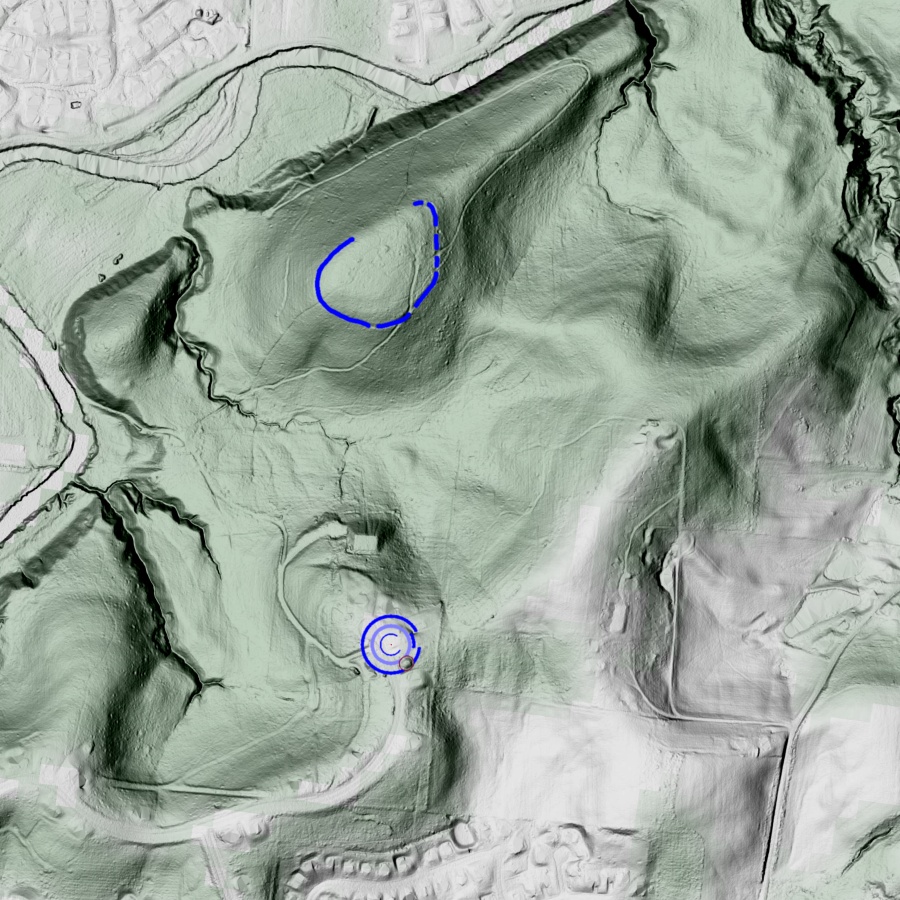
Now let me switch to a larger view of the whole Newark Valley, with many of the earthworks shown.
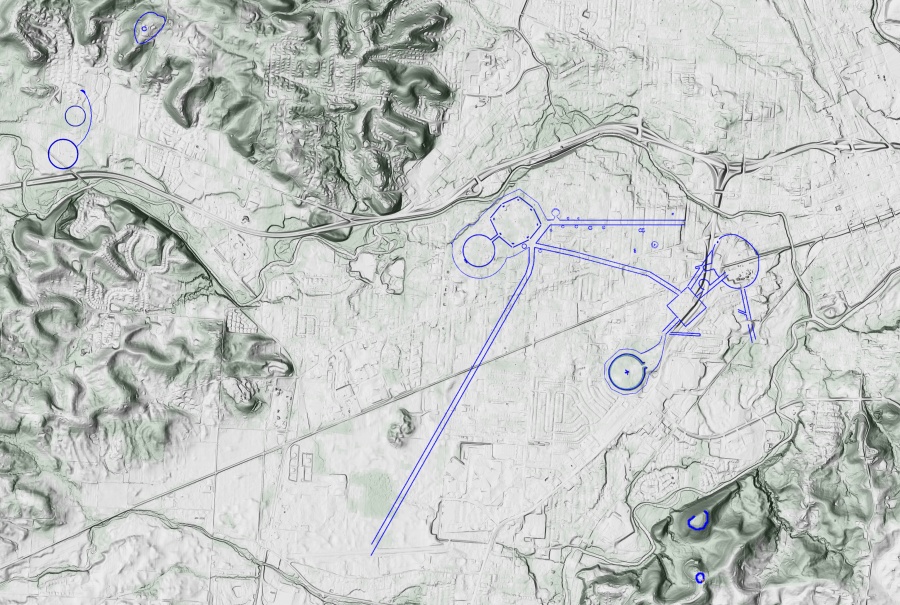
You can see the main earthworks in the center. The Salisbury hilltop enclosures are in the southeast, and you can see the Raccoon Creek valley in the northwest.
We know that the Octagon points to the rising of the Night-Shiner's Widest Turn-Back. It also has a leg that points to the corresponding setting. That setting direction is a reflection through north of the rising.
If we add those rise/set lines to the picture, and include other "strategic" lines marking those same rise and set directions, this is what we get.
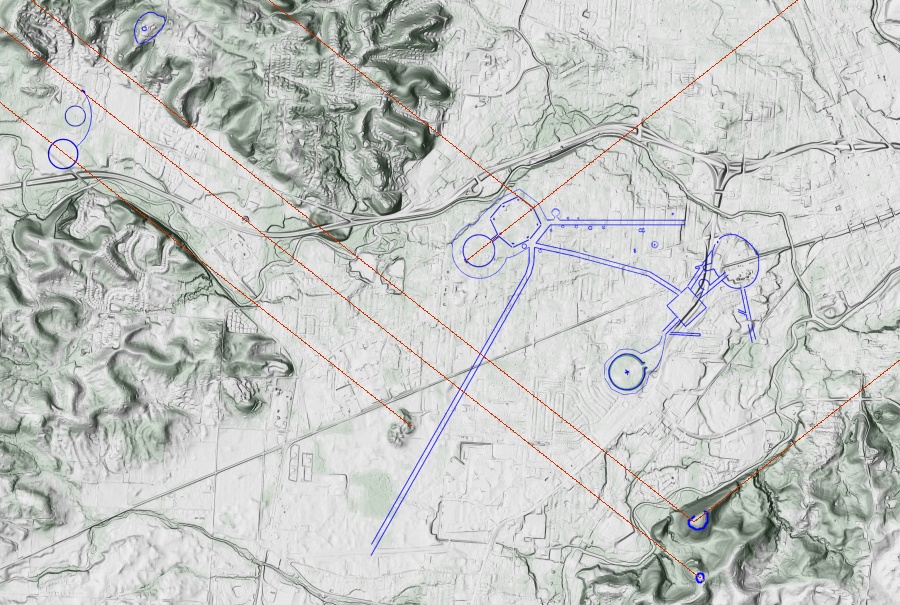
Let me point out the naturally-occuring features of the post-glacial Newark Valley.
-
We have the Widest Turn-Back Night-Shiner rise from Salisbury Hill.
-
We have the Widest Turn-Back Night-Shiner set from Salisbury Hill along the northeast edge of Raccoon Valley.
-
We have the Widest Turn-Back Night-Shiner set from Geller Hill along the southwest edge of Raccoon Valley.
-
We have the Widest Turn-Back Night-Shiner set from Hill Fort #2 up the middle of Raccoon Valley ending where Alligator Mound is. Note that the alligator is only about 1,000 years old, yet that protruding hill capping the middle of the valley was there since the glaciers retreated.
This is the landscape that the tribes living in the Newark Valley for nearly 13,000 years would have seen and would have become intimately familiar with, just as the Chacoan Tribes would have become intimately familiar with Chimney Rock.
Can we prove that the tribes noticed this natural alignment with the Widest Turn-Backs? No. But we can look at what is here. We can look at the example of Chimney Rock. And it is awfully suspicious. The Newark Valley is naturally the Valley of the Moon.
Before I finish up, I'd also like to draw a further connection to Chillicothe. Here's that broad picture again, with the alignments on it. The Newark Valley is in the upper right.
You may notice that I've added a green line. That line is basically perpendicular to the Octagon and runs from the center of Observatory Circle to the top of Salisbury Hill. It is parallel to the High Bank Octagon.
[I suspect that this particular green line ending atop Salisbury Hill may be a coincidence. There are other reasons to think that the Octagon and Observatory Mound are where they are. But if this additional alignment was noticed after the fact—or even during construction—it could have been seen as a powerful confirmation of the importance of that location.]
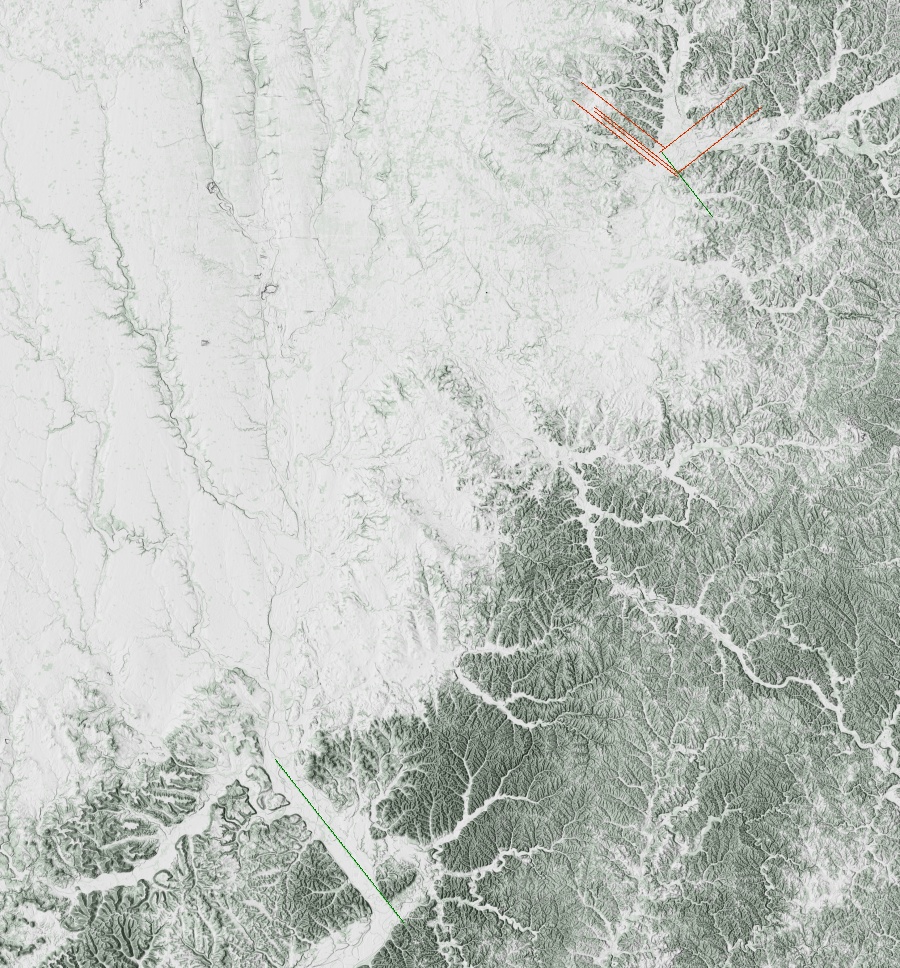
So if you now look at Chillicothe on the lower left, you can see that green line again. The High Bank Octagon aligns with the natural topography of the Scioto River Valley it sits in. Also, the Liberty Works and the Works East in Chillicothe are on that same line.
I think that this provides a further hint that one of the things the local Tribes were doing was observing how the alignments of the Shiners were also aligned with their topography.
"One elder reminded me of what I have been taught all my life: that these sites are not sacred because of what was built here. These structures were built to acknowledge the sacredness that preexisted humans; these sites only confirm and celebrate the power that was already here."
— John Low (Potawatomi), Professor Emeritus,
Director (Retired) of the Newark Earthworks Center,
The Ohio State University-Newark
Sacred Site, Sacred Earth, Sacred Sky, Sacred Landscape
I think what we have seen this evening is some of what made these sites at Newark and at Chillicothe so especially sacred. We see an awareness of the natural geography of the Sacred Earth and a sensitivity to the power in the Sacred Sky.
This is a Sacred Site, built on the Sacred Earth, witnessing the Sacred Sky, within a Sacred Landscape.
My thanks to Casey Hunter, Bret Ruby, and Marti Chaatsmith for reviewing this talk in advance and providing many helpful suggestions. Any errors are my own.