08/19/2025.
Today I'd like to talk about two different lunisolar calendars. The first one is well-known and most people probably know about it. The second one, though, is not so well-known.
The usual lunisolar calendar includes those like the Jewish calendar, the Buddhist calendar, and Chinese calendar. There are also various others ones, like a Hindu one and a Vietnamese one. They are based mainly on the motions of the moon, with adjustments to keep them in line with the seasons.
We get a full moon (or any other specific phase) every 29.531 days. That means that there are 12.37 months in a year. Or, to look at it another way, 12 lunar months add up to 354.37 days, 11 days short of a solar year. That means that, if you use a pure lunar calendar, your seasons will drift on you. (The Islamic calendar, used for religious purposes only, is a pure lunar calendar. The Christian liturgical calendar is kind of based on a lunar calendar, which is why Easter moves around the way it does.)
To keep your lunar calendar in line with the seasons, you occasionally have to add a 13th month (one about every 3 years).
In general, the Indigenous Peoples of the Americas used lunisolar calendars, and that is almost surely the case for the Indigenous Peoples of the Hopewell Culture.
In the 1800s, ethnologists made note of the fact (Marshack 1985) that the Indigenous Peoples in North America all used a common sort of calendar: lunar, with the names describing events that occurred in that month. There was a "strawberry moon" (for ripe strawberries) or a "raccoon moon" (when raccoons came out of their winter torpor [Dakota]) or a "moon of dust storms" (typical desert southwest weather [Zuni]). Note that, despite the usual Western assignments of specific names, the various tribes usually had different names that depended on their local conditions. For instance, for April, there was women's moon (Choctaw), geese-arriving moon (Cree), emerging-leaves moon (Cheyenne), geese-laying-eggs moon (Dakota), big-dust-storms moon (Zuni), and maple-syrup-making moon (Potawatomi).
For any of those names, the drifting of the seasons would be quite noticeable, and adjustments would have to be made.
This picture shows Tshi-zun-hau-kau a Winnebago (Ho-Chunk) Chief from around 1820.
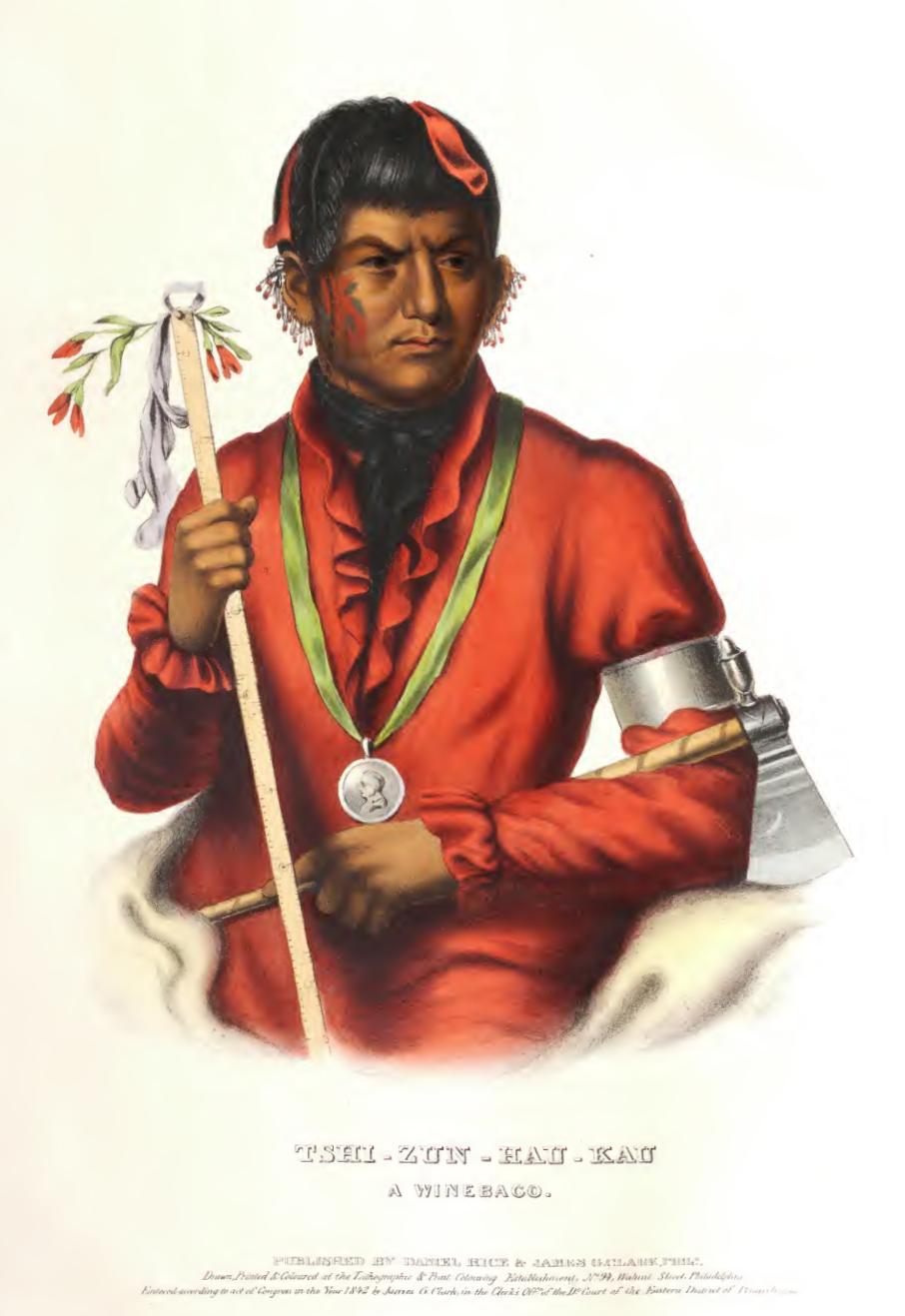
He is holding what is called a "calendar stick". This one covers two years, with every day marked and the occurrence of full and crescent moons noted.
For many, many tribes, the keeper of the calendar stick was an important ceremonial person, either a chief or shaman, who had the duty of keeping it current.
Here is one month's worth of that Winnebago calendar stick.

You read it from right to left. It starts out with a few days (3?) of (invisible) new moon. Then a small crescent appears and they are in the waxing period of the month (9 days). Then they go to a full moon and the large-moon period (11 days). Then they go to the waning period (9 days), ending in another thin crescent that disappears into a new moon. And then a new month starts.
The stick also has a separate section with extra days that appears to be recalibration to match the yearly seasons.
The Cincinnati Tablet is a stone table taken from an Adena Culture mound. William Romain has identified on that tablet notches that are acting just like a calendar stick. (Romain 1991)
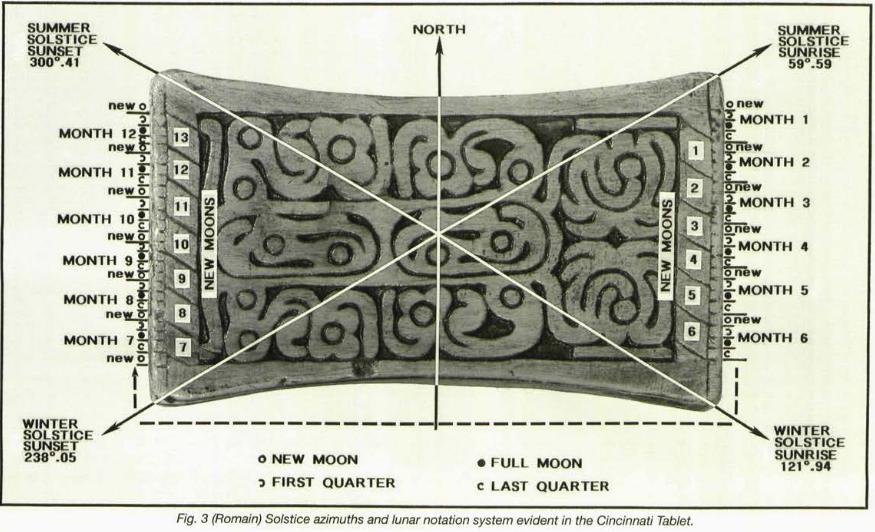
Picture drawn by Bill Romain.
This tells us that the Indigenous Peoples were doing the same kind of moon-watching, and calendar creating, over 2,000 years ago. Obviously, as the culture moved into Hopewellian times, such knowledge would have been built upon leading to the sophistication of the Hopewell Ceremonial Earthworks.
I surmise that the Cincinnati Table is a ceremonial archetype or representation of the calendar sticks that were in wide use among the different tribes of the time. While the wooden sticks did not survive, the tablet did.
Other examples come from Ancestral Puebloans. For the Zuni, "winter middle time" occurred with the full moon near the Winter Solstice. The new year then started with the appearance of the first crescent moon after that.
The picture shows a Fremont Pendant on the left, and a Hopi moon bowl on the right. (Lundwall 2022)
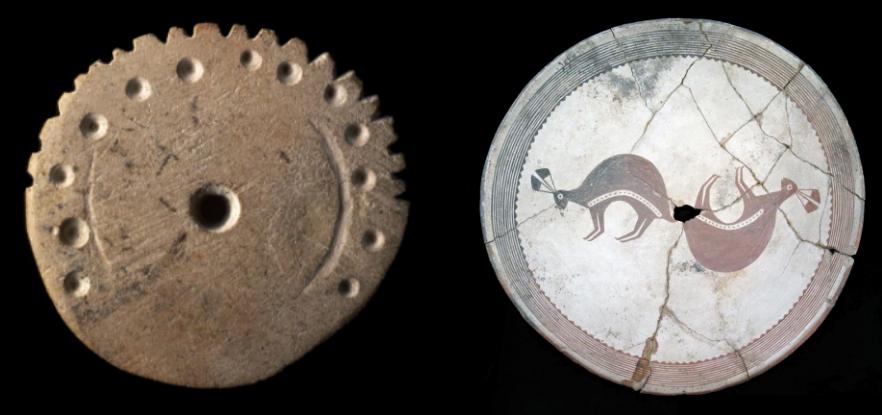
The Fremont Culture was in Utah north and to the west of the Four-Corners Ancestral Puebloan region. However, they have also been shown to be genetically related to the Ancestral Puebloans. The center of the pendant has been interpreted to show a full moon with crescent moons on either side of it. Then there are 13 moons, which could be showing that a seasonal year encompasses 12 months and part of a 13th. (Or maybe something else, which we will get to in a moment.)
And then there are the 19 notches across the top. While that is suspiciously close to 18.6 (where have we heard that before?), it could be something else. Stick around.
On the Hopi moon bowl, we see 2 rabbits. (The Hopi did not see a "man in the moon", they saw rabbits.) If you look very closely, each rabbit has 19 dots along its spine.
So now it is time to talk about the Metonic Cycle, which ties lunar and solar calendars together.
In an incredible cosmic coincidence, 235 full moon cycles take almost exactly 19 years, to within a couple of hours. That means that, like the Zuni and probably many others, you can pick a solstice as a reference point and then note when the full moon occurs relative to the solstice. Having detailed records over the years allows you to spot that 19-year Metonic Cycle. "Hey, 19 years ago we also had a full moon right on the winter solstice!" It also means that you can plan when to add extra months. For the Greeks and Hebrews, that's years 3, 6, 8, 11, 14, 17, and 19.
At some point, the Adena, and countless other tribes, would have noticed the lunistice, how the rise and set points of the moon pretty much do what the rise and set points of the sun do: move north and south over time (though much faster for the moon).
They would have also noticed that these cycles follow the Metonic Cycle, with both moon phases and rise/set points repeating every 19 years. (Note: I am not talking about the 18.6 year Standstill Cycle that you are undoubtedly aware of—that gets discussed later.)
I've discussed elsewhere the "magic" formula that connects the length of the year, the length of the full moon cycle, and the length of the lunistice cycle. (See this Facebook post.) The equations in this picture show how they are related (equation 1).
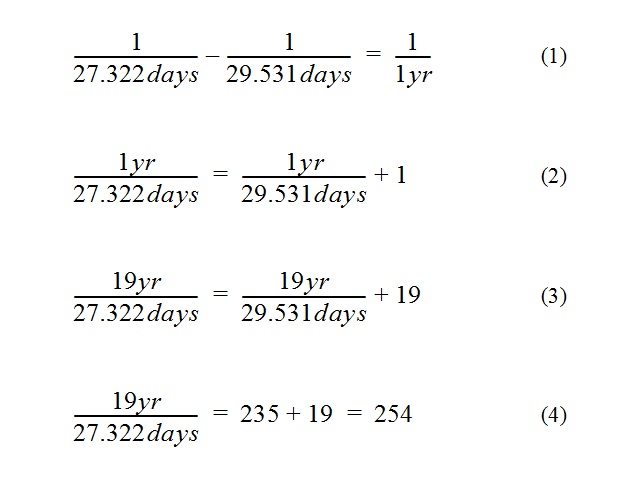
The second equation shows how, while the number of full moons in a year is 12.37 (365.25/29.531), the number of northern lunistices is one more than that: 13.37 (365.25/27.322). Equation 3 modifies that to look at what happens over the 19 years of the Metonic Cycle, and equation 4 demonstrates that since 19 years of full moons is an integer (nearly), so too must the number of northern lunistices be an integer. In fact, there are 19 more lunistices.
Not only that, but this interaction between the full moon cycle and the lunistice cycle creates a completely regular pattern. It happens every single year, imposing a yearly cycle on top of the moon's movements.
This picture shows what happens for the austral (southern) lunistices.
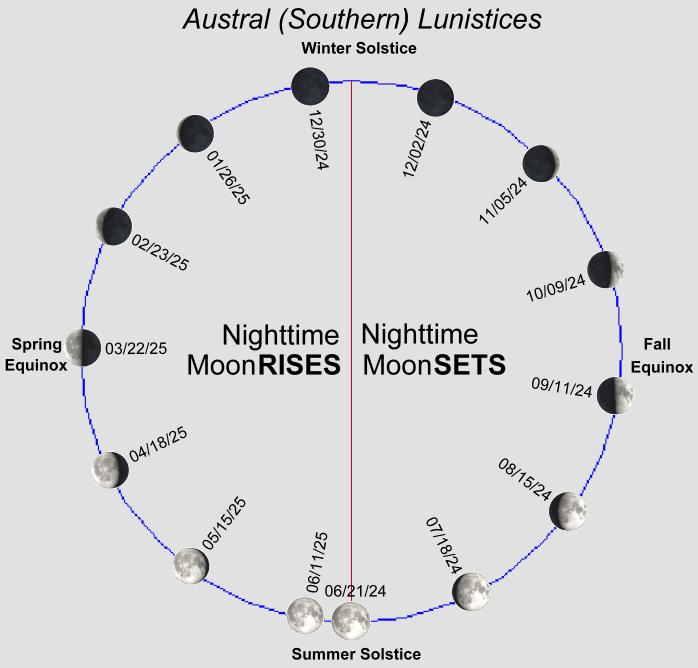
Starting at the bottom of the picture, the austral lunistice very close to the summer solstice always occurs with a full moon. Bret Ruby can tell us about that. (See this Facebook post.) As the year progresses from July to December, all the austral lunistice moonrises occur during the daytime (and are hence mostly invisible along the horizon) while the phase fades away. By the time of the winter solstice, the austral lunistice occurs with a new moon. However, from January to June, the austral moonrises occur at night, the phase slowly increases, and by the summer solstice we have a full moon austral lunistice again. In fact, the full moon and the austral lunistice occur within a day or two of each other.
That full moon austral lunistice, however, doesn't happen on the same day/night as it did a year ago. 13 times 27.322 days is just about 355 days, 10 days short of a full year. You can see in the picture how the last full moon austral lunistice comes up a bit short. The austral lunistices exhibit the same drift that months do, only, again, to repeat exactly after 19 years.
So, while Bret was able to put on a program on June 21, 2024 with a combined summer solstice sunset and austral lunistice moonrise, the Metonic Cycle guarantees he will be able to repeat the program on June 21, 2043, exactly 19 years later.
This is the flip side of the previous picture.
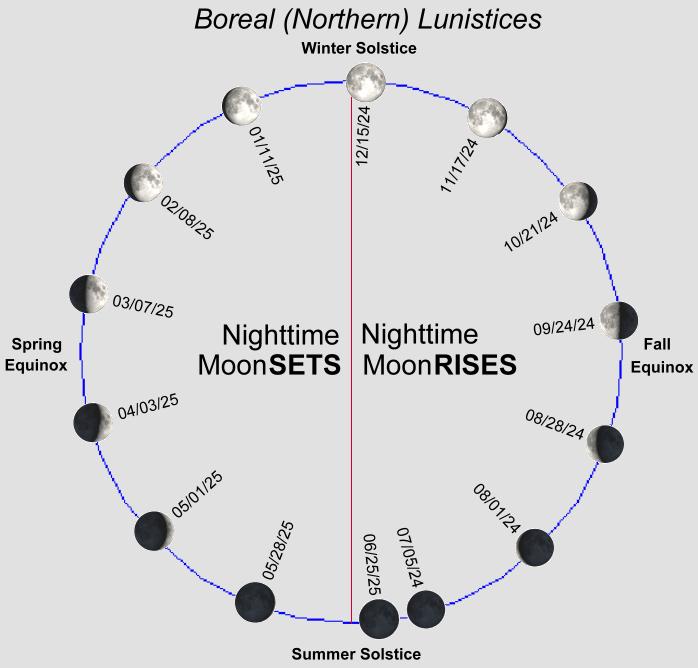
It deals with the boreal (northern) lunistices. Again, it happens every single year, not just during any sort of Major or Minor Standstill. This picture, along with the previous one, is a handy-dandy guide to observing the behavior of the lunistices.
The picture also particularly pertains to the Newark Octagon, since the Octagon points at the northernmost boreal lunistice moonrise.
In this case, starting with the summer solstice, the boreal lunistice moonrise occurs with a new moon. As the year progresses, the boreal lunistice moonrise gets more and more full, culminating with a full moon around the time of the winter solstice. While the full moon/boreal lunistice is not guaranteed to hit the winter solstice, the full moon is guaranteed to be within a day or two of the boreal lunistice. All of these are night-time moonrises. After the winter solstice, only boreal lunistices moonsets will be visible.
This was well-known to the Zuni (and undoubtedly the Indigenous Peoples of the Hopewell Culture). The Zuni felt that a winter solstice should occur near a full moon and a summers solstice close to a new moon. They saw the symmetry between a "strong" winter moon (full) with a "weak" winter sun, and a "weak" summer moon (new) with the "strong" summer sun. And they saw that the strong and weak orbs rises were opposite each other (as the lunistices are opposite the solstices).
"Winter middle time involves a bright full moon which, on this night alone, mimics both the large round shape and behavior, though not of course the timing, of the sun by rising in the east at dusk and crossing the sky from east to west in a single night. While the sun at winter middle time is a low and weak southern sun, summer middle time involves a dim new moon combined with a bright high northern sun. Thus, the two solstices are inversions of each other [winter : summer :: strong moon and weak sun : weak moon and strong sun]. The full moon at winter middle time mimics the sun in another way as well, in that it rises and sets at about the same place as the sun at summer middle time; thus [winter full moon : summer sun:: winter sun : summer new moon]. Further,the seasonal and monthly changes of the sun and the moon are declared to be identical [seasons : months :: path of sun : phases of the moon]." (Tedlock 1983; Zeilik 1986)
This brings up the question: does the Octagon point at the most northerly moonrise for the Major Standstill (which happens in the fall), or the most northerly full moon moonrise (which happens in the winter)?
I've repeatly pointed out that the absolute maximums occur around the equinoxes, not solstices, with 3rd quarter moons in the fall rising at night, and 1st quarter moons in the spring setting at night. Tim Pauketat, when discussing Angel Mound (Mississippian times), assumes it's the full moon that matters. (Pauketat 2024) Those equinox maxima are the result of a 177.84 day nutation (wobble) of the earth that aligns with the equinoxes during the Major and Minor Standstills (kind of like the way the full/new moons and lunistices align at the solstices).
As I think about it, it strikes me as very "Western" to go for the biggest, the absolute maximum, as opposed to recognizing the culmination of a 6-month holistic process. In that case, what the Indigenous Peoples would see is a moonrise during the equinox that was slightly more northern than the full moon moonrise, only to have it slightly retreat (about ½ a degree) to line up with the Octagon at the winter solstice before disappearing into daytime rises. I can imagine lore, or a religious event, based upon that occurrence. (As far as I can tell, there is every reason that that ½ degree, about the width of the moon) would be noticeable to the Indigenous Peoples.
So maybe we've been wrong all these years as to exactly where the Octagon points.
Let me let you in on a deep, dark secret.1
There's a lot of slop regarding just when and where the moon rises. You've seen that if you've attended one of the moonrises. For one thing, it depends on what you consider a "moonrise". Is it first light? Is it when the center of the moon is along the horizon? Is it when the moon clears the horizon (called "lower leg" or "lower limb")? Since the moon rises at about a 45° angle, that right there gives you a ½ degree leeway in what you call "northernmost". Furthermore, if you take into account a distant horizon, every fraction of a degree it rises about "zero horizon" means that the moon "rise" is that fraction further south.
To stress that point, the first paper from Hively and Horn used a horizon moonrise at first light, and showed remarkable precision. Then, later, they changed to zero-horizon for the moonrises/sets with a lower limb tangency. This provided a better fit for the northernmost arm of the Octagon. But it really did not change any of their major conclusions. (What it did do is provide a much better fit for the northernmost leg of the Octagon.)
This video shows two moonrises in the year 200 as best as I can figure them out (using the SAMPAS software package provided by NASA).
On the bottom (in yellow), I show the edges of the mound legs, or equivalently, the edges of the guardian mound, at the point of the Octagon. I then show the moonrise first for the fall equinox (3rd quarter moon), and then a second time for the winter solstice (full moon). In each case I mark "first light", "center", and "lower limb". I use a zero-horizon.
Which you call a better fit depends entirely on what you count as a "moonrise" and your aesthetics. But it sure looks to me like a full moon alignment is definitely in the cards for what the Indigenous Peoples were aiming for.
Let me now return to the other lunisolar calendar I originally lured you in with. With the original lunisolar calender, Indigenous Peoples had to deal with drift due to the mismatch between needing 12.3 months for the moon to make one year for the sun, even though they are pretty close. (There is also a slightly smaller mismatch between the 13.3 lunistices for the moon to make one year for the sun.) We also have a mismatch between the 19-year Metonic Cycle and the 18.613 year Standstill Cycle. Here again we have "drift". What would the Indigenous Peoples have seen?
What they would have been looking at is the full-year Zuni-like correspondences between the full moons and the lunistices. They would have been looking at when the full-moon/lunistice occurred around the winter solstice, and keeping track of that. Were the Fremont Pendant and Hopi Bowl showing the Metonic Cycle or the Standstill Cycle? Hard to tell.
And as the width of the moonrises changed over the 18.6 year Standstill Cycle, they would have observed that happening overlaid onto a year-by-year pattern that displayed itself over exactly 19 years. They would NOT have seen anything at all happening at 18.6 years.
But the 18.6 year Standstill Cycle would be overlaid onto the 19-year Metonic Cycle while drifting through it. While observing the offset of the full moon, and lunistice, from the winter solstice, they would see (and record on their calendar sticks) the 19-year pattern, except that over time, one particular timing (e.g. full moon 3 days before winter solstice) would fade out and be replaced by a different timing (e.g., full moon 13 days before the winter solstice) as the Standstill's 18.6-year cycle displayed itself.
I have tried to show that in this video.
I've started the video in Adena Culture times. The winter solstice is in the middle (left/right). I have marked the highest Standstill with the gray bar across the middle. If you watch it, you can see how the 19-year repeats slowly move to the highest standstill moonrise, and then fade away. Each particular timing is marked by a different color. And finally, since I am using a Gregorian calendar, sometimes the day number changes due to leap days.
Obviously, any one person could not have seen more than 3 Standstills. But the calendar sticks could tell the story. And if you looked Standstill to Standstill, you would see pretty much what you saw 19 years previously, but maybe shifted from a maximum to a year-off maximum.
One might ask: if the Tribes were doing this, why hasn't it been documented by ethnologists and anthropologists. I suspect that they really did not know about these details about the movements of the moon, and so they did not ask any such sorts of questions when interviewing Tribal members.
But regardless, it was a remarkable achievement to be able to appreciate and document, by writing upon the sacred earth, what they were seeing in the skies.
References:
Lundwall 2022.
Interpreting the apparent lunar symbolism on a Fremont Indian pendant, by John K. Lundwall, John McHugh, Elizabeth Nagengast-Stevens. Archaeoastronomy and Ancient Technologies 2022, 10(2), 30-55.
Marshack 1985.
A Lunar-Solar Year Calendar Stick, by Alexander Marshack. North America American Antiquity, Vol. 50, No. 1 (Jan., 1985), pp. 27-51
Pauketat 2024.
Heavenly history and the moon, by Tim Pauketat. March 19, 2024. <https://blogs.illinois.edu/view/7447/1420656572> (last accessed Aug. 21, 2025).
Romain 1991.
Calendric Information Evident in the Adena Tablets, by William Romain. Ohio Archaeologist (1991), 41:4, 41-48.
Tedlock 1983.
Zuni Sacred Theater, by Barbara Tedlock. American Indian Quarterly, Vol. 7, No. 3, American Indian Religions (Summer, 1983), pp. 93-110.
Zeilik 1986.
The ethnoastronomy of the historic Pueblos, II: Moon watching, by Michael Zeilik. Archaeoastronomy 1985, No 8, supplement to the Journal for the History of Astronomy 1985, XVI, S1–S24.
Endnotes:
1. It's not really a "deep, dark secret". But it is a mostly unexamined assumption that's just taken for granted.