05/12/2025.
The full moon is today. The austral (southern) lunisice is Thursday. This is part of a general lunar pattern as we approach the summer solstice. Near the time of the summer solstice, the austral lunistice is always within a day of a full moon (and vice versa). This is part of the dynamics of the earth/moon system. It is something that the Indigenous Peoples of the Hopewell Culture would have been well aware of (even as it is something that we, today, pay no attention to).
In the following, I will try to explain what is going on.
I'm going to start by explaining why the length of a month, full moon to full moon, is (approximately) 29½ days.
This picture starts with a full moon.
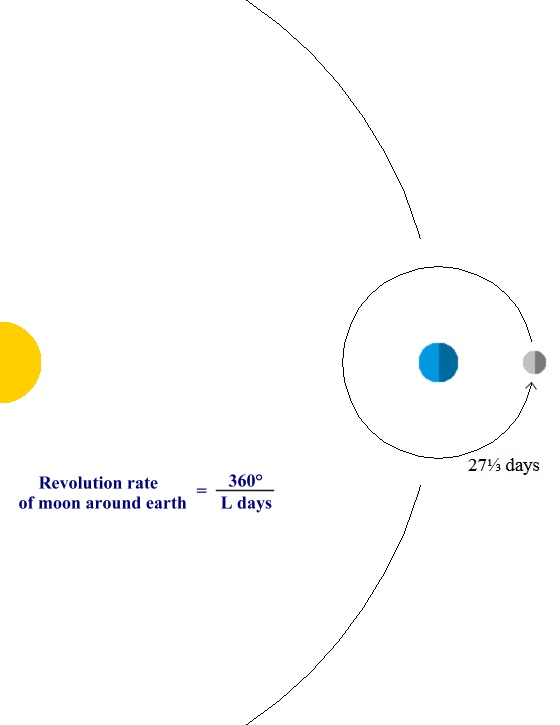
The moon revolves around the earth in (approx) 27⅓ days, as this picture shows. That is, it takes 27⅓ (L) days for the moon the revolve a full 360°.
But this picture is not correct. After all, while the moon is revolving around the earth, the earth is also moving around the sun.
The earth also revolves around the sun, doing 360° in 365¼ (Y) days. In this picture, it shows where the earth really is after 27⅓ days.
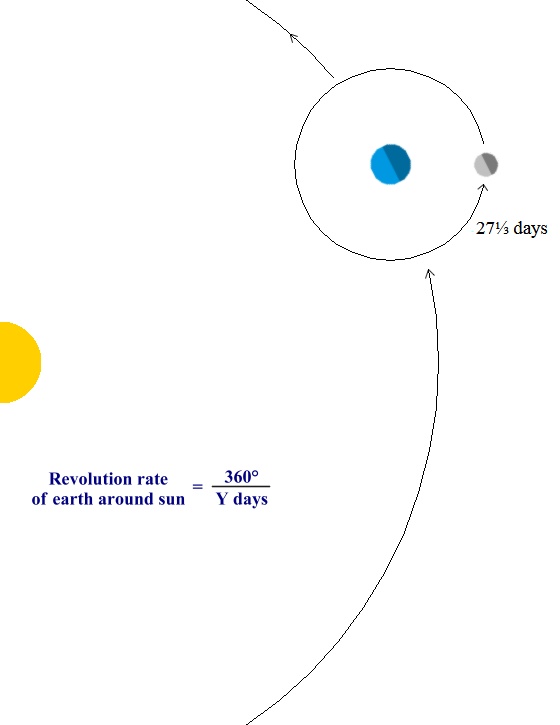
Notice that we have NOT yet returned to a full moon—the moon hasn't revolved enough yet. The moon needs to revolve a bit more to get to its full moon position (and while doing so, the earth is also going to revolve a bit more around the sun).
This picture allows us to calculate when the full moon occurs.
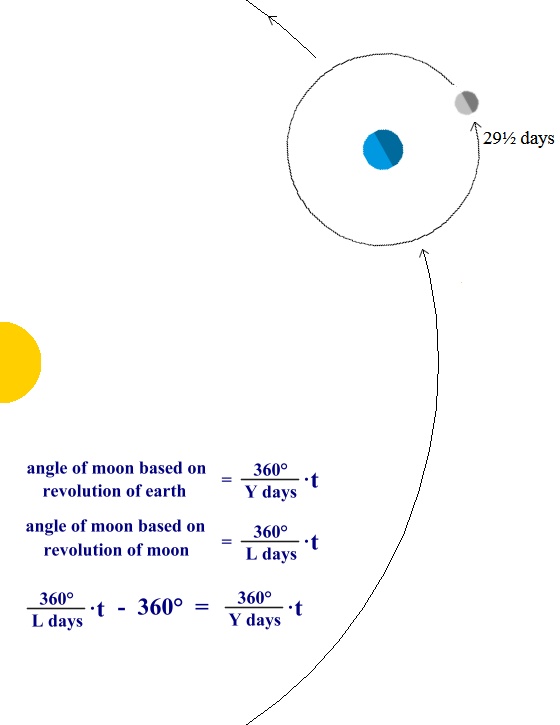
We're letting a time, t, elapse, and we need the angle from the sun to the earth to be the same as the angle from the earth to the moon. In other words, we need them all to line up to get a full moon.
The last equation on this page is a little tricky. The moon has to have revolved more than 360° to line up properly, so we need to subtract that off in our equation to make the number of degrees match. (To put some numbers to it, the moon would have revolved around the earth by about 389° while the earth would have revolved around the sun by about 29°. To make those numbers match we have to subtract off one full revolution of the moon.)
We can then call "t" the length of a month, M, and write our equation relating them all.
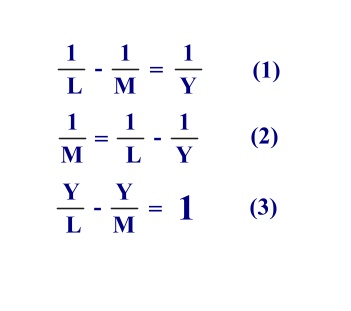
Equation (1) is that previous equation (with 360° divided out), and using L, M, and Y.
Equation (2) allows us to solve for the length of a month. If you plug in L = 27⅓ days and Y = 365¼ days, then we get that M is 29½ days. That is where that number comes from. (PS. Those numbers are not exact, but close enough for my purposes.)
Equation (3) is interesting because Y/L is the number of lunistices in a year, and Y/M is the number of months in a year. Many people know that there are 12.368 months in a year (which is why luni-solar calendars need occasional extra months), but are unaware that there are 13.368 austral lunistices in a year.
Also, let me give you a bit of foreshadowing: when you have equations like this related to periodic events, additional patterns occur.
Why, you might ask, do the months and the lunistices line up with the full moon hitting the austral lunistice at the time of the summer solstice? (And similarly, we also get a full moon hitting the boreal lunistice at the time of the winter solstice.)
It has to do with the dynamics of what solstices and lunistices mean, as this picture attempts to show.
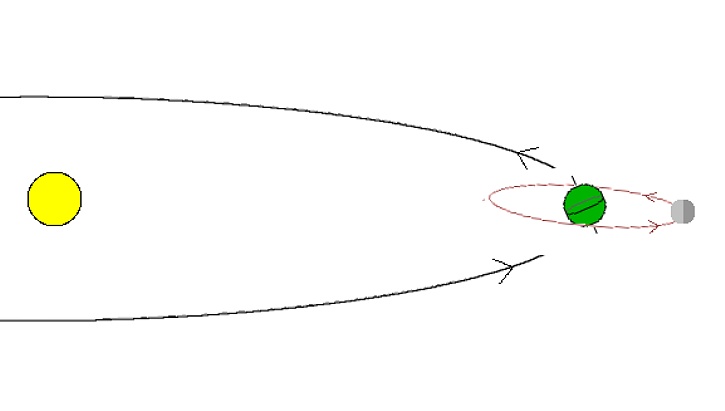
From our schooldays, we probably recognize how the tilt of the earth has the northern hemisphere pointing toward the sun at the summer solstice. But that also means that, for a full moon, the moon itself is far in the south (i.e., a southern lunistice). If that were the sun, we'd call it winter. So, at the summer solstice, the moon is acting the way the sun acts at the winter solstice (hence, the name austral, or southern, lunistice).
Those two events being physical opposites of each other force the alignment.
As I mentioned before, when you have an equation like (1) that describes periodic motion, that is what forces something like the full moon and the lunistice to occur very close to each other (basically, half the difference between 29½ days and 27⅓ day, or about 1 day).
This video tries to give a feel for such periodic events, and illustrates each of the numbers involved.
Let me call 1/20 of a second a "jot". I have one event happening every 29½ jots (simulating a full moon) and one event happening every 27⅓ jots (simulating the lunistice).
It starts out with 10 seconds of the full moon events (higher pitched) and follows with 10 seconds of the lunistice events (lower pitched), just to get you used to them. The lunistice events occur slightly faster. Next, at 25 seconds, both start simultaneously. You can see how they get out of phase, but then start coming back into phase. At around 43 seconds (365¼ jots!), they are nearly simultaneous again (within 1 jot of each other), and then start going out of phase.
Listen as long as you like to get a feel for it, but this illustrates how the full moon and the lunistices stay in sync with each over over the years.
The full moon today and the austral lunistice on Thursday make up the near convergence just before the close convergence that occurs on June 11, which, this summer, is the one closest to the summer solstice.
The Hopewell Culture National Historical Park is holding an event, hosted by Dr. Bret Ruby, to watch that southernmost moonrise.
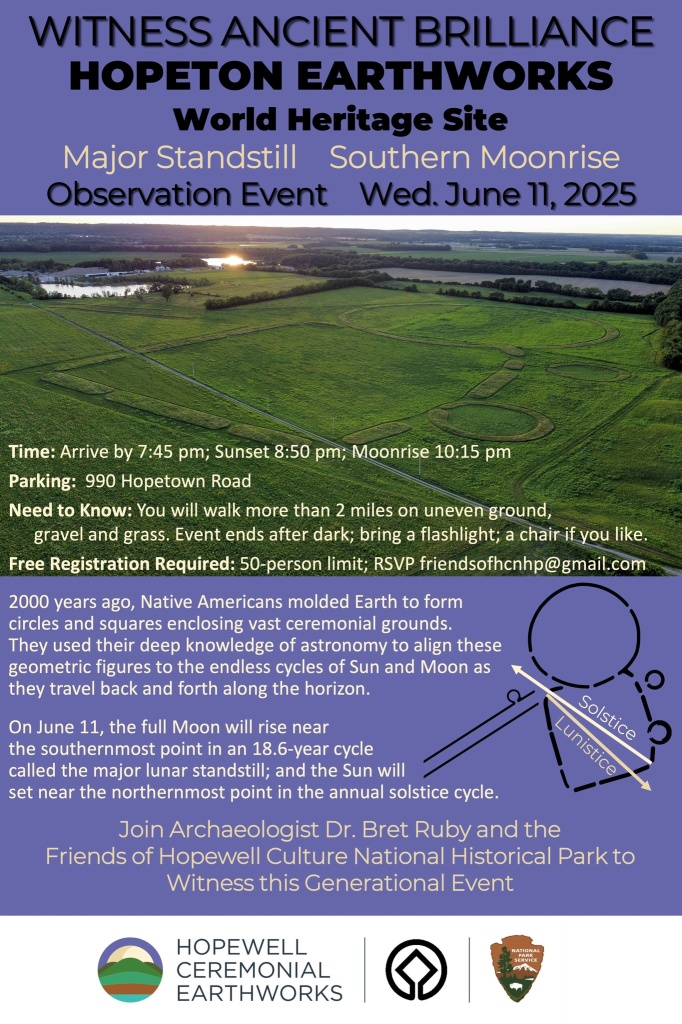
Note that while the convergence of the full moon and austral lunistice occurs every year like this, because we are in the time of the Major Standstill (driven by that 18.6 year cycle), this is the southernmost summer solstice moonrise you will see in a long time.