09/14/2024.
This post is a cautionary tale about museum exhibits. Even with the best of intentions, insufficient attention to detail can propagate misinformation and make the public think they have learned something when they have not.
What I want to do here is highlight a time the Field Museum in Chicago went rather far astray. Did museum-goers get hurt by it? Probably not. Most probably won't even remember it. But they were given "knowledge" that just wasn't true, and one never knows where that sort of misinformation might pop back up. In addition, if a venerable institution gets one major thing wrong, how can one trust their other presentations (or know which ones to trust)?
In this one small area, they botched it pretty thoroughly.
Back in 2008, the Field Museum had a major exhibit on "The Aztec World". It actually was pretty cool. There is an archived copy of their web-version presentation at <archive.org>.
The Aztecs spoke classical Nahuatl (from which we get, through the Spanish, a lot of English words like "tomato", "avocado", "ocelot", "chile", and "chocolate"). As part of their display, they gave a handy-dandy pronounciation guide to their Nahuatl words. Unfortunately, while the exhibit had an impressive cast of curators, knowledge of Nahuatl was not one of their strengths and basic errors were made and passed along.
As you may have noticed before, I've "dabbled" a fair bit in Nahuatl, the language of the Aztecs. The standard orthography of Nahuatl is based on what the Spanish used back in the early 1500s. Most importantly, sounds that were not regularly a part of Spanish were depicted using digraphs—two letter combinations. Even though they are two letters, they depict a single sound. They are like "sh" in English.
Here is one of the worst of their efforts: "This hearth fire represented Xiuhtecuhtli [zhee-ooh-tay-COOT-lee], the "Fire God".
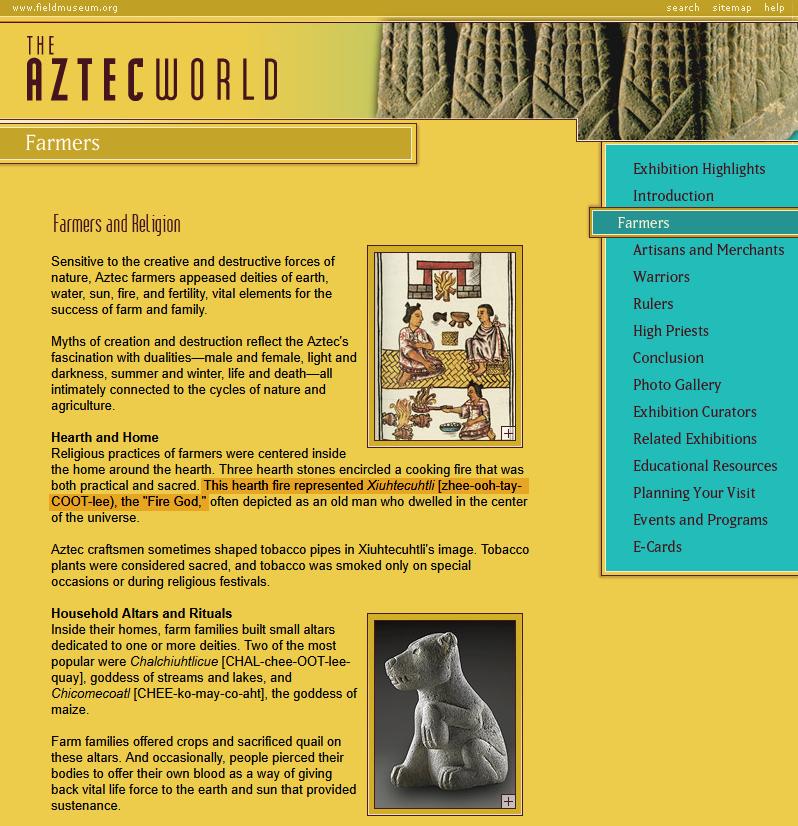
Let me tell you how to really pronounce it. "X" stands for the "sh" sound (as it used to in older Spanish—think about that next time you see the name "Xavier"), not "zh". "Uh" is one of those digraphs. In fact, "uh" and "hu" are two digraphs that represent the same sound: "w". "Uh" is used at the end of a syllable, and "hu" is used at the beginning. So that first syllable should be rendered more like "shew".
Next, "tecuhtli" is a hot mess. It's a misspelling of "teuctli" (which DOES mean "lord" or "god"). As it says in An Analytical Dictionary of Nahuatl, "In older Nahuatl texts, this is misleadingly written as tecutli or tecuhtli, which suggests a bisyllabic stem with a stem-final glottal stop when in fact it is a monosyllabic stem with a final labialized velar consonant". You see "cu" and "uc" are a pair like "hu" and "uh", and stand for a single sound, "kʷ", which is a "k" sound with pursed lips instead of wide lips (which makes it sound rather "w"-like. So "tecuhtli" mixed up that "uc" which is used at the end of a syllable, and then added that "h" to make it look like "uh". And then there is that "tli". "Tl" is another digraph—a single sound—so you don't break the "t" and the "l" between syllables any more that you would break "wishing" into "wis-hing". The "tl" is pronounced like our "t", but with the air released from the side of the tongue instead of the tip.
Thus, a more proper pronounciation, one that should have been presented to the public would be "Xiuhteuctli: [Shew-TEWK-tli]" (and using that explanation of the "tl"). At least they got the stress on the penultimate syllable (which it not coot).
Here's just another example: "Huitzilopochtli [wheet-see-lo-POACHT-lee]".
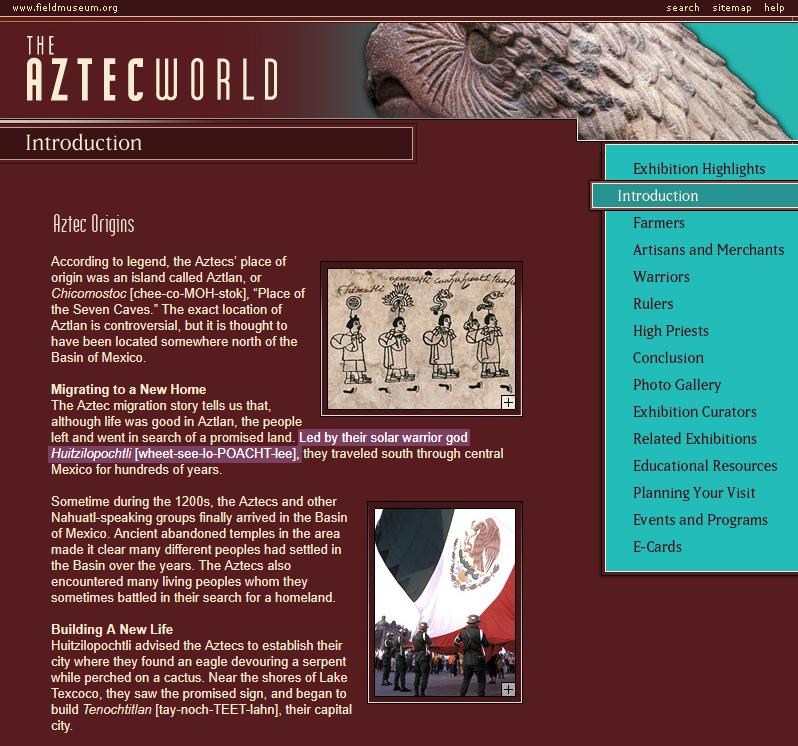
"Tz" is another digraph; it sounds like "ts", like the Russian "ц". This word is better rendered as [Wee-tsee-lo-POACH-tli]. Don't break apart the digraphs!
This has been a cautionary tale. Every aspect of a display really should have a competent, diverse set of inputs. There are people out there who could have helped, if only they had been consulted. Instead, the Nahuatl part of the exhibit was . . . less than ideal.
Lest anybody think I am out over my skis, for the longest time I've been on the Nahuatl-list, which is hosted by and used by such Nahuatl luminaries as John Schwaller, Frances Karttunen, and Joe Campbell. I brought this before them back in 2008-2009 and they pretty much agreed with me. They are the experts in this field. It's a real shame that the experts were not consulted.
Resources:
Introduction to Classical Nahuatl (Revised Edition), J. Richard Andrews, University of Oklahoma Press, 2003.
An Analytical Dictionary of Nahuatl. Frances Karttunen, University of Oklahoma, 1983.
Vocabulario en Lengua Castellana/Mexicana, Mexicana/Castellana. Fray Alonso de Molina, Estudio Preliminar de Miguel León-Portilla, Editorial Porrúa (quinta edición), 2004.