02/24/2024.
What is a calque? And might there be one relevant to the Newark Earthworks?
We're going to talk some linguistics here. Words "evolve". We know about something like Proto-Indo-European because we can track the changes through time. Through regular sounds changes, Latin "pater" becomes Spanish "padre" and French "pére". English "father" comes from the same source (p→f, t→th), and there are the older Greek "πατήρ" and Sanskrit "pitṛ". All descend from an ancient "*pəter". (The asterisk means the word was reconstructed using linguistic techniques.)
But all words in languages don't come about that way. Often you can get loan words, like "le weekend" in French(!). But there is also something called the "calque". This is where the concept of a new word is translated into the new language and adopted that way. They happen when a culture shares a common emerging experience. A good example is "skyscraper". In many languages, the components are translated separately, and then stitched together. In Spanish, it's "rascacielos", "scratch the skies". In the totally unrelated Hungarian, it's "felhőkarcoló", "cloud scratcher".
If you look at many Native America languages, you can also deduce various proto languages, like Proto-Algonquian, Proto-Uto-Aztecan, Proto-Muskogean, Proto-Iroquoian, Proto-Athabaskan, and Proto-Siouan. These proto languages are deduced by looking at the similarities and evolution in their descendant languages.
If you look at the words for "moon" and "sun", most Native languages have totally different words. For instance, in in Comanche they are "taabe" and "mua".
But if you look at Proto-Algonquian (PA), the word for "sun" and "moon" (and "month") are the same, being derived from the same Proto-Algonkian word "*kishethwa". In almost all languages descended from PA, the moon is called the "night sun". For instance, in Shawnee, based on the PA root "tepexk" ("night), the moon is "tepeki-kiišeθwa".
Here's where things get interesting. If you look at Proto-Siouan (ancestor of Lakota, Dakota, Crow, Hochunk, Quapaw), the same thing happens. The word for the "sun" (and "month") in Dakota is "wi". The word for "moon" is "haŋwí" ("haŋ" = "night"). Or, they'll use "aŋpe´tuwi", ("day-sun") for the sun and "haŋyetuwi" ("night-sun") for the moon, when distinguishing the two.
Would you like more? In Proto-Muskogean (ancestor of Choctaw, Chickasaw, Seminole, Creek), it happens again. For instance, in Choctaw, "sun" is "hushi" and "moon" is "hushi ninak". "Ninak", unsurpisingly, means "night".
Interestingly, Iroquoian languages do not do this, except for a southern branch: Cherokee. There "nvda" is either "sun" or "moon", and if you want to distinguish the two, you use "iga ehi nvda" ("iga" = "day") and "svnoyi ehi nvda" ("svnoyi" = "night").
[Note added 02/24/2024. As I've looked into this further, I've found there are quite a few more Iroquoian languages that name their moon this way.]
Now, back to the possible calque:
It's almost as if, something like 2,000 years ago, these 3 language groups (and Cherokee), as unrelated as Italian, Arabic, and Hungarian, while living near each other in the middle-south of the continent, were sharing a new common cultural experience in which knowledge of the sun and the moon, with their intimate similarities between solstices and lunistices, brought them all to adopt a calque highlighting that common knowledge.
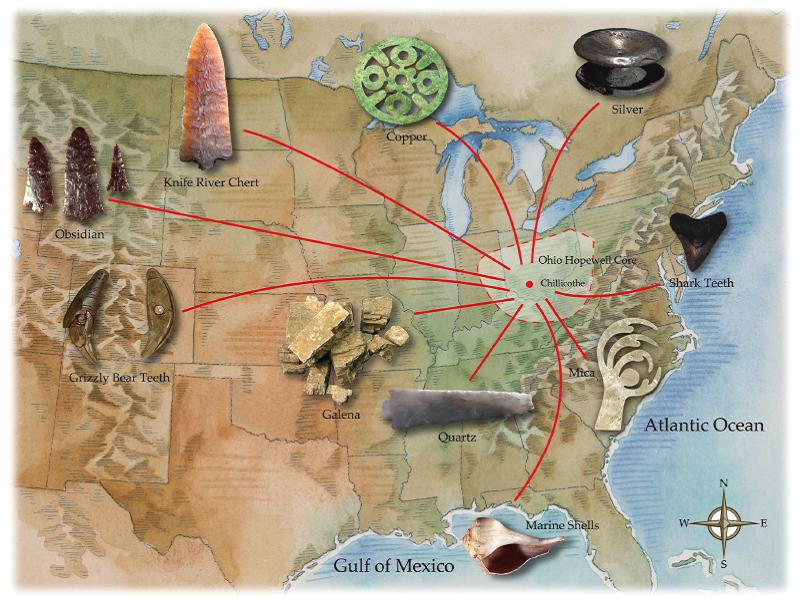
And of course you will recognize that their locations are not too far from the center of the Hopewell Interaction Sphere.
This would be really hard to prove, but I hope you will accept it as at least a hint of yet another common bond, and, that clues may be hidden where you least expect them.
[Note added 02/24/2024. That said, I've also found that this moon/sun connection is way more common in the Americas than the rest of the world. However, it is hard to see how any Hopewell connection could account for South America. So it is not clear at all whether a Hopewell connection is involved at all.]
The Hopewell Interaction Sphere: