I've been doing a series of "Moonwatch" postings on Facebook related to the Octagon at the Newark Earthworks. I have collected them here, and will update this as I add to the series. When I first started, I didn't know I'd be doing a series, so it starts out rather raggedly, and is a bit repetitive.
I pretty much abandoned this in 2023. I've tried to restart it here, and hope to keep adding the missing ones.
There has been some minor editing to fit them into this format, or to correct some minor flubs on my part.
There is a Table of Contents right after "The Latest Entry".
The Latest Entry
04/11/2023.
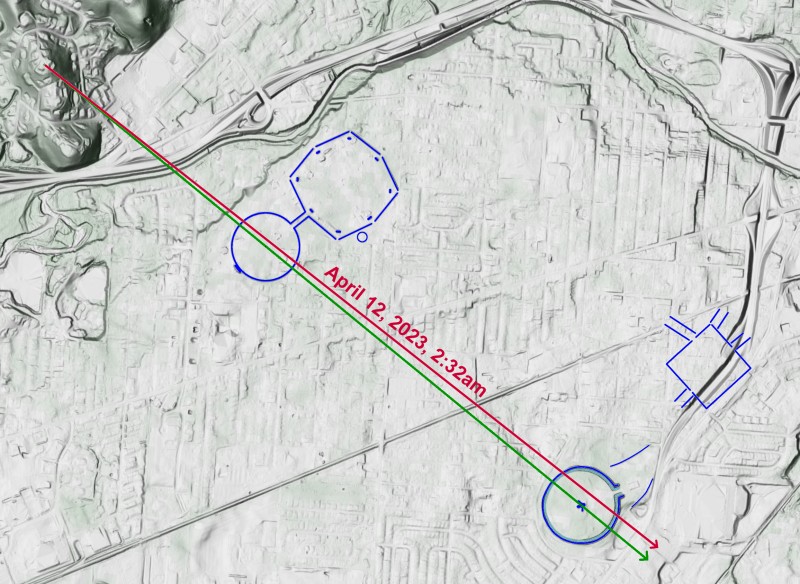
Tomorrow is another austral (southern) lunistice. As we approach summer, the moon is working its way to being full for the austral lunistices, and it rises when the sky is dark, at 2:32am. With the Major Standstill approaching, the moonrise is also working on aligning with the southeast leg of the Octagon, and also aligning with the line from Dugway Hill to the center of Observatory Circle to the Great Circle.
Since the austral lunistice is the lunar equivalent of the winter solstice, that means that the moon will not rise very high in the sky, and because of the approach of the Major Standstill, even at its highest point it is particularly low—lower than even the solstice. This picture shows the moon's path across the sky its lowest meridian, March 22, 2025; tomorrow's meridian, at 6:54am; and finally, how high the sun gets on the winter solstice.
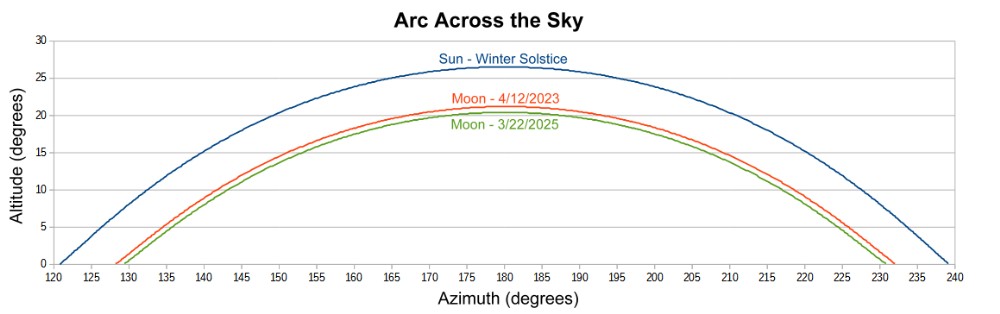
Table of Contents
- 03/23/2021. The Moon is high in the sky.
- 04/30/2021. Introduction to the austral lunistice.
- 11/08/2021. Austral lunistice moonset.
- 11/08/2021. Introduction to boreal lunistice moonrise.
- 12/18/2021. Why there is a full moon for a boreal lunistice around the winter solstice.
- 12/19/2021. Picture of the moon at the boreal lunistice.
- 01/15/2022. Boreal lunistice.
- 03/10/2022. Boreal lunistice near spring equinox. Daytime moonrise. Winter nutation slump. Meridian angle.
- 03/24/2022. Austral lunistice near spring equinox. Octagon Alignments. Moon really low in the sky at meridian.
- 04/08/2022. Austral lunistice near spring equinox. Video of moonrise for one lunar cycle.
- 04/10/2022. Some photos from the April 10, 2022, Open House.
- 04/11/2022. Video of what a noon moonrise looks like.
- 05/01/2022. Sunwatch. Cross-quarter sunrise at the Great Circle.
- 05/04/2022. Boreal lunistice. Video of the approach to Maximum.
- 06/01/2022. Boreal lunistice. Moonset just after sunset.
- 06/14/2022. Austral lunistice. Moonrise line between Observatory Circle and the Great Circle.
- 06/28/2022. Summer solstice boreal lunistice. New Moon.
- 07/12/2022. Austral lunistice at the Super Moon. Relative sizes of Observatory Mound and the Great Circle.
- 08/06/2022. Sunwatch: On its way back south, the sunrise passes the gateway into the Great Circle.
- 08/07/2022. Austral lunistice. Now it's a waxing gibbous moon.
- 08/21/2022. Boreal lunistice. The "northern bumps", a nutation that makes the maximum moonrises occur around the equinoxes.
- 09/04/2022. Austral lunistice. This time of year, watch the moonset.
- 09/17/2022. Boreal lunistice. The pause and rest of the approach to alignment.
- 10/02/2022. Austral lunistice. How to get equal areas for the Octagon and Wright Square.
- 10/09/2022. The ascending nodes of the moon and Wright Square.
- 10/13/2022. Boreal lunistice at the Open House.
- 10/15/2022. Moonset along the northernmost moonset leg of the Octagon.
- 11/11/2022. Twin lunistice moonrises.
- 12/01/2022. The tilt of Wright Square and the ascending nodes.
- 12/07/2022. Alignment of full moons and boreal lunistices around the winter solstice.
- 12/08/2022. Boreal lunistice with the moon nearly overhead at meridian.
- 12/09/2022. Boreal lunistice moonshadow picture.
- 12/22/2022. Winter solstice coincides with a new moon at the austral (southern) lunistice.
- 01/04/2023. Boreal lunistice around the full moon. The sun and moon are in synch for maximal viewing.
- 01/19/2023. This time of year the austral lunistice occurs near the new moon.
- 01/31/2023. This time of year the boreal lunistice moon has a rises during the day but sets at night.
- 02/09/2023. How to Design the Octagon.
- 02/15/2023. Lining up 6 Observatory Circle down to the Great Circle at the austral lunistice.
- 02/28/2023. Focus on the meridian and moonset for the boreal lunistice this time of year. And the advance toward the Major Standstill takes a break.
- 03/15/2023. Consider the austral lunistice from atop Dugway Hill.
- 03/28/2023. Moonrise in a Spring boreal lunistice is during the day. Look for the meridian or moonset instead.
- 04/04/2023. Why Salisbury Hill is special.
- 04/11/2023. Austral lunistice aligning from Dugway Hill.
- 04/24/2023. Boreal lunistice moonrise is during the day, but moonset aligns nicely.
- 05/05/2023. At the Great Circle for the cross-quarter day, Beltane, with a simultaneous full-moon moonset.
- 06/05/2023. The austral lunistice moonrise is starting to align with the line from Dugway Hill to Observatory Circle to the Great Circle.
- 06/18/2023. The boreal lunistice occurs with a new moon, so there is nothing to see.
- 07/15/2023. Being past the summer solstice, moonrises are starting to happen during the night.
Entries
03/23/2021.
Last night was a preview of the upcoming Lunistice Standstill.
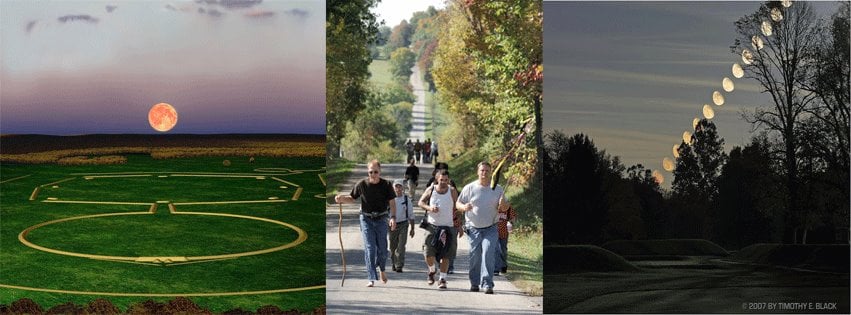
If you happened to look up last evening around 9:00pm, you will have noticed that the Moon looked very high in the sky. It was about 15.3° away from being directly overhead. Last night was the boreal lunistice, where the Moon's orbit puts it as high as it can during any particular lunar cycle. And then there is a longer, 18.613 year cycle, in which that elevation gets even closer to overhead. The Newark Earthworks, built 2,000 years ago, celebrate that occasion. The next occurrence of that maximum will be in 2024-2025.
On March 7, 2025 the Moon will get as high as it gets: within 11.6° of directly overhead. Like last night, the Moon will rise at around noon, and then around 9:00pm (EST), get as close to overhead as it ever does. And then you'll have to wait another 18 years to see it again.
BTW, it was no coincidence that this occurred so close to the Spring Equinox. The planets conspire (ok, it's the Earth, Moon, Sun) to make this happen every single time.
https://www.facebook.com/newark.earthworks
04/30/2021.
Early tomorrow morning will be an austral lunistice. This is like a winter solstice, except with the moon. The moon will be rising from the southernmost point in its orbit (at about 1:04am), just as on the winter solstice the sun rises from the southernmost point in its orbit. When the moon is at due south (at about 5:39am) it'll have its lowest elevation on the horizon in its orbit (just like the sun on the winter solstice). It'll only make it 23.6° above the horizon. The skies should be clear if you want to see either occurrence.
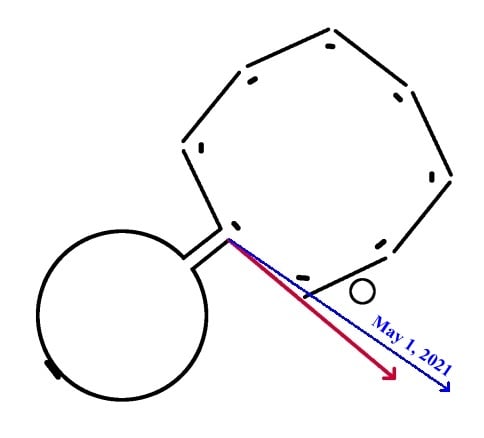
This is even less than what the sun manages (26.6°) because we are heading toward a Major Lunistice Standstill in a few years. Over that period, the moon's austral lunistice will get lower and lower (down to 21.5°) until it turns around and gets higher again. Regarding the moonrise, which is celebrated by the Newark Earthworks, over the next few years that southeastern austral lunistice moonrise will lie closer and closer to the southeast leg of the Octagon.
11/08/2021.
Today is an Austral Lunistice. This is like the winter solstice, but for the moon. Just as it is for the winter solstice, the moon barely makes it up above the horizon. Today, at its highest point (due south at 4:11pm) it'll make it to about 22.8° above the horizon. It will be barely visible (if at all), because it's just past being a new moon, it's daytime, and there will be a lot of washout (or trees!) along the horizon. An Austral Lunistice that occurs near the winter solstice will always be nearly a new moon.
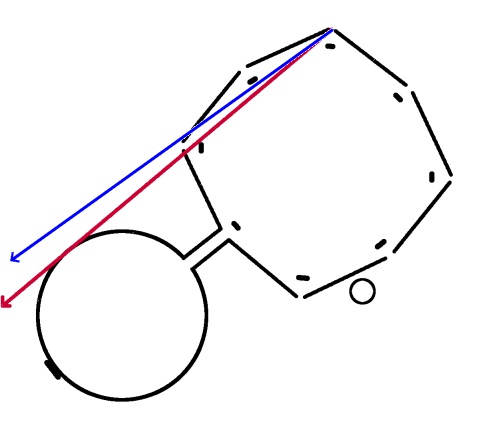
As 2024-2025 approaches, the Moonset (8:43pm) will increasingly approach an alignment with the Newark Earthworks. The picture shows how close it is right now. Red is the alignment rediscovered by Hively & Horn, and blue is where it will set tonight.
11/22/2022.
Today is the Boreal (northern) Lunistice. This is like the summer solstice, but for the moon. Just as it is for the sun at the summer solstice, the moon will rise in the northeast, sweep high across the sky, and then set in the northwest. Because the orbit of the moon is tilted by about 5° compared to the orbit of the earth, and because that tilt rotates, during this period, the moon rises farther to the north each month for each Boreal Lunistice. As we approach the winter solstice, the Boreal Lunistices occur near a full moon. (You will recall the lunar eclipse at the full moon a few days ago.)
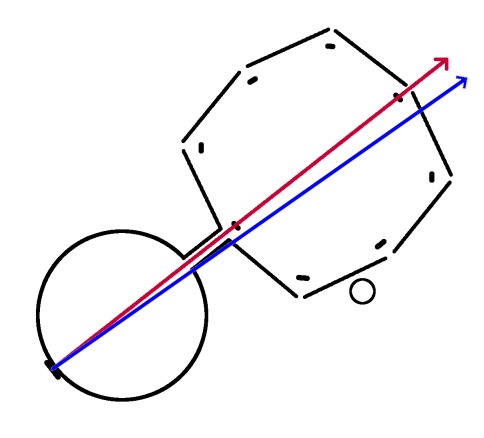
As 2024-2025 approaches, the Moonrise (7:29pm in Newark) will increasingly approach an alignment with the Newark Earthworks. The picture shows how close it is right now. Red is the alignment rediscovered by Hively & Horn, and blue is where it will rise this evening.
Also, just as for the summer solstice, at lunar "noon" (the "meridian"), the moon will be close to overhead. At 3:22am tomorrow morning, the moon will be 14.0° from being directly overhead. This is better than the sun ever does on the summer solstice (16.6°), and in 2024-2025 the moon make it to 11.5°. So, go take a look if you happen to be awake. A nearly full moon almost directly overhead should be spectacular.
12/18/2021.
The moon is full tonight at 11:36pm. Here in Ohio, the weather will probably preclude our seeing it. But tomorrow evening is the Boreal (northern) Lunistice, which acts like the summer solstice, but with the moon. And the Winter (southern) Solstice is at 10:59am on Tuesday. It is no coincidence that these are all happening so close together.
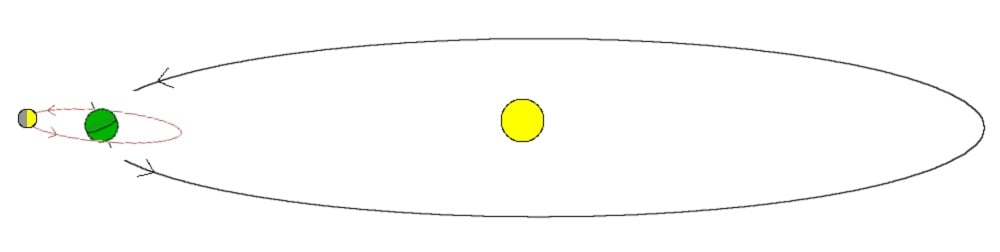
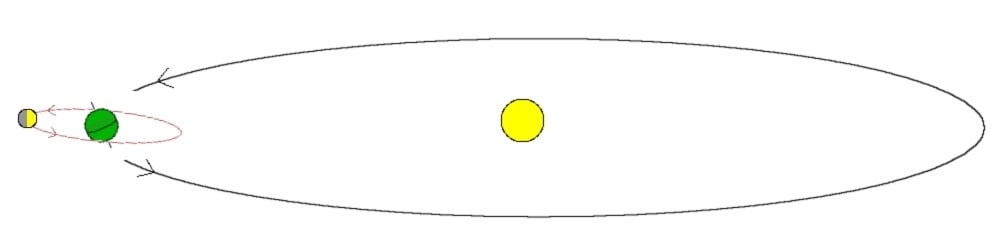
This picture shows how everything is aligned right now. Usually, when we are taught how the solstice works, we are shown that picture with just the sun and the tilted earth. But at the full moon/lunistice nearest the solstice, while the earth is tilted AWAY from the sun, it is also tilted TOWARDS the moon. So the Winter (southern) Solstice is always accompanied by a Boreal (northern) Lunistice and a full moon. (The opposite occurs at the Summer Solstice.)
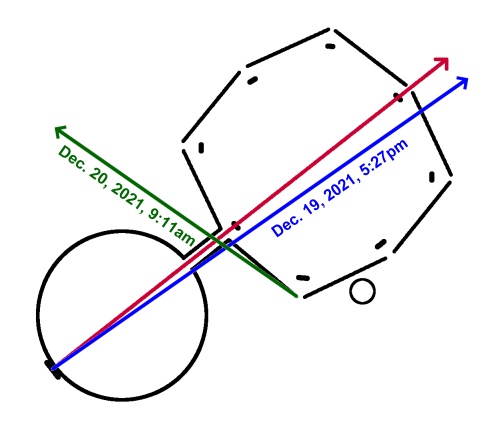
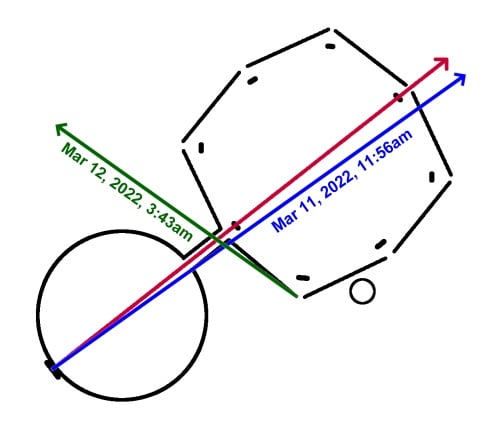
And meanwhile, while the tilt of the moon's orbit is slowly aligning with the tilt of the earth (coming in a few years to what can be called a Maximum Lunistice Standstill), the moonrise and moonset on the Lunistice are slowly aligning with the Newark Earthworks. This next picture shows how close they are getting. Red shows the perfect alignment for the northernmost moonrise. Blue shows the alignment for the rise of the moon for the lunistice tomorrow evening. Green shows the alignment (with a small cheat) for the setting of the moon the next morning. And at about 1:20am early Monday morning, the moon will be nearly directly overhead. It looks like the weather around here will be clearing enough by then to see these events.
12/19/2021.
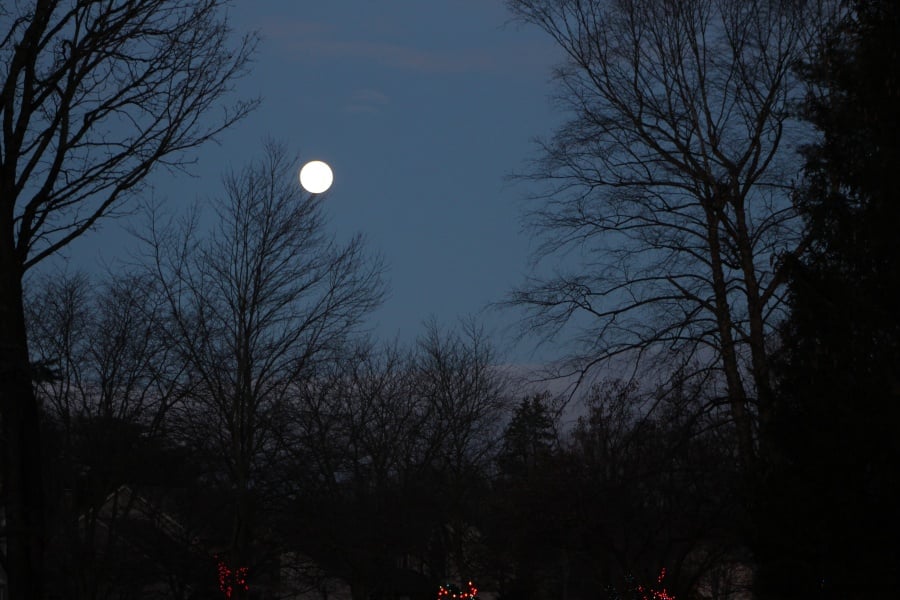
Skies cleared just in time around here for the full moon moonset. Officially, I guess this is called the "cold moon", but I think "solstice/lunistice moon" is not inappropriate.
01/15/2022.
We're at another boreal lunistice, and we'll have great weather this evening, clear in advance of the approaching snow showers. The northernmost moonrise for this one is tomorrow afternoon at 4:14pm. but this afternoon was close to that at 3:23 (so it's been up for about 2 hours as I post this). At the Newark Earthworks, that northernmost rise is very close to what I showed last month—actually, it's slightly less because when it comes to the moon, there's a wibble to its wobble on its trip north.
This evening though, we'll get the maximum meridian. At 11:16pm, the moon will be its highest in the sky in this orbit. It will get within 13.0° of being directly overhead. So if you get a chance, at 11:16 this evening, look nearly straight up at a nearly full moon. And try not to fall over backwards.
We're now at the period where, as Spring approaches, the boreal lunistice moonrises will occur earlier and earlier in the afternoon, so that in March, the moon will be rising around noon. And the boreal moonrises will continue heading north to their peak in March of 2025 (and best viewing in September 2024).
03/10/2022.
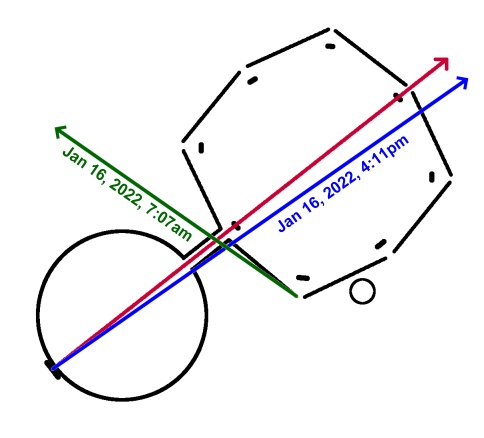
Tomorrow is another boreal lunistice, with the moonrise getting closer and closer to an alignment with the Octagon at the Newarks Earthworks. This is what Spring boreal lunistices look like: the moon rises around noon, has its meridian in the early evening, and sets early the next morning. It is always in its first quarter. However, tomorrow's weather looks pretty bad for viewing the moon (or even the streets!). This afternoon, however, is nicely clear at the moment, so if you look straight up, you should see that quarter moon nearly directly overhead. The meridian is at 7:00pm, and the moon will be within 14.2° of vertical.
I tried to watch it rise this morning around 11:10am, but that's really hard to see along a horizon with the sun nearly overhead.
If the weather had cooperated, you would have seen this moonrise. Actually, you probably would have missed the moonrise since, with the sun overhead, I've found it takes at least half an hour to be able to distinguish it from horizon haze. The peak in this lunar cycle (the 18.613 year cycle) will be on March 7, 2025. However, the best viewing will be during the previous fall.
The 18.613 year cycle and a 177 day nutation of the moon "conspire" to make the absolute peaks (kissing the Earthworks) occur during the spring and fall. You'll hit one peak, the moon will recede about a full moon width, and then hit another peak.
Along with the alignment, the moon also gets very high in the sky, even higher than the sun does on the solstice. In this picture, the moon gets up to the red line on the maximum, and only to the green line 9.31 years later. You can see we're getting close.
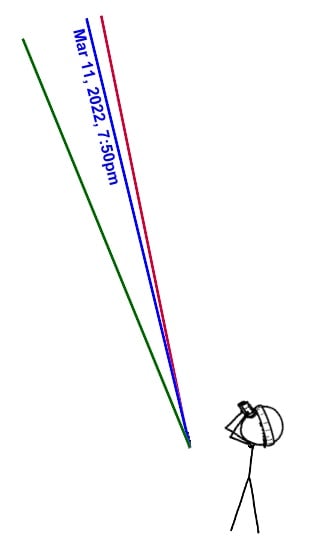
I've wondered if there might be some archaeology traces left at the Newark Earthworks in which the Hopewell would have carefully erected a near-vertical pole with the correct 11.4° tilt.
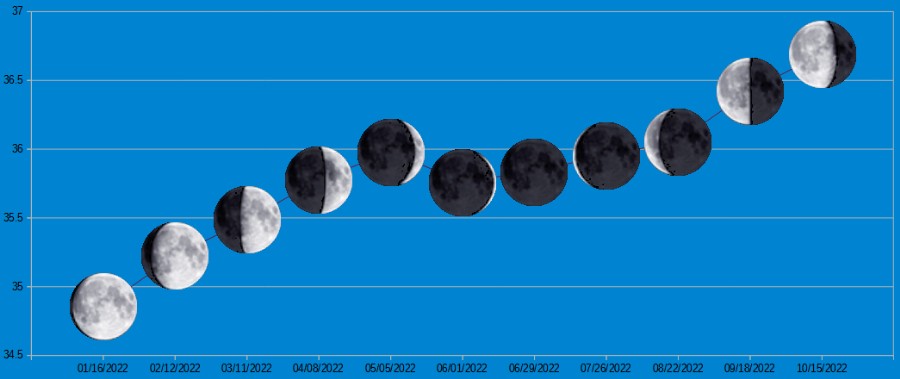
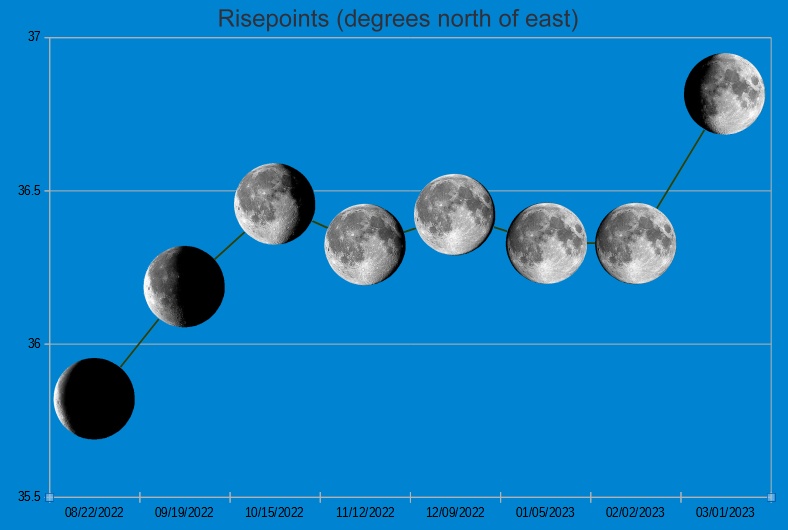
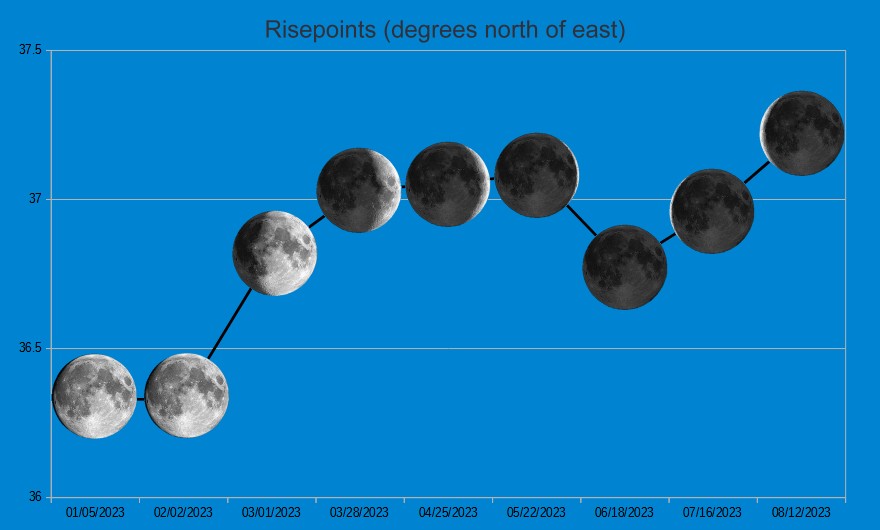
As we approach the maximum and the alignment, that 177 day nutation makes the moon on the boreal lunistices reach higher in the spring and fall, but then recede. This graph shows how far north those those boreal lunistices have been hitting around now, along with the phases of the moon for them. As you can see, the summer is not great for lunar visibility for the main alignment.
However, the Earthworks also have lesser alignments built into it. Right now, while the moonrise is around noon, the moonsets are around midnight, and nicely visible when it is not snowing. And in the summer, it is the southerly moonrises that occur with a full moon. (You may recall that, conversely, the winter moonrises had full moons.)
We'll see how the weather is come April. It'll be a lesser moon, but still a mid-day moonrise.
03/24/2022.
Tomorrow is the latest austral lunistice, which is the lunar equivalent of the winter solstice. And just like the winter solstice, the moon barely rises into the sky, and it's only up for a relatively short time. Just as the moon is aligning with the Octagon for the northernmost rise at the Major Standstill, it is also starting to align with the Octagon at the Newark Earthworks (now officially nominated to be a UNESCO World Heritage site) for the southernmost (austral) rise. Here are those austral alignments.
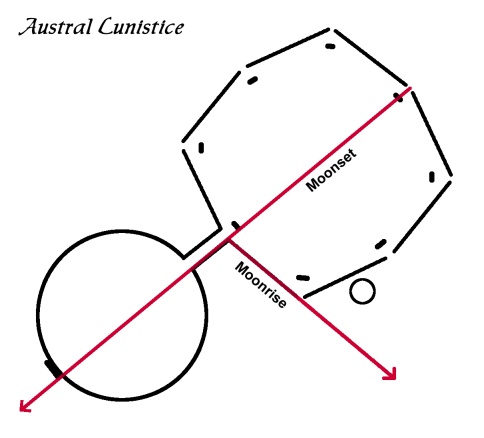
Two weeks ago we saw the boreal lunistice; the austral is almost completely the opposite. Boreal: moon rises in the middle of the day; Austral: moon rises in the middle of the night. B: moon sets in the middle of the night; A: moon sets in the middle of the day. A: moon in 1st quarter; B: moon in 3rd quarter. B: moon rises high in the sky; A: moon barely makes it into the sky. And by the way, this is how these lunistices are for a Major Standstill every time it occurs every 18.613 years.
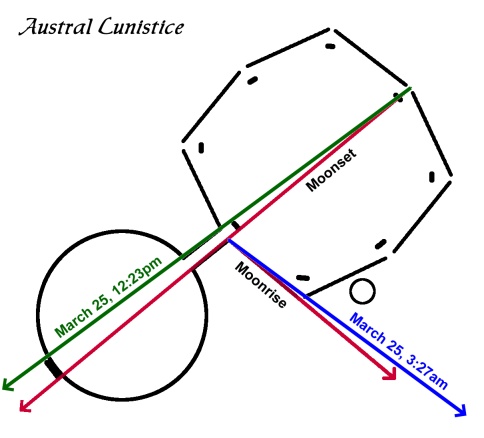
This next picture shows how close tomorrow's moonrise and moonset are getting to align with the Octagon. Unfortunately, it looks like the weather will not be cooperating—welcome to springtime in central Ohio.
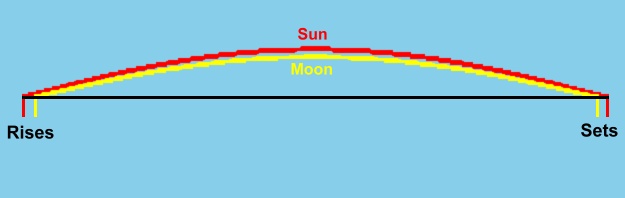
This final picture shows how, when the moon does its circuit approaching a Major Standstill, it doesn't manage to get even as high in the sky as the sun does at the winter solstice. Right now it's about 4.2° below that. At the winter solstice, the time between sunrise and sunset is 9 hours 19 minutes. Tomorrow, the time between moonrise and moonset is 8 hours 59 minutes.
04/08/2022.
Today is another boreal (northernmost) lunistice. The weather does not appear to be cooperating. However, this is a typical boreal lunistice for around the Spring equinox: the moon is in its first quarter; it rises around noon (11:37am); and the weather is often iffy. And as the boreal lunistices head toward the summer, they increasingly become closer to occurring with a new or sliver of a moon—it's the austral (southernmost) lunistices that get the nearly full moon in the summer, but they are not aligned with the main axis of the Octagon.
Since I showed you the last austral lunistice (March 25), I thought this time I'd show where the moon has been rising since then, and on to the next austral lunistice. In the video, the moonrise locations are shown for one full orbit of the moon. You can see how closely they are fitting into the "envelope" of the Newark Earthworks as the Major Standstill approaches in 2024-2025.
There are Open Houses at the Newark Earthworks on April 10 and 11 (you really should go if you get the chance). I've highlighted the mid-day moonrises for those two days. On the 11th, the moonrise happens to coincide with the moonrise leg of the Octagon for the Minor Standstill (2:35pm). If there is good weather you can get a feel for what springtime boreal moonrises look like. (Back in the Fall of 2015, for the Minor Standstill, with a near-midnight moonrise and a 3rd quarter moon, it was spectacular.)
04/10/2022.
Some pictures from today's Open House at the Newark Earthworks. While the boreal lunistice was 2 days ago, on the moon's trip back south it came close to aligning with one of the legs of the Octagon, so I have a few moon shots. I also went on the tour guided by John Low (Director of the Newark Earthworks Center) and Tim Jordan (Site Manager for Flint Ridge).
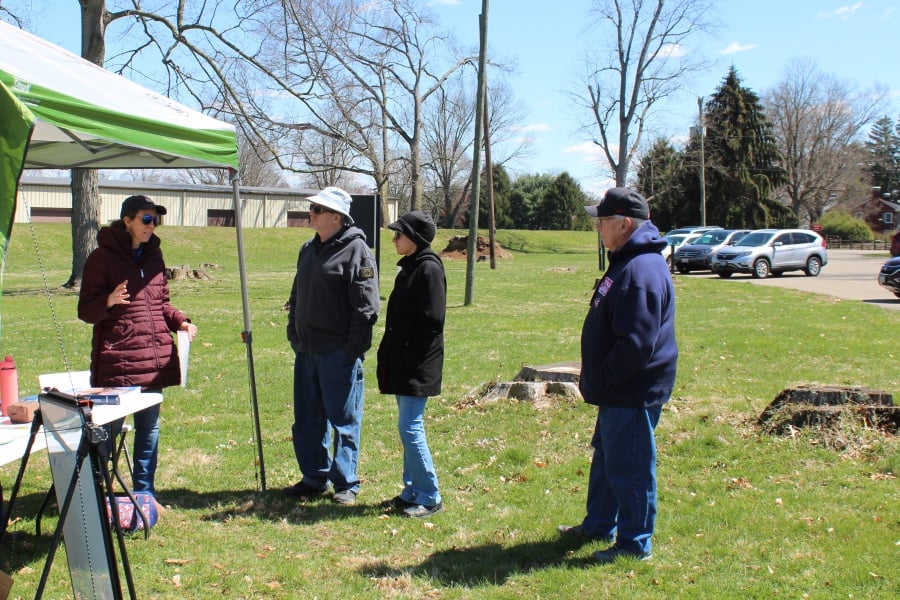
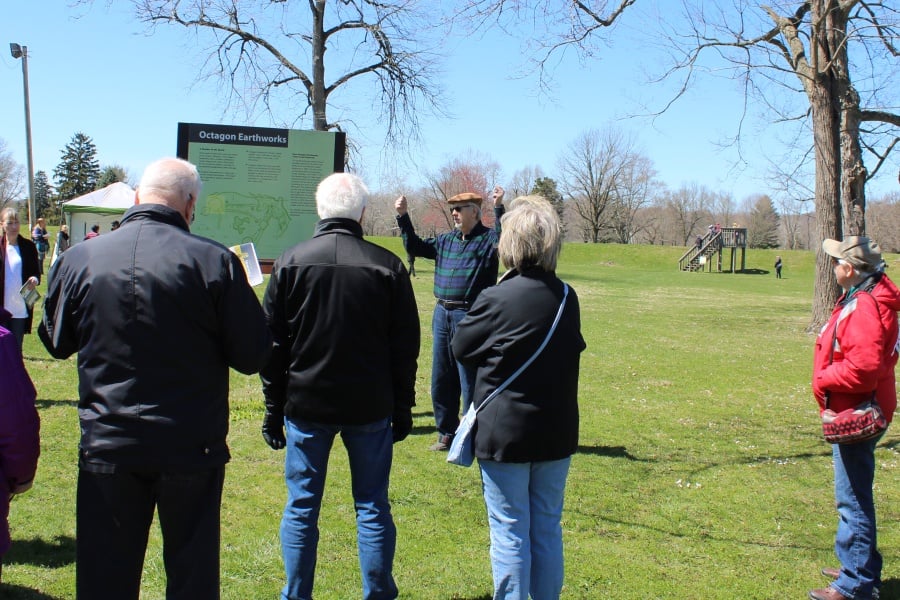
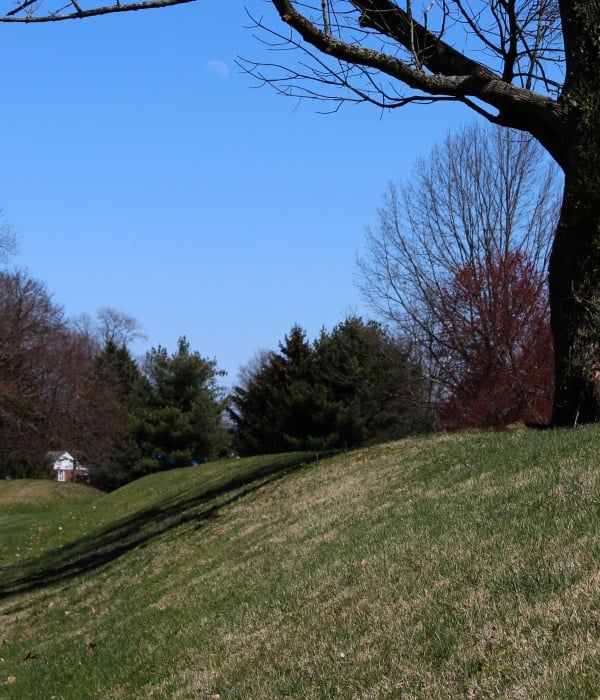
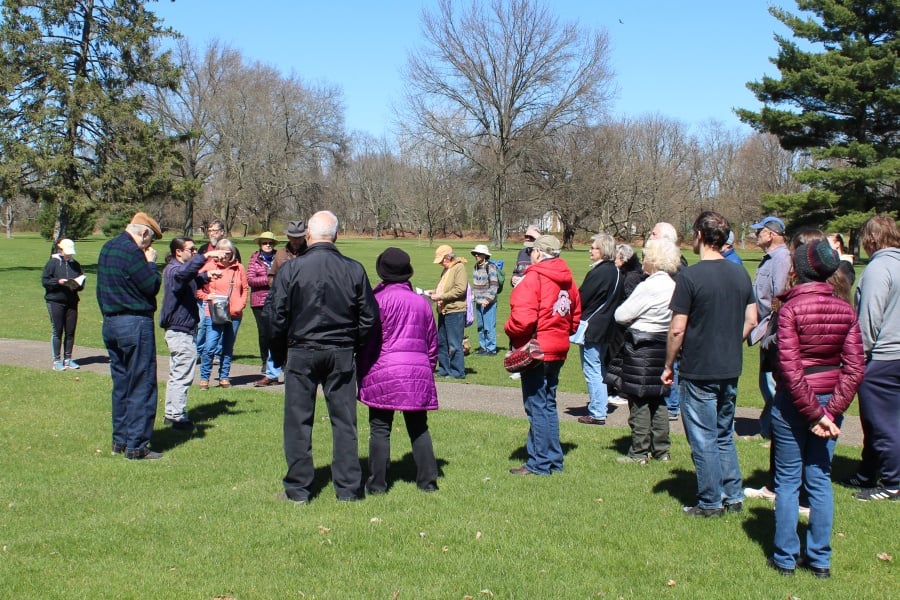
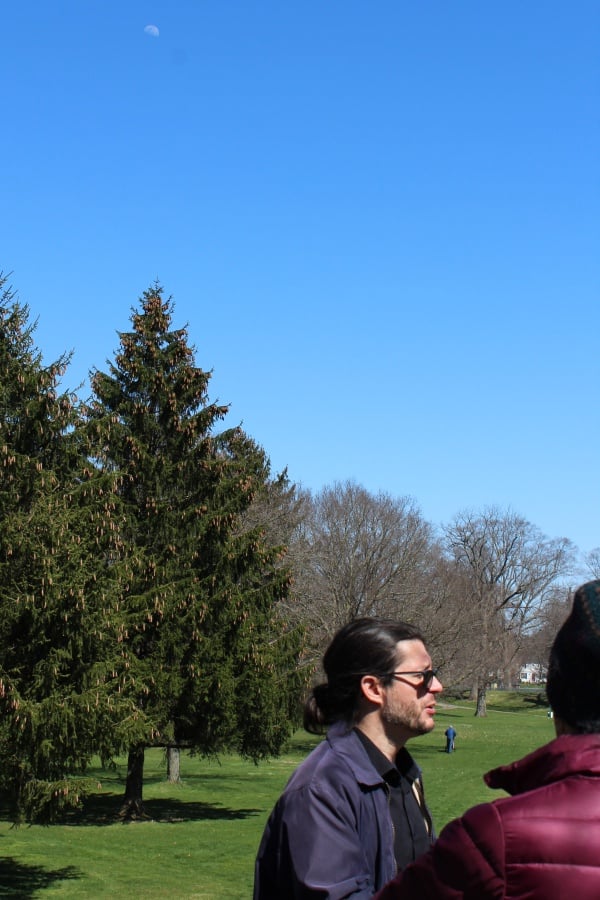
04/11/2022.
While today is also an Open House at the Octagon, the weather is, shall we say, less than ideal. So, let's look at this video, which was created using photos I took exactly 7 years ago, on April 11, 2015. It shows what boreal (northernmost) lunistice moonrises look like in the Spring around the time of the equinox. You may need to play it more than once. The moonrise always appears mid-day, as a first-quarter moon. To be fair, due to my lesser photography skills, the moon itself is more visible, and more impressive, to the naked eye than these pictures show. But they are not all that far off.
The moon seems to need to get at least 8° into the sky to be able to see it in today's citified atmosphere. I don't have a feel how how different that might have been 2,000 years ago.
OK, I cheated.
These pictures were taken around noon. But they were for a moonset along the north leg of the Octagon. I reversed them to make the moon move up, and flipped them to get the direction right. These changes mean that it is an accurate representation of what the moonrise looked like then.
Each photo was taken 40 seconds apart.
05/01/2022.
Okay, this time it's not a moonwatch; it's a sunwatch. And we move from the Octagon to the Great Circle. We are at the time of the Cross-Quarter (part of which makes May Day special), midway between the Spring Equinox and the Summer Solstice. (In Celtic culture, this is Beltaine.) As you can see, the Great Circle aligns nicely with the sunrise. Tomorrow morning (May 2) will be a great time to observe this at 6:28am. There should be about 25% cloud cover at that time. My thanks to Jeff Gill for drawing this to my attention.
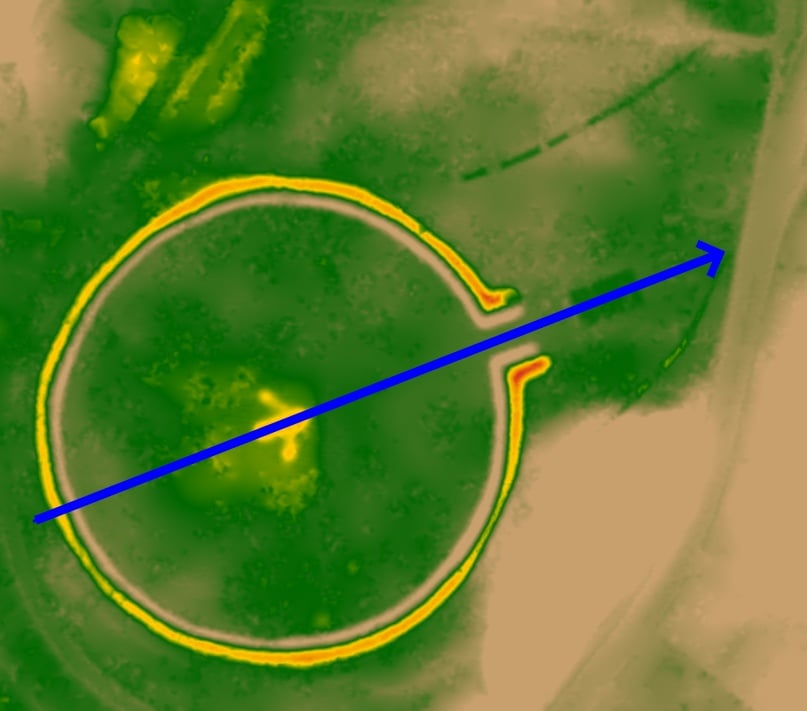
Some caveats: The actual cross-quarter (mid-time between the equinox and solstice) is actually May 5 this year, and by then this won't be a "perfect" alignment (and the weather will be lousy). Identifying the first of the months for the cross-quarters is related to some calendar lagging (see, e.g., Gregorian Calendar vs. Julian Calendar). Also, quite frankly, I was too lazy to see what the sun was doing back in the year 200-300 or so; the Earth's orbit changes its eccentricity and orientation in time. So there's some slop here.
However, I also didn't look at exactly how (and by how much) the hills in that direction affect the angle. I do know, however, that they will get the observed sunrise on the 5th closer to this angle that we will see on the 2nd. (In other words, the sun would rise on the 5th, but when it cleared the distant horizon, it would align better with this axis.)
Finally, note that this alignment has significance for all the cross-quarters (Celtic Beltaine, Lughnasad, Samhain, Imbolc). On the way back south after the summer solstice, the sunrise will pass through again on Lughnasad. And for the other two, standing at the Eagle Mound, one should see one's shadow pointing at the opening at sunset.
05/04/2022.
Tomorrow will be another boreal (northern) lunistice. As we get closer to the summer solstice, you will notice that the moon for the lunistice gets closer and closer to being a new moon. Tomorrow is 5 days past the April 30 new moon. The next boreal lunistice on June 1 will be 2 days past the full moon of May 30, and the one after that on June 29 will be 1 day past the full moon. They will all be waxing crescents with respective illuminations of 21.9%, 4.9%, and 0.5%. After then they will switch to waning crescents and occur before the new moon, not after. This kind of pattern occurs every year.
I think it is pretty clear that the Hopewell people would have been quite aware of this pattern, and the knowledge and observation would have been passed down from generation to generation (and I suggest it is quite likely that the Adena did the same). This is just not something that we in the "modern" world notice.
Moonrise will be at 9:27am. Weather forecast is for heavy cloud cover. So, today I've included a video showing how the boreal lunistices advance toward and retreat from the Octagon alignment between 2021 and 2027. You will notice that they take a fews steps and then pause, and repeat. That is a general feature due to a large nutation (wobble) with a period of 177 days. That nutation ends up aligning with the equinoxes at the Maximum Standstill, so it is at the equinoxes that the best alignments with the Octagon occur. The Hopewell, with reasonably careful observation, would have noticed this over generations, too. In the video, the size of the moon I've drawn shows the relative size of it compared to the Octagon as seen from Observatory Mound. This video runs rather slowly (nearly 2 minutes) so that you can read the dates.
This next video is a "fast" version of the previous one, so you can watch it and maybe get a feel for the pattern.
05/18/2022.
Tonight is another austral (southern) lunistice, and the moonrise is still working its way to align with the southeast leg of the Octagon in 2024-2025. The moonrise is at 12:09am tomorrow morning. The weather is common Ohio springtime weather: rainy/cloudy. (Last week was quite an exception, wasn't it?)
We're getting to the time when the austral lunistices are trying to line up with the full moon around the solstice a month from now. As you may have noticed, it just missed the full moon by 3 days. Of course, our full moon was highly noticeable as the blood moon eclipse.
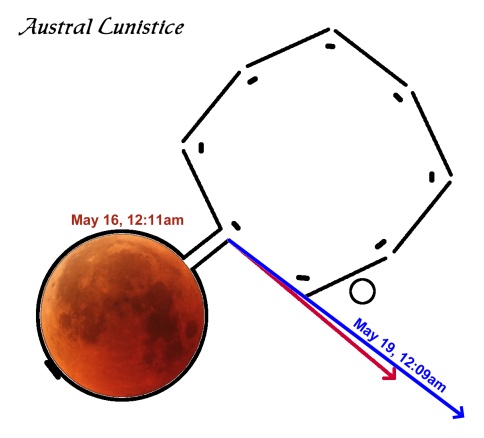
During austral lunistices (the equivalent of the winter solstice), the moon does not get very high in the sky. For this one, it's 22.9°, and that'll get even lower as we approach the 2024-2025 Major Standstill. Related to that, you may have noticed how the eclipse happened with the moon pretty low in the sky—that's because the eclipse and the lunistice were just a few days apart. The moon only made it up to 29.5° for the eclipse. While it was a "super moon" (closer to the Earth), it may also have looked even larger than usual because of the optical illusion that makes it look bigger near the horizon (or trees).
06/01/2022.
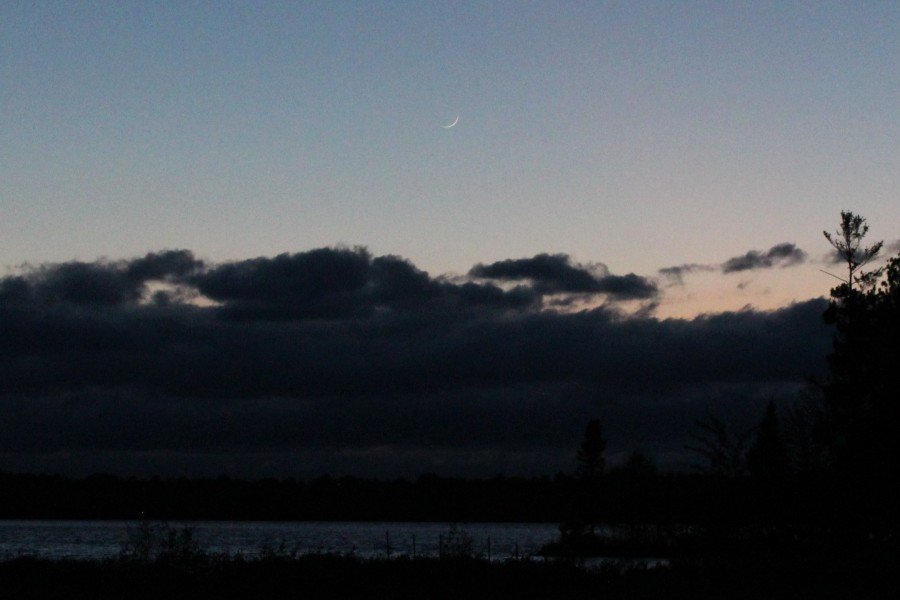
As the summer solstice approaches, boreal (northermost) lunistices occur very close to the new moon, which makes them very hard to observe. Right now, for today's lunistice, the moon is a waxing crescent moon (the new moon was on May 30), and moonset follows the sunset. However, because we are approaching the Major Lunar Standstill, the moonset for the lunistice is a bit farther north than the near-solstice sunset, by about 5°. This picture, taken over a northern Wisconsin lake, was from last evening (May 31), after sunset but with the moon about to set.
06/14/2022.
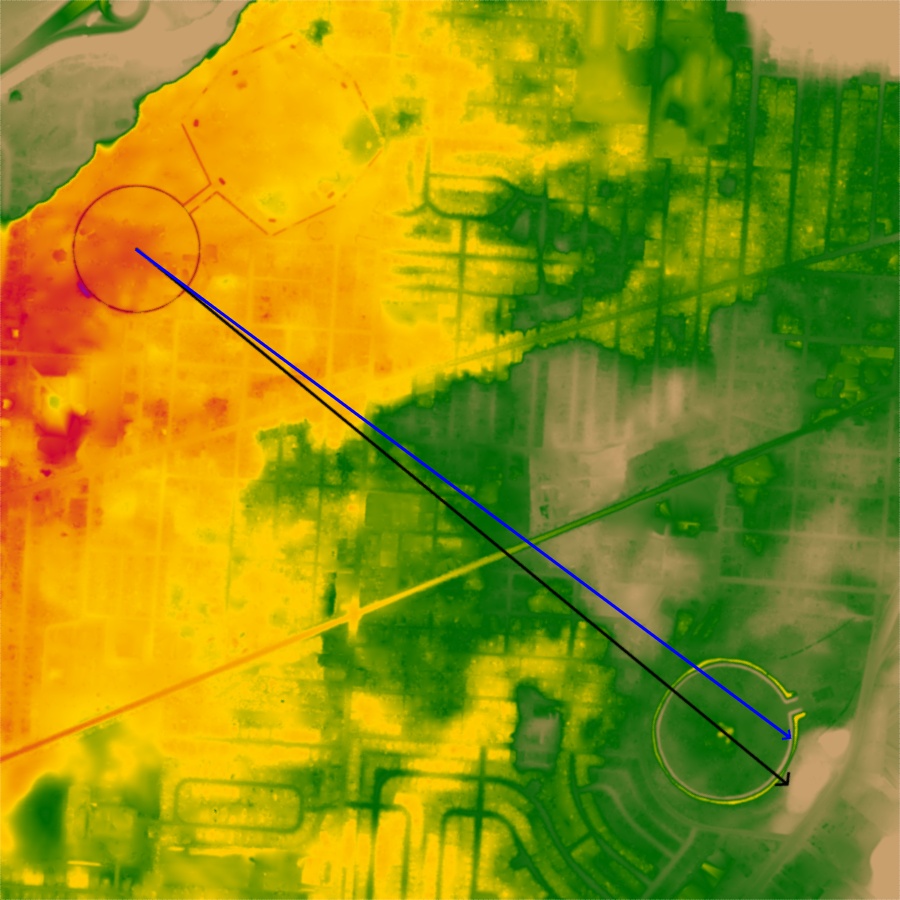
Around the summer solstice, the austral (southernmost) lunistice tries very hard to coincide with a full moon. Well, tonight, it hits it. It's a full moon, and this evening that full moon will rise at 9:47pm well in the south before heading back north again. The forecast for this evening is for clear (but hot) skies. Since this is an austral lunistice, its equivalent with the sun is the winter solstice, so at meridian (2:18am, equivalent to solar noon), the moon will only have risen quite low in the sky: 22.2°. If you hold your hands out sideways as far as possible, that's about 2 1/2 hand widths above the horizon.
As we approach the Major Standstill in 2024-2025, the austral lunistice approaches rising along the southeast leg of the Octagon. But this time, instead of showing that picture, I'll show how close it is to aligning with the arrow between the centers of the Observatory Circle at the Octagon, and the Great Circle, for it aligns with them, too.
06/28/2022.
There's really not much to see. For this boreal (northern) lunistice, nearly on top of the summer solstice, the moon is about as "new" as it can be, as it always is around the solstice. So, tomorrow morning, the sun rises at 6:03am. Then the moon rises at 6:08am, 5 minutes later. Each is rising about as far north as it can, but because we are approaching the 2024-2025 Major Standstill, the moon does so 5.3° farther north than the sun.
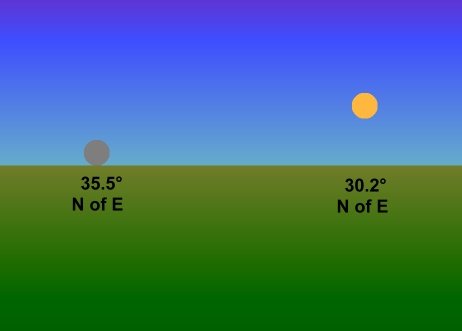
Note that, for the picture, astronomers like to use the "azimuth", with degrees measured clockwise from the north. Since we are concerned with the Newark Earthworks and the Octagon, I really prefer keeping track of how far north (or south) of east the rises occur. Additionally, the picture accurately depicts the relative widths of the sun/moon and their distance apart.
07/12/2022.
There's plenty to watch tonight. Since we are still so close to the summer solstice, the austral (southern) lunistice works really, really hard to be near the full moon, and BINGO. We have a full super moon. The moon will rise about 8:36pm this evening, and it is getting very close (as the Major Standstill of 2024-2025 approaches) to aligning with the southeast leg of the Octagon.
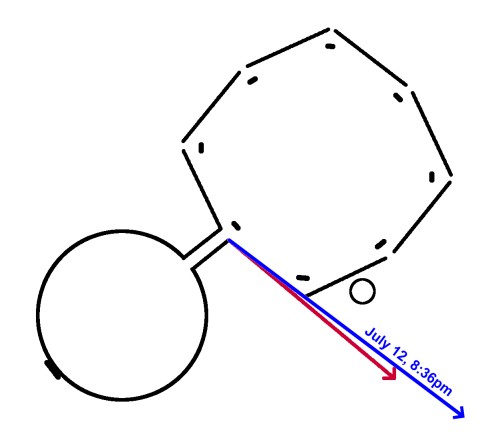
Then, at 1:02am (now the 13th) the moon will pass its meridian, due south and at its highest point in the sky. Because this is an austral lunistice (like a winter solstice, but for the moon), that will be very low, only 22.2° above the horizon. If you look at your shadow (and yes, it will be bright enough to see your shadow), that'll be 2.45 times your height.
Continuing, at 5:00am, just about the time the moon is setting, it will be at "perigee", closest to the Earth in its orbit, which is why the moon looks so large. In addition, with the moon so close to the horizon, the "Moon Illusion" effect can make the moon look even bigger than it is. If we size the moon to fit inside the Great Circle during perigee, the "apogee" moon (when it is furthest from the Earth and looks its smallest) fits inside the Observatory Circle at the Octagon.
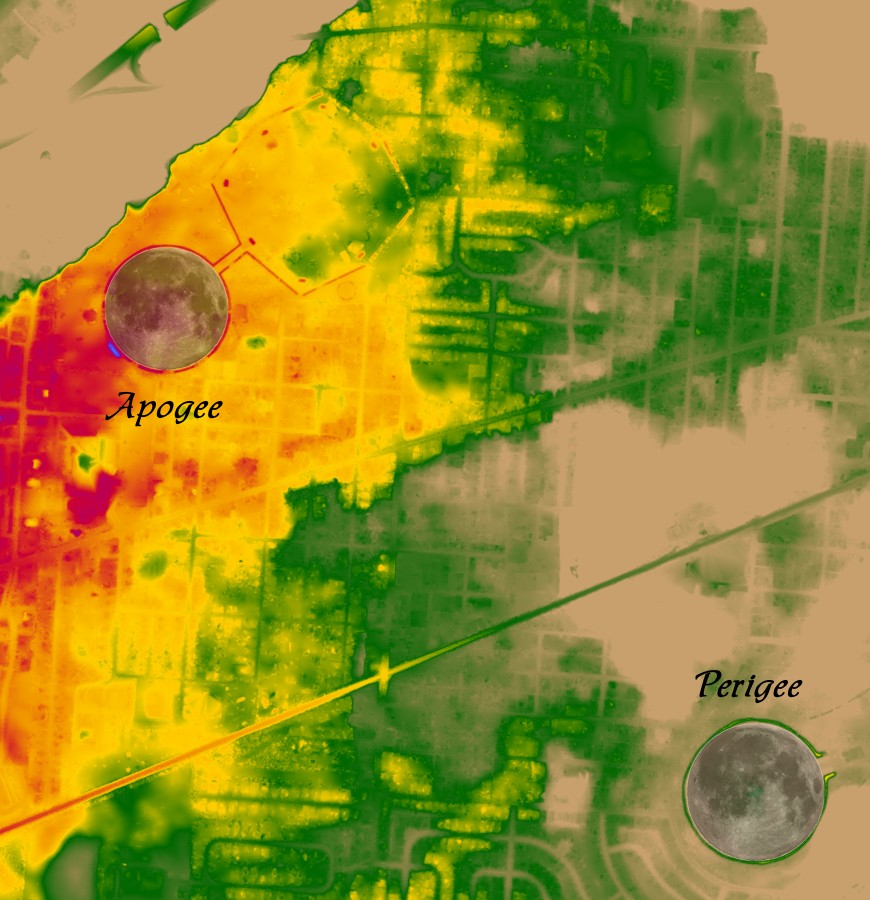
Finally, at around 2:40pm, with the moon on the other side of the Earth, it will officially turn "full".
08/06/2022.
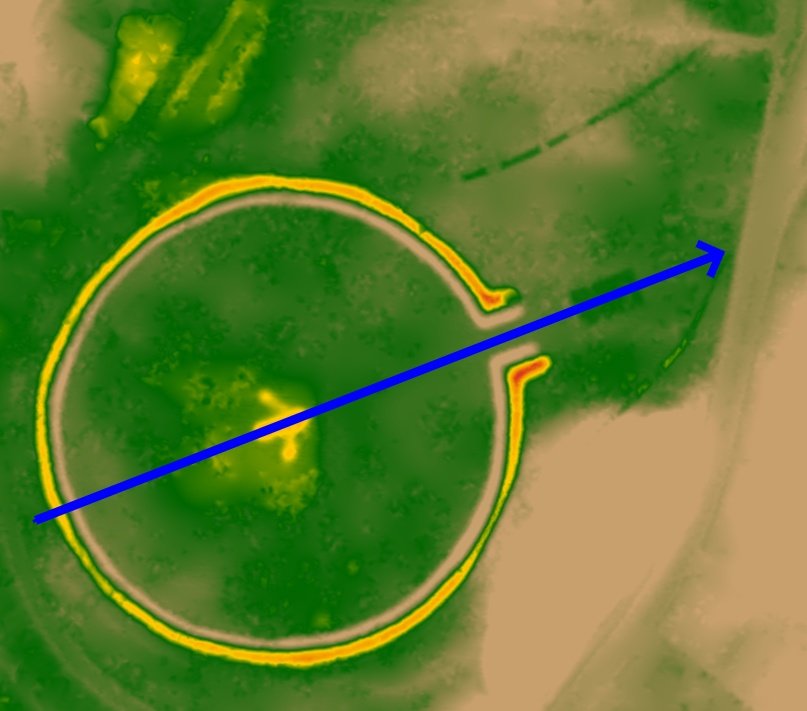
Time for another sunwatch. In early May, the sun headed north towards the summer solstice and at sunrise passed through the opening in the Great Cirlce in Newark. Well, now it's headed back south again, and it's passing through the opening again. In Celtic culture, this is called Lughnasadh.
The exact midpoint this year between the summer solstice and the upcoming fall equinox is at 1:08 EDT tomorrow morning (August 7), but the opening is wide enough to encompass a few days (and I doubt the Hopewell had the precise computer I had access to—they'd probably just count days from the solstice).
The weather right now will almost assuredly preclude being able to watch the cross-quarter sunrise.
08/07/2022.
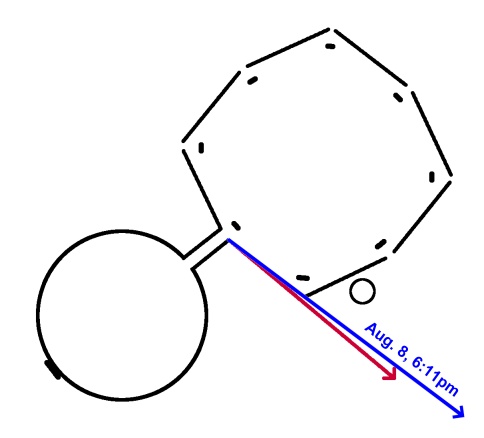
Tomorrow is the austral (southern) lunistice, when the moon rises at its southernmost point in its orbit. As we approach the Major Standstill, it is getting even closer to its maximal southernmost point, and is close to aligning with the southeast leg of the Octagon at the Newark Earthworks. It will rise at about 6:11pm.
Since the austral lunistice is the lunar equivalent of the winter solstice, the moon does not get very high in the sky, and it does not stay out for very long. There will be only 9 hours of moonshine, and it will be highest in the sky (the lunar equivalent of solar noon) at 10:41pm, reaching on 22.1° above the horizon. It will then set at 3:10am on the 9th (a southernmost moonset).
Since we are now well past the summer solstice, the austral lunistice is no longer occurring near a full moon, but will we will instead have a waxing gibbous moon. The full moon isn't until the 11th. As we move towards the fall equinox, the austral lunistice will be happening earlier and earlier in the afternoon, and the more spectacular lunistice will be the boreal (northern) lunistice, in which the moon rises after dark
08/21/2022.
We are now at the time of the year when the boreal (northern) lunistice has moonrises that appear in the middle of the night with the moon in the first quarter. Pretty obviously, these are the easiest to see and they have the potential for being more spectacular. When the weather cooperates. Which is does not look like it will do tonight. Anyways, as we approach the Major Standstill of 2024/2025, the moon is rising closer and closer to an alignment with the Octagon at the Newark Earthworks. It will rise early on the morning of August 22 at 2:02am about 2.4° away from alignment. This picture shows how close the alignment is right now.
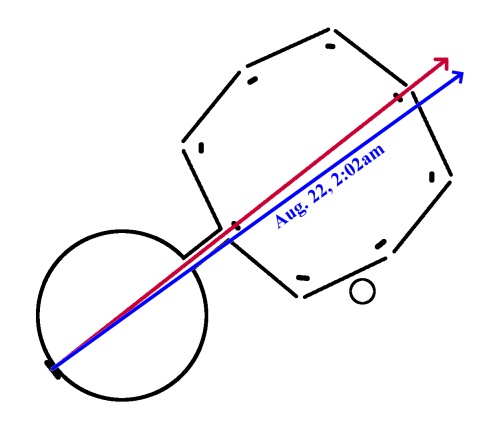
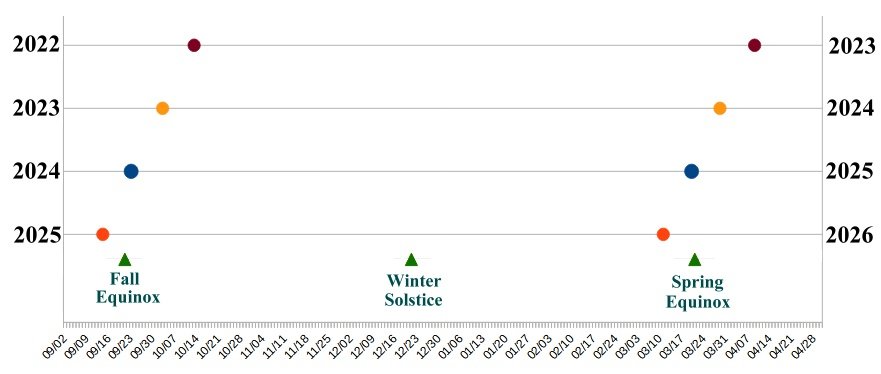
This is also the time of year (getting near the equinoxes) during the approach of the Major Standstill, when the "northern bumps" are "trying" to align the equinoxes and the Major Standstill. The "northern bumps" are the result of a nutation (wobble) of the Earth that makes a moonrise occur at a slightly (about half a moon width) more northern location than it otherwise would. Their timing ensures that the northernmost moonrises always occur pretty close to the spring or fall equinoxes (despite the Standstill having an 18.6-year cycle). The spring equinox northernmost moonrise is hard to see (with a mid-day rise), while the fall equinox northernmost moonrise is easy to see (with a late-night rise). Depending on Ohio weather, of course.
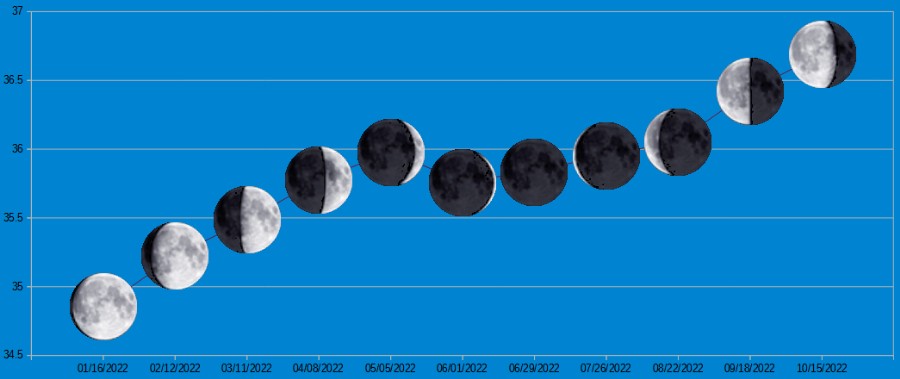
The next picture shows when the "northern bumps" will be occurring over the next few years. You can see how they approach the equinoxes, and how close they get to lining up during the 2024/2025 Major Standstill.
09/04/2022.
This is the time of the year, around the fall equinox, when the boreal (northernmost) lunistice comes to the fore: we have a 3rd quarter moon that rises in the northeast near midnight and goes high in the sky. But that's not what we have right now, with an austral (southernmost) lunistice, which is pretty much the opposite in so many ways: it's a 1st quarter moon that rises in the southeast in the middle of the day (about 4:00 this afternoon, and about 5:00 tomorrow afternoon) and only makes it about 22° above the horizon. But that also means that the moonSET happens during the night, at 12:57am tomorrow morning.
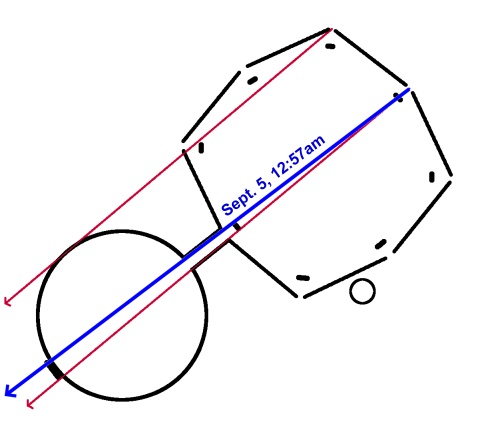
The Octagon is "aimed" at the northernmost moonrises. As Jeff Gill has put it, it's sitting there saying, "Look that way!". However, as we approach the Major Standstill of 2024-2025, the austral lunistices get pretty close to aligning for moonsets in the opposite direction (it's opposite day, right?). Hively & Horn show two different alignments (one in their 1982 paper, the other in their 2013 paper). The picture shows the H&H alignments (in red), and how close it has gotten so far (blue). Unfortunately, the weather is unlikely to cooperate, though two and three nights ago, as the austral lunistice approached, there were some really nice late night moonsets in the southwest.
09/17/2022.
This is an important time of the year for the approach of the moon's risepoints to alignment at the Newark Earthworks.
First, it is ALWAYS true that the boreal lunistice around the time of the fall equinox happens with a 3rd quarter moon that rises in the middle of the night. For this one, that's at 12:41am the morning of the 19th. These are the most visible, since they occur with maximum darkness. Here we can see how close to alignment the moon and Octagon are right now.
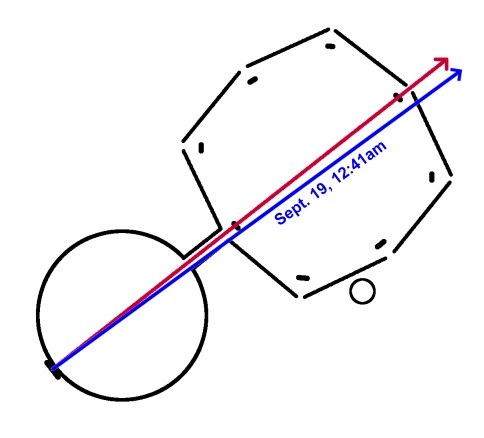
Second, as we approach the Major Standstill in 2024-2025, the moon is working on aligning its maximums during the lunistice to the equinoxes. That means that, with the Major Standstill being 2 years away, the moon's risepoints jump farther north around now, and then rest for a while before jumping again as the next equinox (spring) approaches.
10/02/2022.
Today (Oct. 2) is the austral lunistice. As usual around the autumnal equinox, we have a 1st quarter moon, the moonrise occurs in the middle of the day (2:58pm) and the moonset occurs in the middle of the night (11:52pm).
But today I want to talk about something else.
One of the things Hively & Horn mentioned (in passing) in their original 1982 paper was that the area of the Observatory Circle is the same as the area of Wright Square.
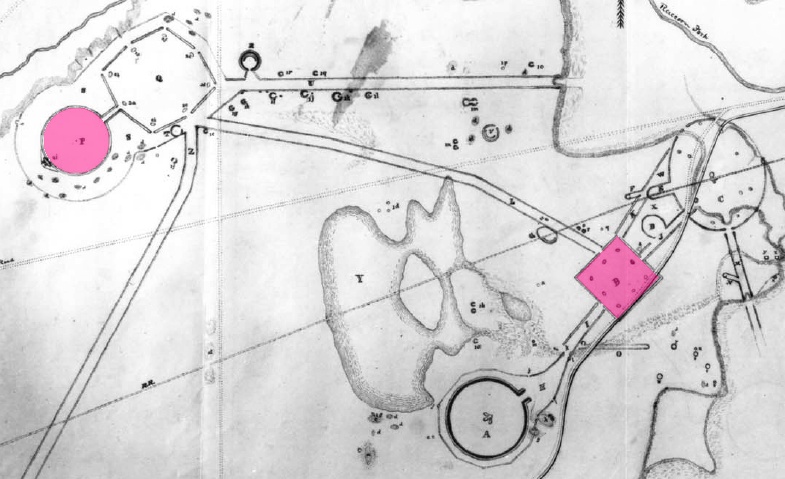
So, I thought I'd go over a possible way the Hopewell could have been able to do the construction. Clearly they had great engineering skills, not only in constructing earthworks, but also in their daily use buildings. It is also clear that they were experts on circles, right angles, and squares.
I suspect that one of the techniques used in making the large earthwork circles was that they had good, non-stretching rope (maybe twisted vines, or basket-woven reeds?). You put a stake in the middle, attach the rope, stretch it out, and move in a circle. But to do that with a 527 foot (the radius of the Observatory Circle) rope makes it even more impressive.
But would they have had the mathematical skills to know the area of a circle?
I don't see why not. This picture shows an "easy" way to find out the area of a circle.
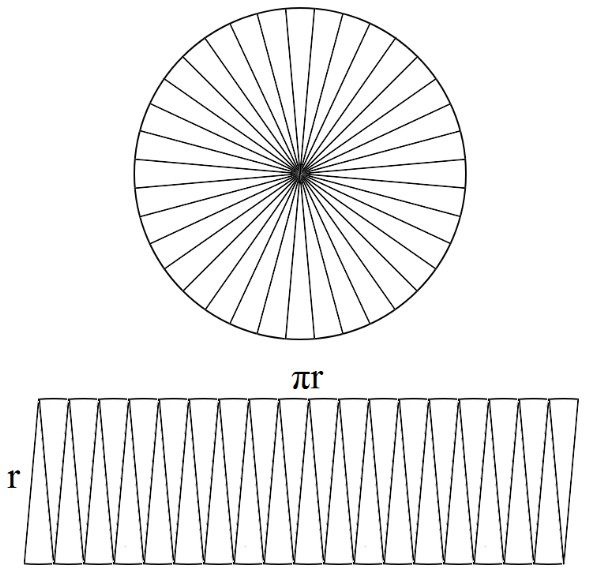
If you cut the circle into a bunch of equal wedges, those wedges can be rearranged to approximate a rectangle. And the narrower the wedge (the beginnings of CALCULUS!), the better the approximation. While they would not have used the letter π as half the circumference, they would have had some way of expressing and manipulating the concept. (After all, our modern algebraic notation is only a few hundred years old.) Thus, they would have known the area as (πr)*(r) = πr².
And the way they could have gotten π itself would be to use an "engineering" method—just measure it. Run their rope around the edge of their circle and they have it.
Next all they'd have to do was take the square root of π.
With their knowledge of triangles and right angles, this would be easier than it might look. This construction shows how to figure out the square root, and how to create the square with the correct area.
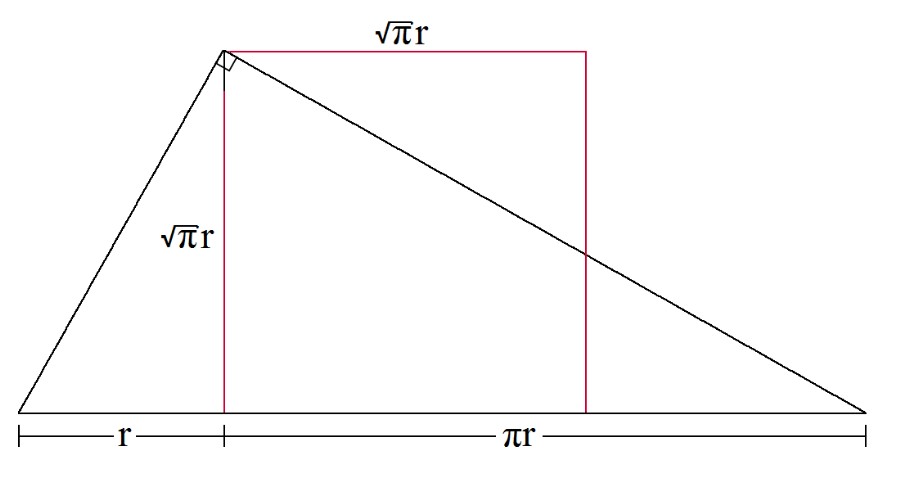
You need to know right angles, you need to know about similar triangles (triangle with the same angles), you need to know how they scale, and you need to see all the similar triangles in the diagream. The Greeks did their geometry with their ruler and compass. All the Hopewell needed were their stakes and ropes, and their knowledge.
Cultures around the world have figured this out—there is no reason the Hopewell could not have done similarly.
10/09/2022.
Usually I talk about the lunistices, which are the lunar equivalent of the solstices. But what about the equinoxes? What are their equivalent with the moon? They are called the "ascending nodes" (from south to north) and the "descending nodes", from north to south. The latest ascending node occurred yesterday, with the moon rising about 2.5° south of east around 6:45pm and setting this morning about 1.7° north of west at around 7:07am. With the sun, it rises and sets nearly due east and west, but with the moon, the period between lunistices is so short (27⅓ days) that is has a lot of degrees to make up from day to day, hence the 4.2° right now between moonrise and moonset. Hively & Horn suspect that the tilt of Wright Square off of true north is a reflection of this difference. I'm not completely convinced.
The ascending nodes that occur around the fall equinox "try" really hard to be close to a full moon, year after year. ("Try" means that the relative configurations of the sun and the moon means they will be quite close to each other—the only reason they are not perfect is because the yearly and monthly periods are not commensurable.) Anyays, this morning was the full moon (so for this one, "try" meant "hit"), and it was really spectacular last night with beautiful clear skies.
PS. That planet near the full moon right now is Jupiter.
10/13/2022.
It's a big weekend coming up. The Newark Earthworks is having a huge Open House. There are activties at both the Great Circle, the Octagon, and places in between. Here are links to them: A Walking Tour of the Newark Earthworks; Newark Earthworks Open House, October 16, 2022.
First up is a walking tour of the "hidden" Newark Earthworks on Saturday. Starting at the Great Circle, Jeff Gill will show you some of the less obvious remnants of the original 4½ square mile Newark Earthworks. On Sunday is the Open House for the Octagon. There will be talks and tours at both the Octagon and the Great Circle.
Better yet, the weekend coincides with the boreal (northern) lunistice.
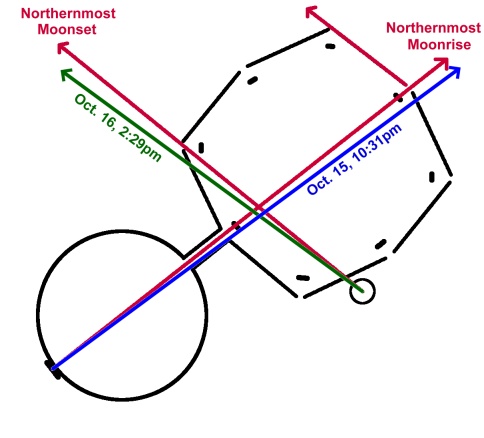
The moonrise occurs at 10:31pm Saturday night, officially before the Open House. Unfortunately, the Golf Course had not granted access for that. This is one reason they need to leave.
The moonset occurs at 2:39pm during the Open House. Of course, that is during the day so it's not clear just how much of the moonset we'll be able to see. Current weather forecast calls for about 35% cloud cover, so this is worth looking out for, starting at around 1:00pm.
There is one other event, at 6:31 in the morning on Sunday, when the moon will pass the meridian (be its highest in the sky). This is like the sun being nearly overhead during the solstice, but with the moon at the lunistice. The moon will be even higher in the sky than the sun for the solstice. For the solstice, a 6-foot person would cast a 21½ inch shadow. Early on the 16th, a 6-foot person will cast a 16⅓ inch shadow, and while astronomical twilight will have just started, it should be dark enough, and the moon bright enough (3rd quarter) to see your lunar shadow. Even if you cannot make it to the Octagon for this, you can step outside at home to observe it.
10/15/2022.
After going along on Jeff Gill's tour (see previous entry), I headed over to the Octagon for the 1:35pm moonset occurring within 3° of one of it legs. The sky was nicely clear. In these two pictures, you can see the long mound, pointing towards the moonset, to the right. The pictures were taken about 20 minutes apart with the second picture taken around 1:00pm. I enhanced the heck out of them, because the moon does not show up well against a lit sky. Also, in the second picture, the moon really started to blend in with the schmutz of the horizon.
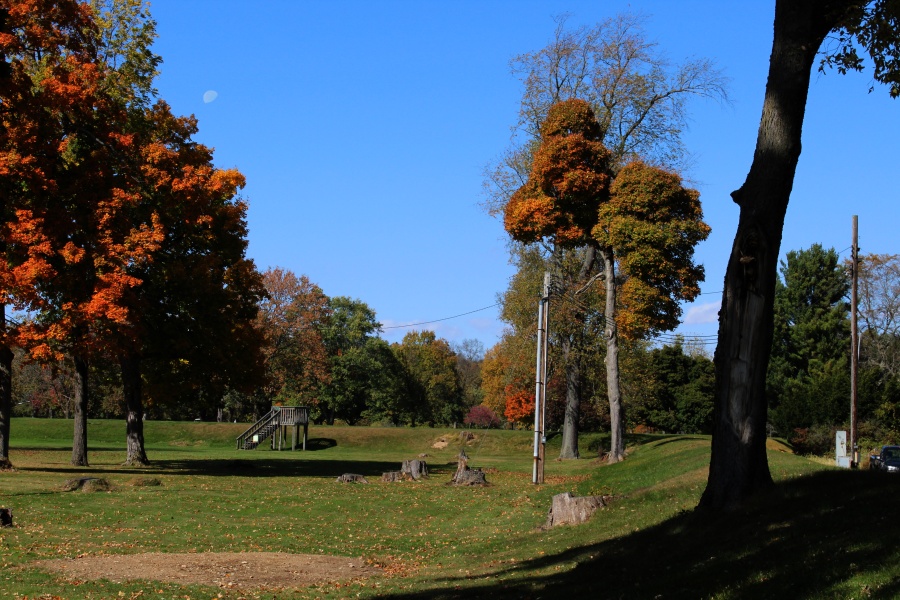
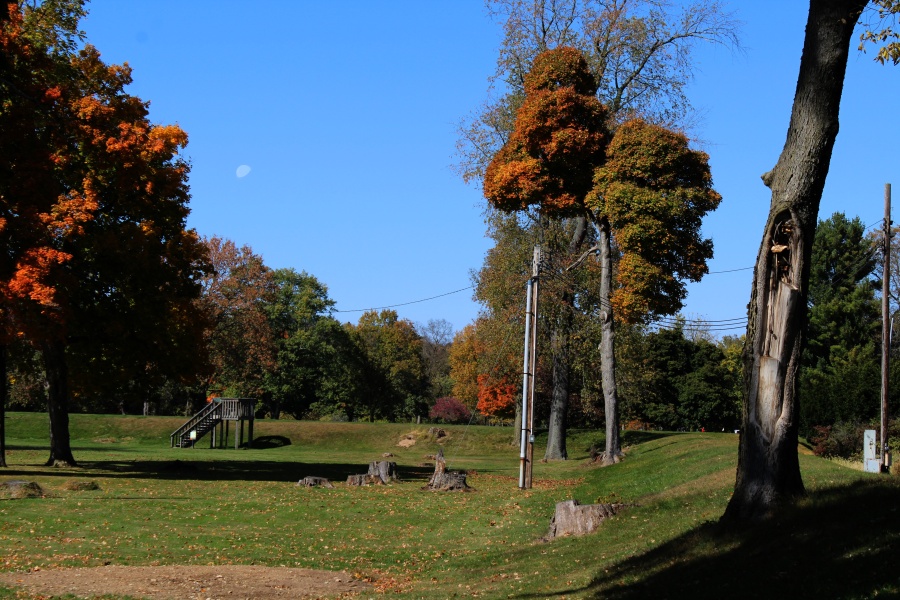
This is similar to what you should see at the Octagon Open House tomorrow (the 16th), except with a 2:30pm moonset. And your naked eyes will do much better than my camera.
11/07/2022.
Everybody loves a full moon. And we have one that rises tonight at 5:00pm, called either the Beaver Moon or the Frost Moon. But better than that, we also have a total lunar eclipse. That will start at 3:02am tomorrow (with the moon 33° above the horizon), and totality will start 5:16am (with the moon 21° above the horizon). The maximum will be at 5:58am (with the moon 13° above the horizon). Totality will end at 6:43am, but then the moon will set at 7:14am, so we won't see the end of its partiality. With the eclipse being so close to sunrise, I expect the moon will be quite red from all the sunlight diffusing through the atmosphere and illuminating it.
We are now approaching the time (the winter solstice) when the boreal (northern) lunistice starts to line up with the full moon. We can see that here, since the next lunistice is just 4 days after the full moon, on the 11th (and 12th—tune in next time to find out what that's all about).
This picture shows how, every year, whether there is a Standstill or not, the winter solstice and boreal lunistice try really hard to coincide with a full moon. For the winter solstice, the earth has to point away from the sun; but for a boreal lunistice, the earth has to point towards the moon. That means that the moon has to be very close to being a full moon.
This seasonal harmonization is something that the indigenous people of the Octagon would have been quite familiar with.
11/11/2022.
Everybody loves a full moon. We're only three days past the (spectacular, total eclipse) full moon, and right now we're getting a twin moonrise alignment for the boreal (northern) lunistice. The nearly full moon will rise at its most northerly spot this cycle both this evening (at 7:23pm) and tomorrow evening (8:14pm).
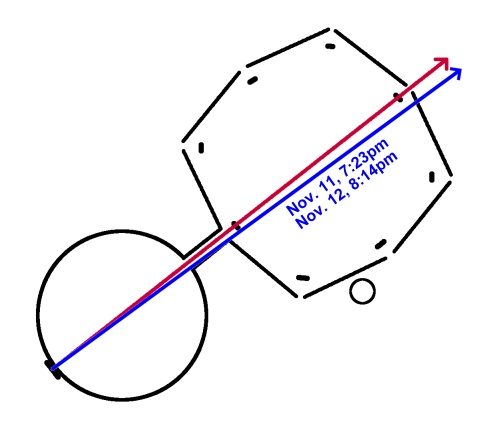
The moonrise will be only 2° (four moon widths) from the maximum risepoint of the coming Major Standstill. And when the moon is overhead at 3:21am tomorrow morning, it will be only 12.8° from being directly above us. If you are 6 feet tall, your moonshadow will be only 16⅓ inches.
Let me explain what is going on with the twin moonrises. The path of the moon across the sky is continuous. However, moonrises occur at discrete spots along that path. This means that how far north maximum moonrises occur depends precisely on their timing in the moon's orbit.
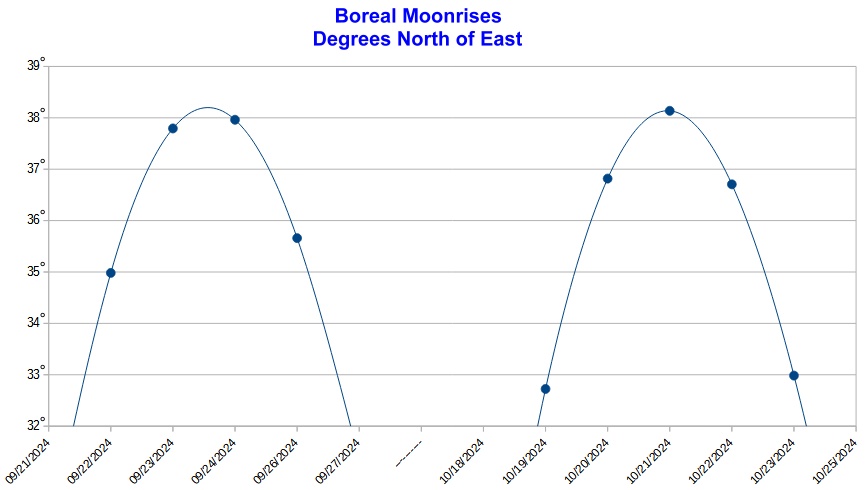
On the right side, the maximum moonrise happens to occur right near the peak (the true lunistice) of the orbit, so it is farther north than the moonrises on the left side, which manage to straddle the peak (even though that peak is slightly higher than the peak on the right side). The left-hand side looks like what is happening today and tomorrow. That is ALSO what is happening during the Fall of the 2024/2025 Major Standstill (which is what the picture is about). The peak occurs at the Fall Equinox with twin moonrises, but the higher moonrise occurs a month later.
One nice thing about twin lunistice moonrises is that you have a second shot at cooperative weather. (But not this time—bad weather both days.)
12/01/2021.
So, tomorrow the moon passes through its ascending node, more or less when it moves from the southern hemisphere into the northern hemisphere. It's the lunar equivalent of the spring equinox. In their 1982 paper that laid out their discovery of the lunar alignments of the Octagon, Hively and Horn speculated that Wright Square is slightly rotated (by about 3°) in observance of the ascending node.
This is what Hively and Horn say: "The diagonal of the Square also has a possible lunar significance. As the rising point of the Moon moves from south to north during the monthly cycle, there is a unique azimuth for which the moon can be observed to rise and set on the same day in opposite direction along the same line. Due to the Moon's rapid apparent motion this azimuth is not 90° as it is for the Sun at the equinoxes; rather for the Moon it is 92.0°. The azimuth of [the center axis] is 92.8°. Thus, an observer could identify the midpoint of the monthly lunar cycle by noting the day when the rising and setting of the Moon most nearly occurred along the [center axis]. The fact that the rising and setting point of the Moon defined a straight line through the observer in this direction may well have had a special significance for the Hopewell, considering their obvious preoccupation with linear geometric figures."
Let me explain what that means. You might think that, on the equinoxes, the sun rises and sets directly aligned with east and west. Well, not quite. You see, as summer approaches, the sun's rise point is moving farther north every day. At the spring equinox, it moves the most, by around half a degree. That means that the most accurate the equinox can be is that half a degree. And the sunset splits the difference, so it will be a quarter of a degree from being exactly opposite of the sunrise.
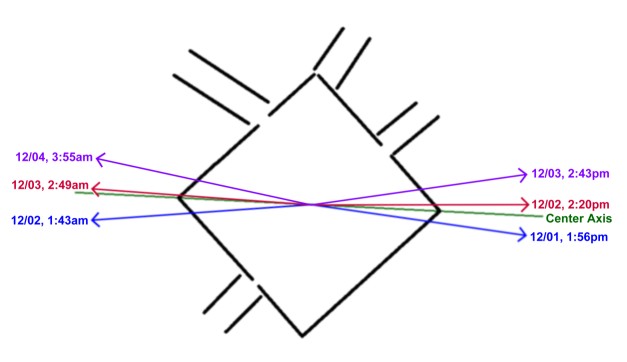
However, the moon does its full orbit in only 27⅓ days, so when the moon's rise crosses the equator, it has a lot more real estate it has to take up. And the moonset is pretty noticeably not directly opposite the previous moonrise. This picture shows Wright Square, from old maps, and how its centerline (green) is not due east/west. I've also shown three days of moonrises (from the east) and moonsets (to the west) right about now. I've color-coded the pairs of moonrises/moonsets.
In a footnote, Hively and Horn add: "Due to variations in the Moon's apparent speed and in the orientation of the Moon's orbit, the precise value of this azimuth varies by ±0.3° about an average of 92.0°".
I find a much more complicated motion than they suggest. As far as I can tell, these moonrises and moonsets are just as subject to large swings as the northern and southern risepoints during lunistices and the Major and Minor Standstills. (I fear H&H may not have looked at the moon's motion over long enough time frame.)
This picture shows the difference in the angle between the eastern moonrise and the western sunset during the ascending node over a two-hundred year period, between the years 100 A.D. and 300 A.D. Pretty busy, eh? I've highlighted that tilt (~3°) of the center axis in red.
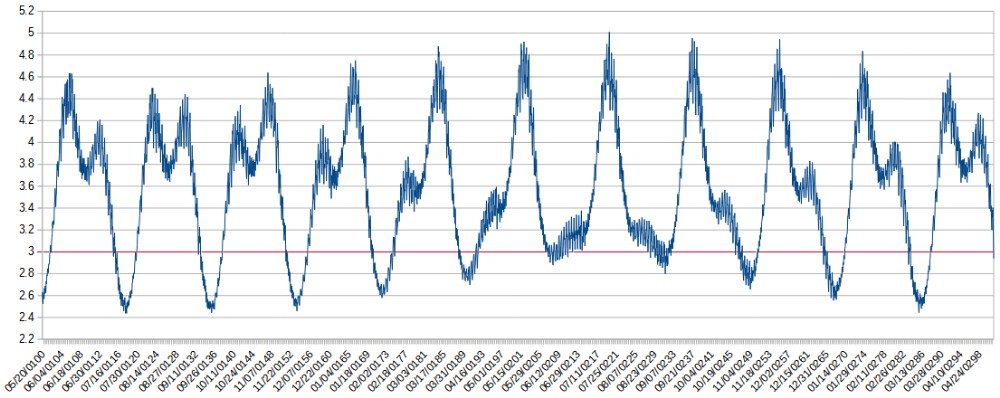
That main cycle you are seeing is the 18.61 year cycle that shows up during the Major and Minor Standstills. We can see that the difference between the moonrise and moonset angles can be as high as 5°, and the peaks occur during the Major Standstill. What's the reason for this? Well, during the lunistices of the Major Standstill, the moon rises (and sets) farther north and south than usual. And to make up all that extra territory, it has to be going faster as it crosses the equator. Really.
You'll also notice a fairly large secondary cycle of 8.85 years. (This barely shows up during the lunistices.) It is related to the eccentricity of the moon. You may recall that the orbit of the moon is an ellipse, so that sometimes the moon is much closer to the earth (a super moon) and other times it is farther away. Not only that, but because of the Kepler's law, when the moon is closer, it is traveling faster, and slower when farther away. The axis of this ellipse rotates with a period of 8.85 years. That means that when the fast part of its orbit aligns with the timing of the ascending/descending nodes, you'll get a larger angle between the moonrise and moonset.
The comb-like peaks come from the standard 177.84 day nutation that makes the Major and Minor Standstills align with the equinoxes.
Finally, I happened to be out walking the dog about 3:00 this afternoon. True to the first picture, the moon had recently arisen just a bit south of east. So my third picture is the rising moon over the old Ohio & Erie canal.
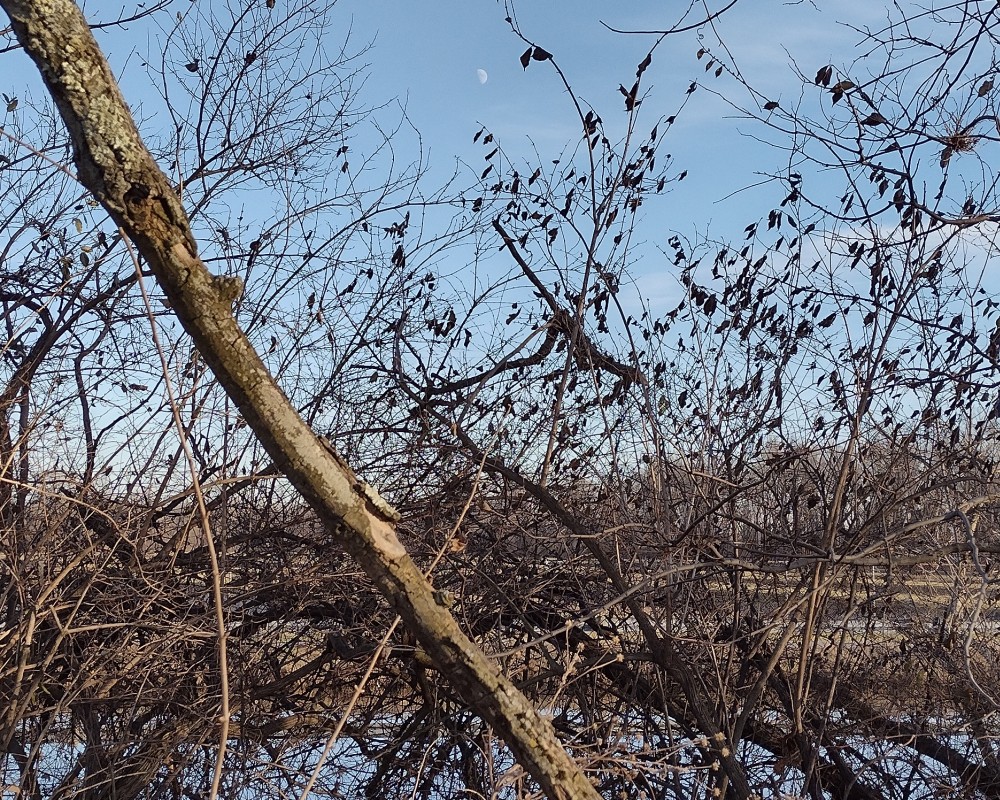
This time of year, the ascending node moonrise will always be during the daytime, the moonset will always be late night, and the moon will be in its first quarter.
12/07/2022.
Everybody loves a full moon, and today's full moon rises at 4:35pm. Two days later, on the 9th, the just-past-full moon will rise nearly aligned with the Octagon. It'll be about 3.5 moon-widths from the maximum alignment and will rise at 6:06pm. Unfortunately, it's December in Ohio, and those moonrises will be obscured by rainy mist, so I'm not even going to bother to include a picture of the Octagon.
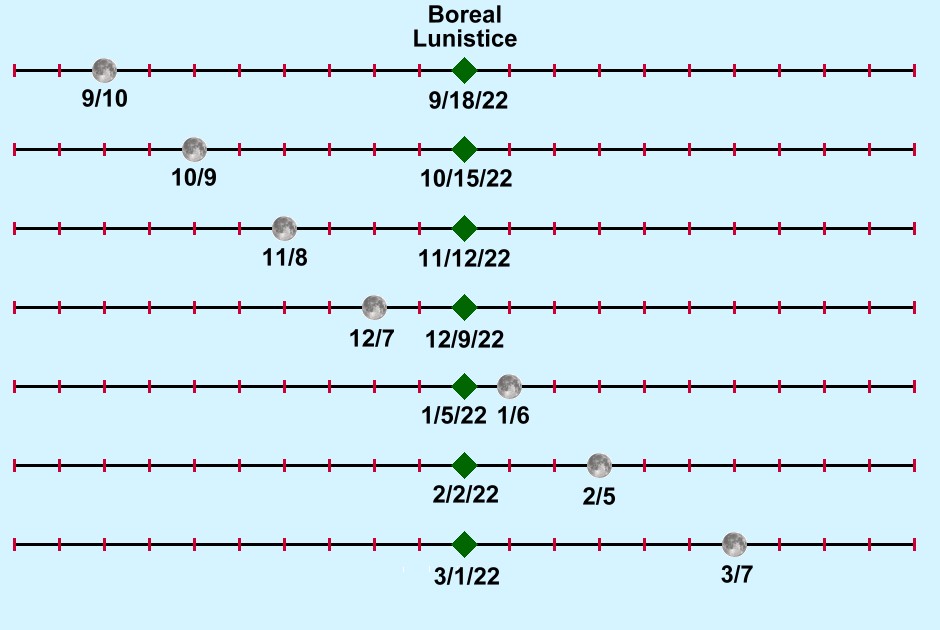
As I've said before, around the winter solstice (2 weeks!), the boreal (northern) lunistice "tries" to occur with a full moon. What does that mean? Well, take a look at this picture. It shows when the full moon occurs in relation to the boreal lunistice around now. The only reason they don't match exactly is because they are discrete events. Yes, occasionally (<ahem>, next year, <ahem>) they happen on the same day. You ought to notice that the cross-over point is at the solstice.
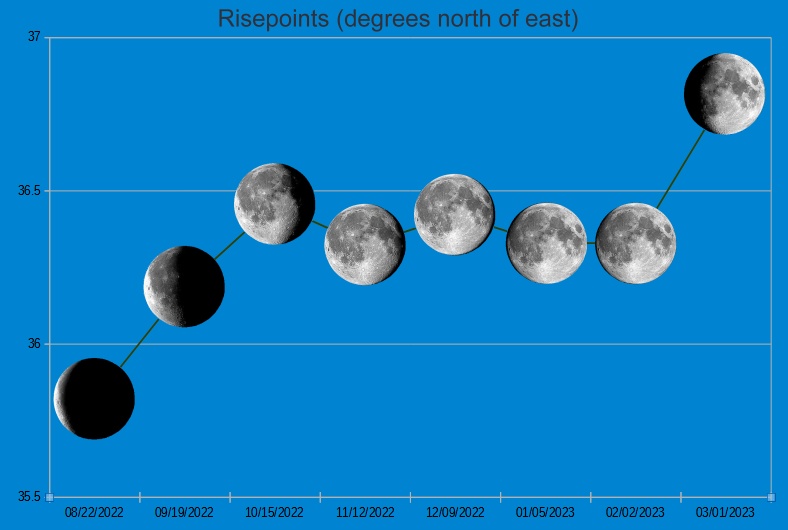
Right now, the moon is pausing as its maximum moonrises head towards the Major Standstill. This is because the maxes "try" (heh) to occur around the equinoxes, and dip at the summer and winter solstices, by about one full width of the moon. By 2024, that "pause" will look more like a real "dip". You can see the pause in the northerly trek in this picture.
12/08/2022.
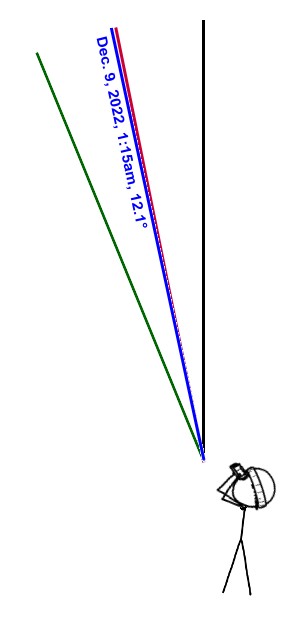
Here's a late edition moonwatch, because I see that the skies are, for some reason, suddenly clearing tonight. If you are up at around 1:15am in the morning, look up at the moon that will be nearly overhead. Don't fall over backwards as you do so. The moon will be merely 12.1° off of being vertical. That's only 1.5° away from what you'll get at the Major Standstill.
We're at the boreal (northern) lunistice, which is the lunar equivalent of the summer solstice with the sun. Around here, at the solstice, the sun only gets to 16.6° of being directly overhead. But since we are approaching the Major Standstill by the moon, it is able to better that by quite a bit.
In this picture, the green line is the best that the moon can do during a Minor Standstill. The red line is the maximum for the moon for the Major Standstill, and the blue is where it will be early tomorrow morning. (Black is vertical.)
12/09/2022.
I find it difficult to document (i.e., take photos) just how high in the sky the moon is for these boreal (northern) lunistices. If I take a picture straight up, there is no way for the viewer to know whether it was taken straight up, or just in some other area of clear sky. But here's my attempt.
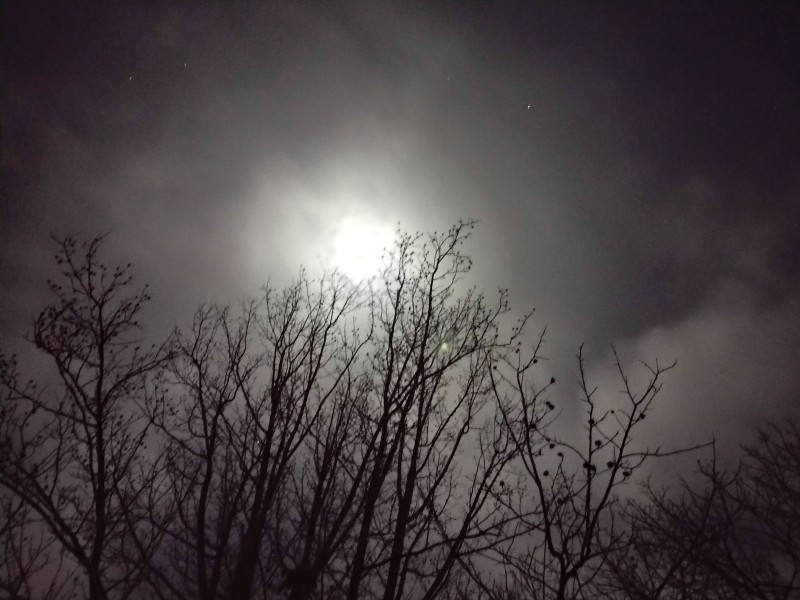
By 1:15 this morning, the sky was not as clear as last night. There were a bunch of thin, misty clouds, but the moon was mostly visible. It really was pretty spectacular to look nearly straight up at the moon. However, my moonshadow was quite variable in its visibility. For the first picture, I tried to shoot up from next to a tree—but again, you cannot really tell that I was shooting nearly straight up. Also, my photography skills really need work (though some of that fuzz came from all the mist in the air).
The next picture is me shooting down at my feet, to show just how short my moonshadow was.
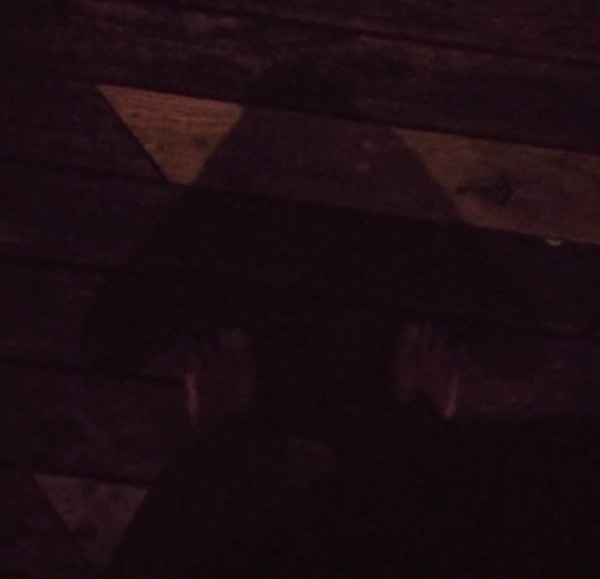
The way I was holding the camera, straight down was about 3 inches past the end of my toes. Also, those boards a 5½ inches wide. So my moonshadow really was pretty close to the 15 inches such a high moon would produce. (Those are my elbows sticking out the side as I held the cameramdash;no, I was not trying to emulate the Eagle Mound.)
This really is a phenomenom that has to be witnessed in person.
12/22/2022.
As you are probably aware, the winter solstice was yesterday. This time of year, the austral (southern) lunistice (the lunar equivalent of the winter solstice) "tries" to occur with a new moon. They actually do coincide this year, with the lunistice and the new moon both happening tomorrow (the 23rd). Of course, that means that there really isn't much to see, since having a new moon means that the moon is approximately at the same location in the sky as the sun. (There also isn't a lot to see tomorrow because of the blizzard—such is central Ohio in the winter.)
But if there were something to see, this picture shows how the moonrise is getting close to aligning with the southeast leg of the Octagon.
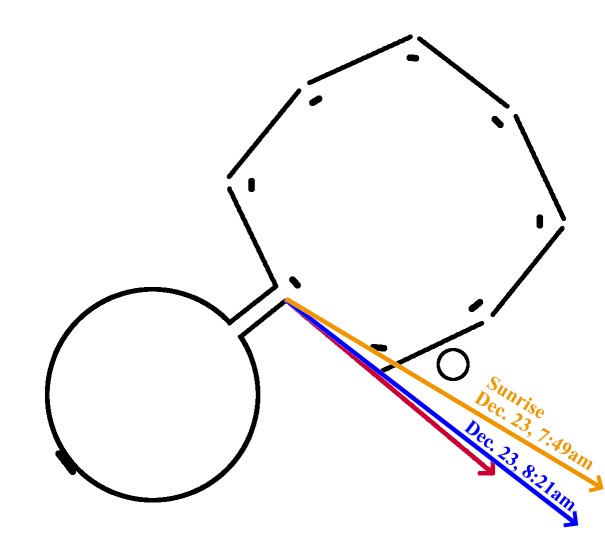
I've also included the sunrise, so you can see its separation from the moonrise. Because we are approaching the 2024-2025 Major Standstill, the moonrise is quite a bit south of the southernmost solstice sunrise, and the moon does not trek as high in the sky as the sun. The sun makes it to 26.5° above the horizon; the moon only makes it to 21.6°.
This video shows how the sunrise and moonrise would look, if it were even possible to see the moon.
01/04/2023.
This winter solstice period has been pretty awful, weather-wise, for observing the synchronicity of the solstice and the boreal (northern) lunistice. So I guess all I can do is tell you what the moon is doing.
We are still in the period in which the lunistice occurs with a near-full moon. The lunistice is tomorrow night; the full moon is the next day (the 6th). For the winter solstice, the sun is in the sky for its shortest period of time. But, conversely, for a boreal lunistice, the moon is in the sky for its longest period of time. So, their respective rises and sets also dance together.
This video shows that dance. I've moved the vantage point from the usual Observatory Mound to what I call a "magic" spot. It's the location on the Octagon from which one can watch both the lunistice moonrise and sunset align with the mounds. From there, one can also see the moon almost directly overhead around midnight.
Another thing that makes that spot "magic" is shown in this next picture.
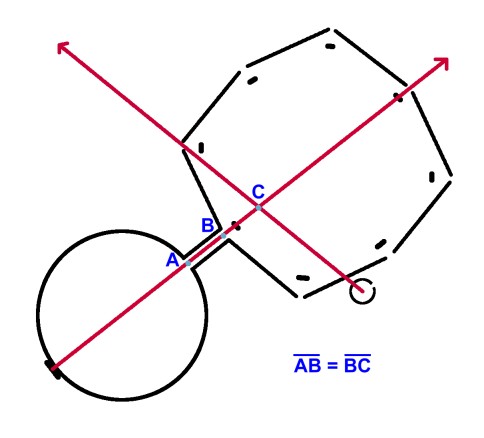
The distance from the edge of Observatory Circle to that spot is exactly twice the length of the corridor between the Circle and the Octagon. Making that work more or less determines the length of the corridor. I have to note that it is highly speculative on my part whether this spot was seen as special by the peoples of the Hopewell culture. It's not clear just what sort of archaeological evidence that would leave that would be meaningful.
Riffing on that, though, the immense scale of the Earthworks has often been remarked upon. They cover an enormous breadth. From this "magic" spot, however, with the moon nearly directly overhead (as occurs during the Major Standstill), I would like to consider the moon itself as part of the construction. In that case, the Circle and Octagon are merely the footpad of an even grander and more immense "construction" that has a greater height than any other monument on (or above) the earth.
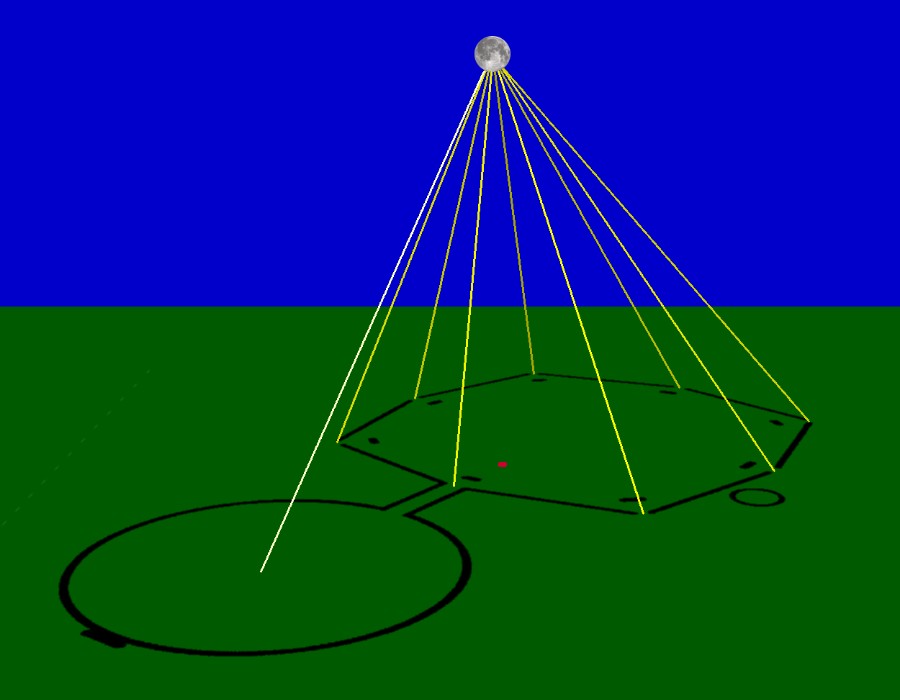
Is there any way to prove this? No. But I think it is interesting to think about.
01/19/2023.
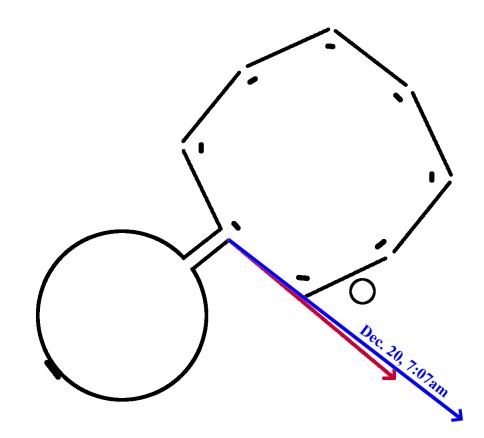
Tomorrow is another wintertime austral (southern) lunistice with the sun's path very low in the sky (but improving!) and the moon's path even lower. The moon will rise as a small waning crescent at 7:07am, followed by the sun at 7:47am. At 10:32am, when the moon is at its highest, it will be not quite 22° above the horizon. In comparison, the sun will make it to nearly 30°. The next day, the 21st, will be the new moon.
This would be a challenge to see even without the heavy cloud cover forecast for tomorrow morning. Such is winter in Central Ohio. This picture shows where we could see it rising, and we can see how close it is getting to aligning with that leg of the Octagon.
01/31/2023.
We are now in the half-year period when the boreal (northern) lunistice moonrise (the one that the Octagon points at) occurs during the daytime. The lunistice moonrise happens at 2:01pm tomorrow, the 1st. You can see such moonrises if you know what you are doing, but they are not spectacular.
At around 10:00pm, the moon will be almost directly overhead at meridian. See if you can catch it at your home.
That still leaves moonsets, which are nighttime occurences during this half-year period. The moonset occurs just before 6:00am on the 2nd. In the picture, the green line shows how close to alignment it'll be.
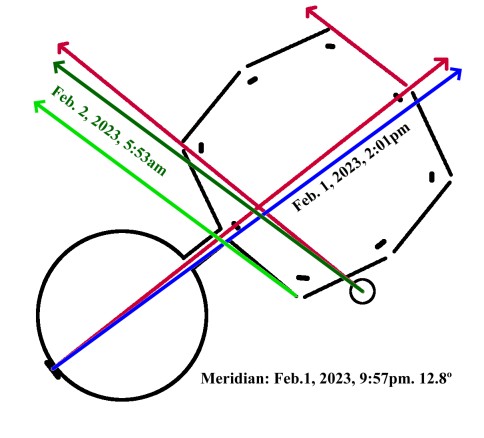
The light green line shows a "proxy" with easy (and legal) access, which is what we observed during the Open House last October. In October, the moonset was in the afternoon and difficult to observe; this one should be much easier to see and appreciate, being about an hour and a half before sunrise.
02/09/2023.
Today is the day that the moon sets (at 9:29am) north of the equator, crosses it, and then rises (at 9:56pm) south of the equator on its way to the next austral (southern) lunistice. There's not a whole lot to see, so I'm going to use the occasion to show you how to design the Octagon.
You will need to watch the attached animation. There are a few points I want to make about it, but so as not to spoil the animation, I'll add those points at the end.
You should be amazed that we had to do nothing to pick up the Minor Standstill alignments. They don't align perfectly, and the indigenous peoples of the Hopewell culture had to nudge the "designed" Octagon slightly to pick them up more accurately, but even without that they are very close.
These near-alignments occur because Newark sits in a fairly narrow band of latitudes where it works. John Low has often said that the Newark site is not sacred because that is where the Earthworks are; the Earthworks are there because the site is sacred. I suspect this union of alignments added to that consciousness of sacredness.
Notice this design says nothing about how the area of Observatory Circle and the area of Wright Square are nearly equal; nor how the perimeter of Wright Square is nearly the same as the circumference of the Great Circle. Those fall out automatically without needing a way to measure areas. They are predetermined. It is difficult to make the argument that they were put there deliberately as part of the design. However, if those measurements are noticed after-the-fact, they could be another reason for the Newark Earthworks to be considered sacred.
You may also have noticed that Wright Square extends not to the middle of each Entry Mound, but to the face each entryway, not top. In this context, the face really is the important part of entering. And besides, that's what works.
I fully realize that I might be doing "special pleading" to make this claim, since the other mounds have been measured from their high points. I have to admit that the size of Wright Square is another accident (and, in fact, I have another, differerent way I can come up with its size). But that is part of the problem with looking at 2,000 year old constructions.
Most of this animation follows observations and analysis by Hively & Horn, though I did independently notice the inscribing of the Great Circle. I did come up with the little green square, though—I am unaware of anybody else having noticed it.
02/15/2023.
Tomorrow is the austral (southern) lunistice. Instead of my usual Octagon picture, I'm going with an elevation relief map that shows the line (purple) between the center of the Observatory Circle and the center of the Great Circle. This aligns with the southernmost moonrise during the Major Standstill, so tomorrow's lunistice moonrise (blue line) is working on aligning with it.
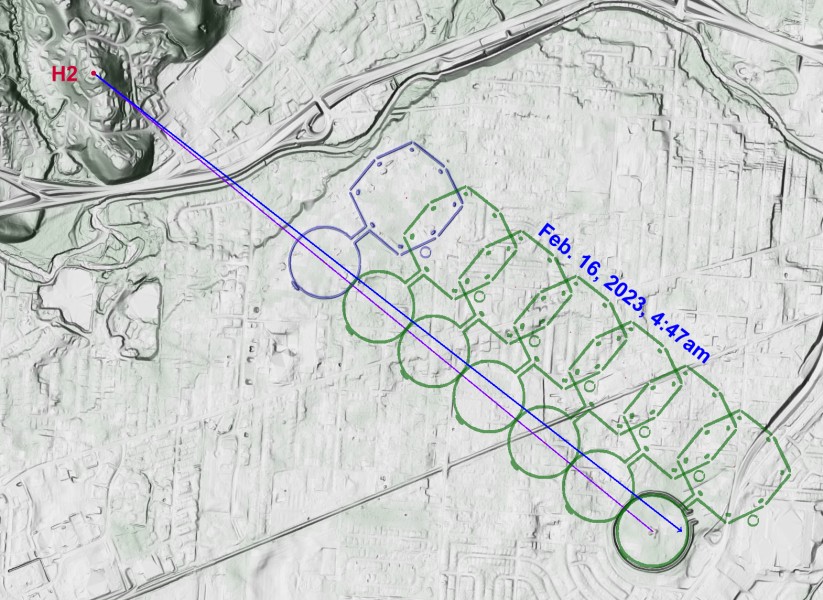
You will also notice that the alignment line extends northwest from the Observatory Circe to "H2", a hill that Hively & Horn identified as a prime observation point that the indigenous people of the Hopewell Culture probably used to help design and set up the Newark Earthworks. It is also a vantage point that allows extreme precision, because of the long distance that one can see. If one wants to create a straight line from it, what one does is set up signal fires that can be observed from it, and then move the signal fires left and right until they are perfectly lined up.
The picture also illustrates how the distance from the centers of the Observatory Circle and the Great Circle is really, really close to six times the diameter of the Observatory Circle.
We are in the time of the year, around the spring equinox, when the austral lunistice moonrise takes place at night (while, according to "The Rule of Lunar Opposites", the boreal lunistice moonrises take place during the day). The moon will rise tomorrow at 4:47am. While in the sky it will stay close to the horizon, getting to its the highest point at 9:09am and 21.43° above the horizon. Good luck seeing that with tomorrow's weather. (Has anybody else noticed that the weather this winter has been AWFUL for observing lunistices?)
02/28/2023.
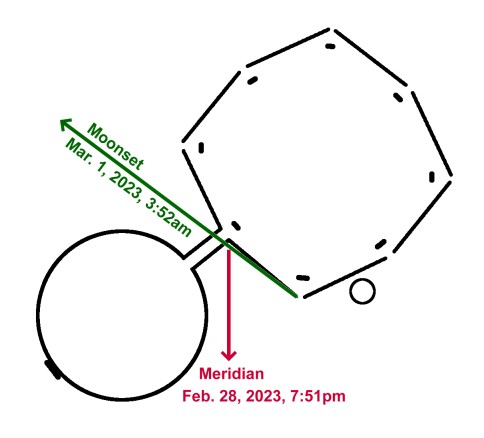
Another boreal (northern) lunistice is coming up. For spring lunistices, the moonrise is in the middle of the day (3/1, 12:45pm) and hard to see. However, it is the moonsets that occur at night, along with meridians. (The meridian is when the moon hits its peak in the sky, and is due south.)
The weather is cooperating!
It will be mostly clear Tuesday evening throught Wednesday noon. The lunistice meridian will be at 7:51pm Tuesday evening, and the moonset at 3:52am early Wednesday morning. Both are easily visible from the Octagon parking lot. The first picture shows a really good proxy leg for viewing the moonset.
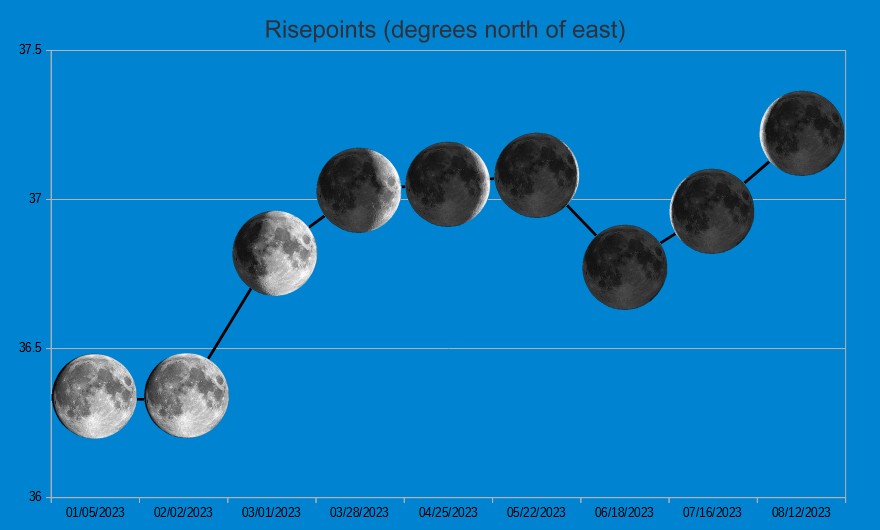
The moon is on its usual Spring surge towards the Major Standstill, before it steps back for the summer, and then resumes it approach in the Fall. The second picture shows that, and also shows how the boreal lunistices tend to fade away for the Spring and Summer (daytime moonrises and/or the moon itself near "new").
03/15/2023.
Spring is when the boreal (northern) lunistice moonrises associated with the major axis of the Octagon occur during the daytime. However, that means that an austral (southern) lunistice moonrise, like the one now approaching, occurs at night. And for those moonrises, what I prefer to show is the alignment of the Earthworks Complex (which is what I did in mid-February). The first picture shows how Dugway Hill (Hively & Horn's H2), the Observatory Circle, and the Great Circle are all lining up.
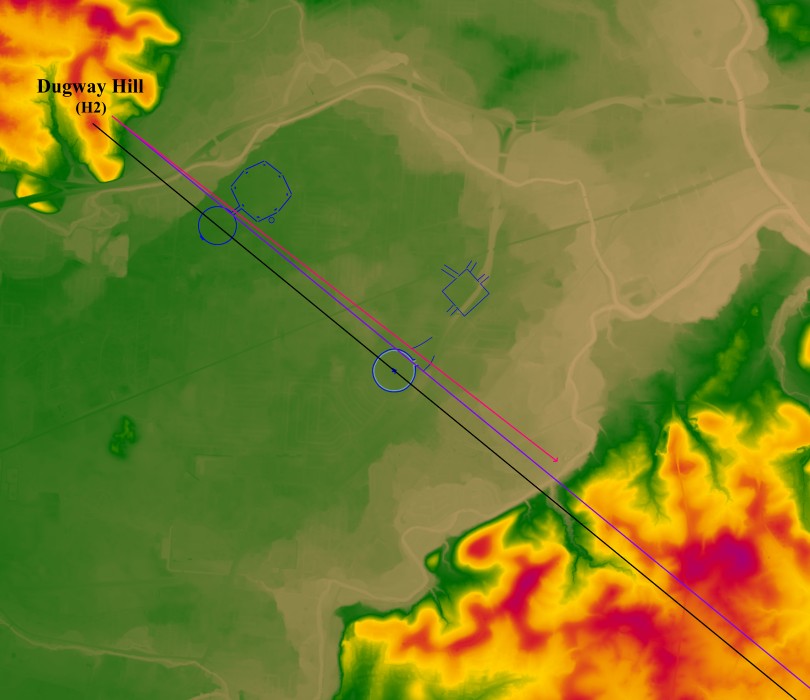
The picture uses one of my color-coded topographic maps to show the valley across Raccoon Creek and the South Fork of the Licking. The black line shows how the top of Dugway Hill looks down upon the aligned Observatory Circle and the Great Circle. That is the line of the southernmost moonrise. The purple line starts at the nearby place we can use to view across the valley today. It runs parallel to the black line, and so also points to the southernmost moonrise. Interestingly, as you can see, this current viewing point is almost exactly one Observatory Circle Radius from the top of Dugway Hill. Coincidences abound! Finally, that fuchsia line shows how close we're getting to alignment.
I am really beginning to think that this alignment is an underappreciated aspect of the whole Earthworks Complex.
Jeff Gill educated me on the "official" name of "Dugway Hill". Those of you who have visited the Newark Earthworks may have noticed that Rte. 16 and Newark-Granville road skirt around the bottom of the hill, which has clearly been dug away to make room for them (and it goes back to at least 1830). You can find out more about the Dugway on page 7 of this issue of "The Historical Times" from the Granville Historical Society.
The top of Dugway Hill, one of the places that the Indigenous Tribes of the Hopewell Culture must have used to design the Earthworks Complex, and which was probably as much a part of the Earthworks as the Octagon, now has houses and trees on it that block that vista. However. There is a decent viewing area nearby, at the corner of Swansea Road and Shoreham Drive. That area sits about 100 feet below the "peak", but still provides a nice view across the valley, and gives a very nice feel for what the people saw 2,000 years ago. This second picture shows that view, along with what the upcoming lunistice moonrise might look like.
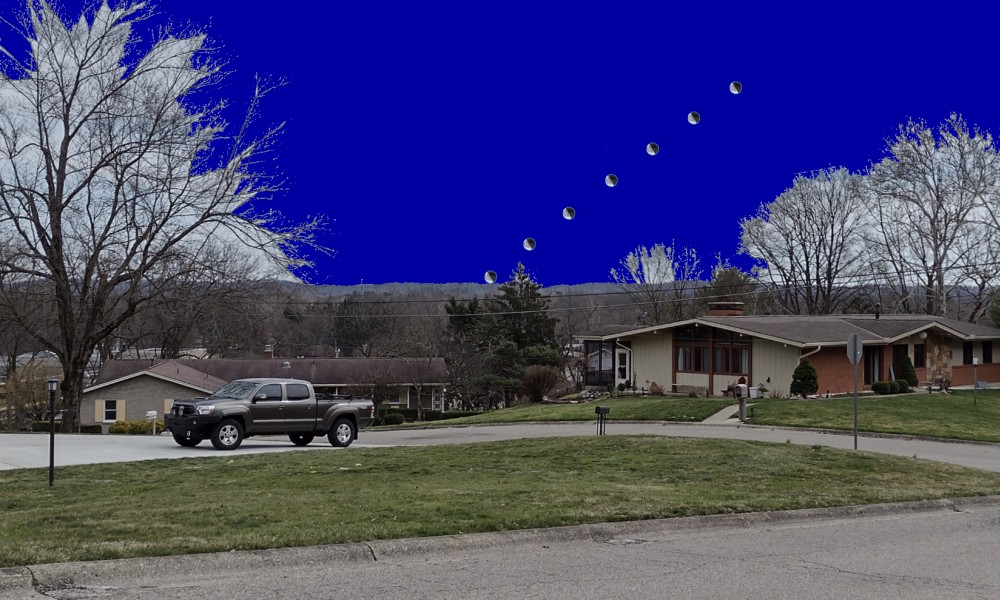
That is the view from the lower vantage point on Dugway Hill. (Obviously I've edited somewhat, by changing the sky, a picture I took.) The moon rises from the hills across the valley. If the trees and houses were gone, we'd be able to see the Octagon and Great Circle down below. It is possible that bonfires in their centers could have been used to enhance viewing the alignment during any ceremony.
As with the sun around the winter solstice, the moon for an austral lunistice does not get very high in the sky. That means that the angle it rises at when rising is pretty small, 38.5°. I've added the moonrise locations to the picture, following the moon at 10 minute intervals for a bit.
The upcoming austral lunistice is another twin lunistice, with two similar peak moonrises on subsequent days. The first occurrence is during the early morning (3:36am) on Wednesday, March 15. The weather looks ideal for viewing. The current forecast calls for crisp and clear! (The weather for the next peak on the next morning, 4:38am, will be non-cooperative.) If you are interested, this might be worth checking out. (If you are not allergic to being awake so early.)
03/28/2023.
Tomorrow the 28th is another boreal (northern) lunistice. It looks very similar to last month's, even to the times. Everything moved about an hour, but we also reset our clocks to Daylight Saving Time. Around the vernal equinox, the moon rises in the middle of the day—in this case 11:33am. Moonsets this time of year are in the middle of the night—in this case 3:34am. The meridian (when the moon is at its highest point in the sky), will be right around sunset, and will show up very nicely. The weather may evey cooperate here in central Ohio, so go out and take a look. The moon will be just 12.3° off-vertical. (Compare that to the 16.6° for the sun at summer solstice.)
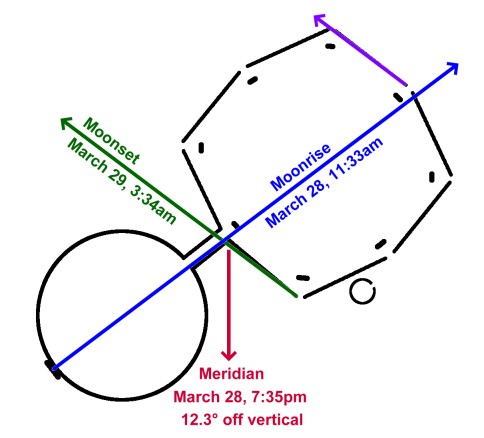
The green line on the picture is a "proxy" for viewing. That leg is "officially" meant for viewing the southernmost moonrise, but it is quite close to being correct when you run it in the other direction. The purple line is the "official" leg for a northernmost moonset, but it is filled with trees.
I'm also reusing the picture showing the approach to the Major Standstill. Again, Spring (and Fall) is when it the moon's northerly rises advance most quickly, before pausing (or dropping back) during the Summer (and Winter).
BTW, "boreal" comes from Βορέᾱς (Latin: Boreus), the Greek God of the North Wind.
04/04/2023.
Today's a descending node for the moon, which is boring (aside from an approaching full moon). So instead I'm going to present: Why is Salisbury Hill so special?
It's pretty clear that the Indigenous Tribes of the Hopewell Culture who designed and built the Newark Earthworks recognized Salisbury Hill as something special. For one thing, it has a hilltop "enclosure" on it. For another, it turns out that it has alignments with the main plan of the Earthworks. I got to thinking about this on a bike ride a weekend ago, while going by Heath High School. This picture shows what Salisbury Hill looks like looming over the Licking River valley.
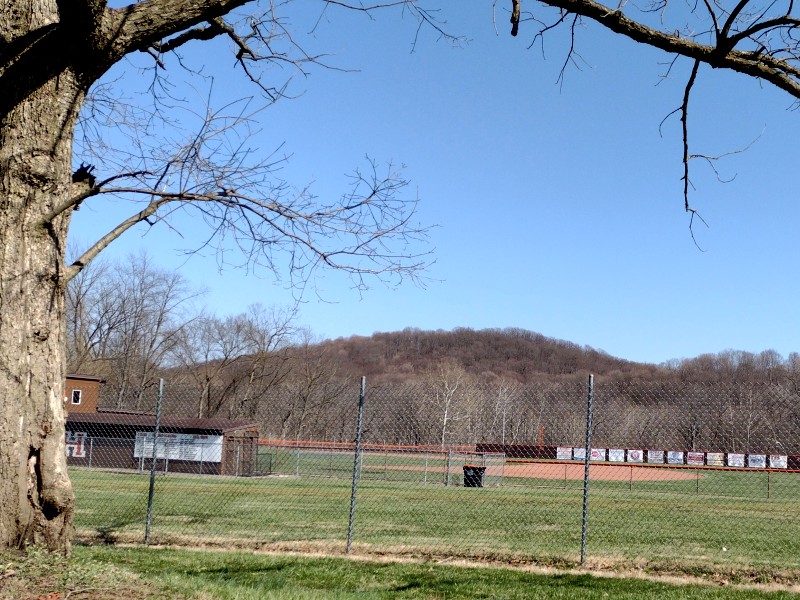
It turns out that a line from the center of the Octagon, and making a tangent with the Great Circle, ends up right at the peak of Salisbury Hill—within about 10 feet or so. Unfortunately, at that point on the Great Circle itself, these days a bunch of trees block the view towards Salisbury Hill. However, the bronze marker in front of the Visitor Center at the Great Circle is aligned sufficiently to give one a feel for the alignment.
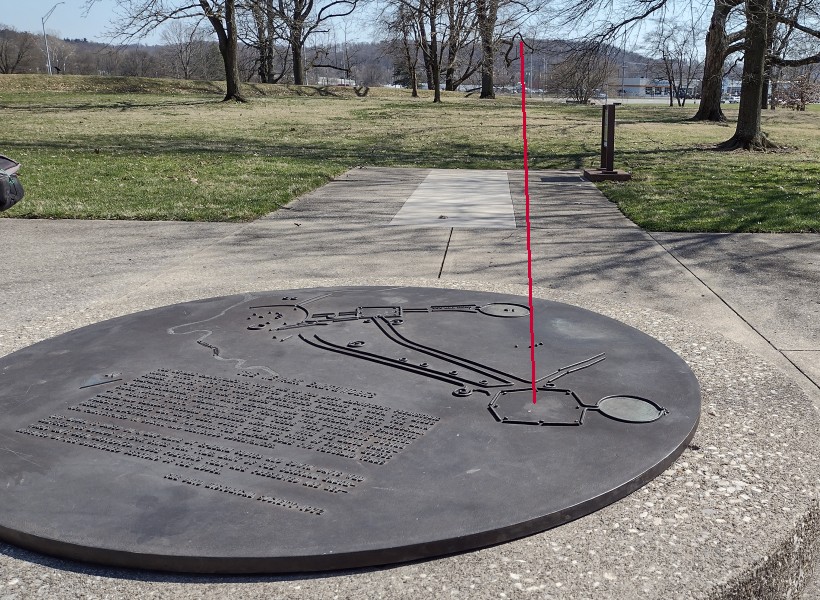
The line does not hit the peak of Salisbury Hill because this viewing location is on the other side (by about 1180 feet) of the Great Circle from the tangent line.
But wait! There's more! It's been known since 2005 (thanks to William Romain) that the distances from the peak of Geller Hill (in Geller Park) to the Great Circle and to the center of the Octagon are the same (again, within 10 feet or so). That's pretty remarkable, and it's hard to think that could be happenstance. But, bringing Salisbury Hill back in the picture, the distance from the center of Wright Square to the center of Observatory Center and the distance from the center of Wright Square to the absolute peak of Salisbury Hill are also the same distance (again, within 10 feet or so).
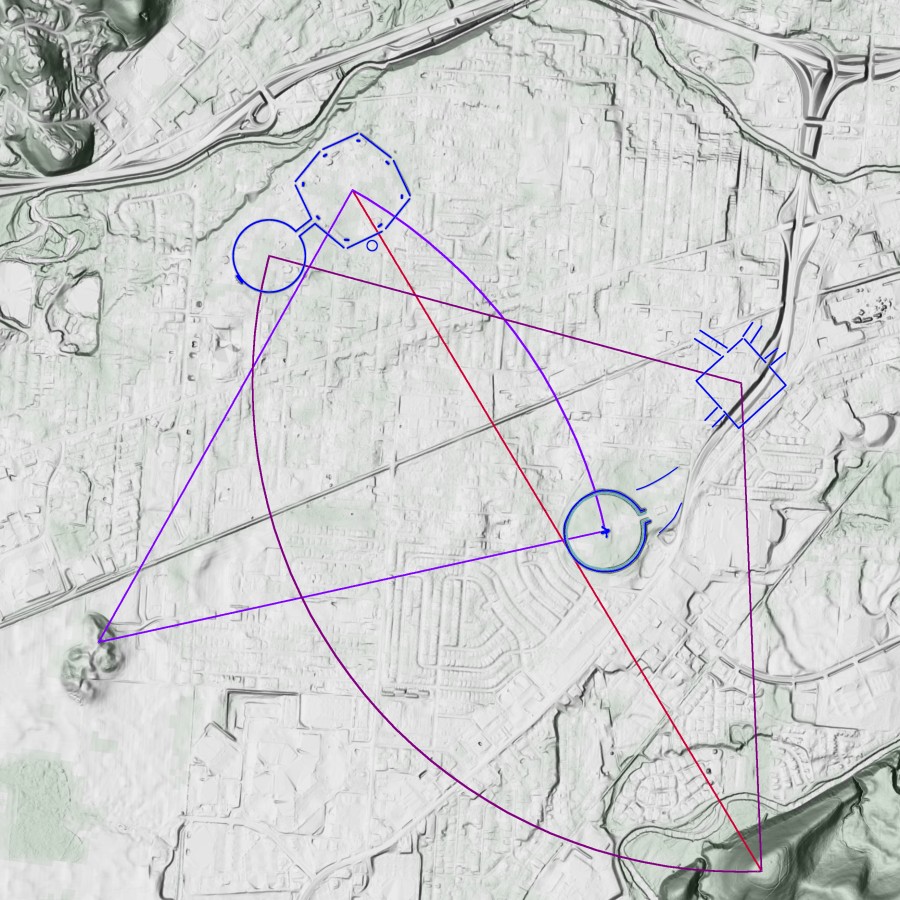
Here, red line shows the alignment from the Octagon to Salisbury hill, the purple line shows the equidistance arc from Geller Hill that hits the centers of the Octagon and the Great Circle, and maroon line shows the equidistance arc that is centered in the middle of Wright Square and the center of Observatory Circle and the peak of Salisbury Hill. It is pretty difficult to argue that this is all coincidence.
These also show really sophisticated engineering/geometrical skills. I can maybe see stretching a rope (or other cordage) over those distances. But crossing over the South Fork of the Licking and accurately measuring to the top of a 250 foot hill is pretty spectacular.
The next three pictures show some views from the top of Salisbury Hill. One needs to look pretty hard to see through the vegetation.
Here we look towards Observatory Circle, looking through the trees as best we can.
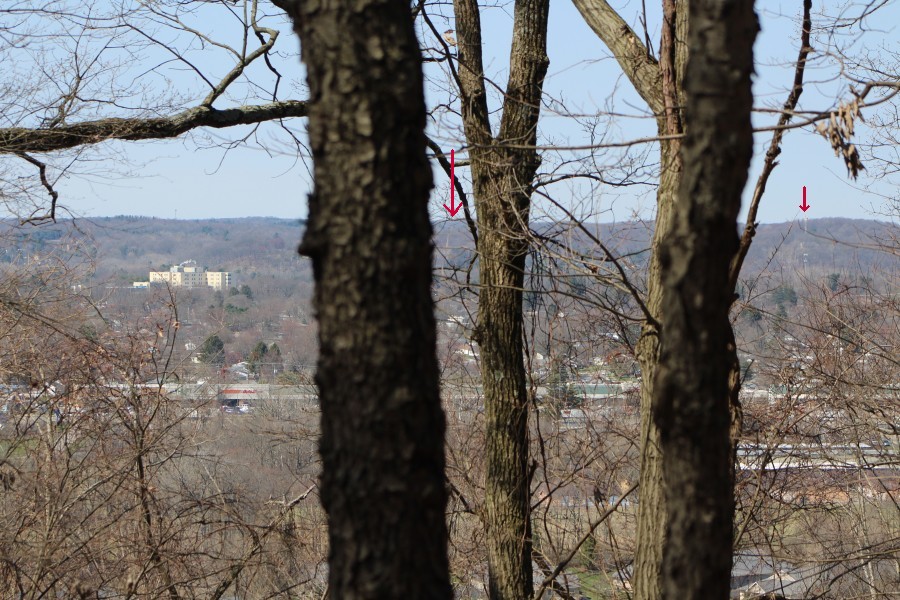
The zoom lens I was using makes the objects appear closer together than they really are. On the left you can see Licking Memorial Hospital, which is just to the southwest of Observatory Circle. The leftmost red arrow shows the location of Dugway Hill, and Observatory Circle is below it (but not visible) just to its right. The rightmost red arrow is pointing to the tower on Tower Court, which sits on the next peak behind Dugway Hill.
This is a close-up of the tower.
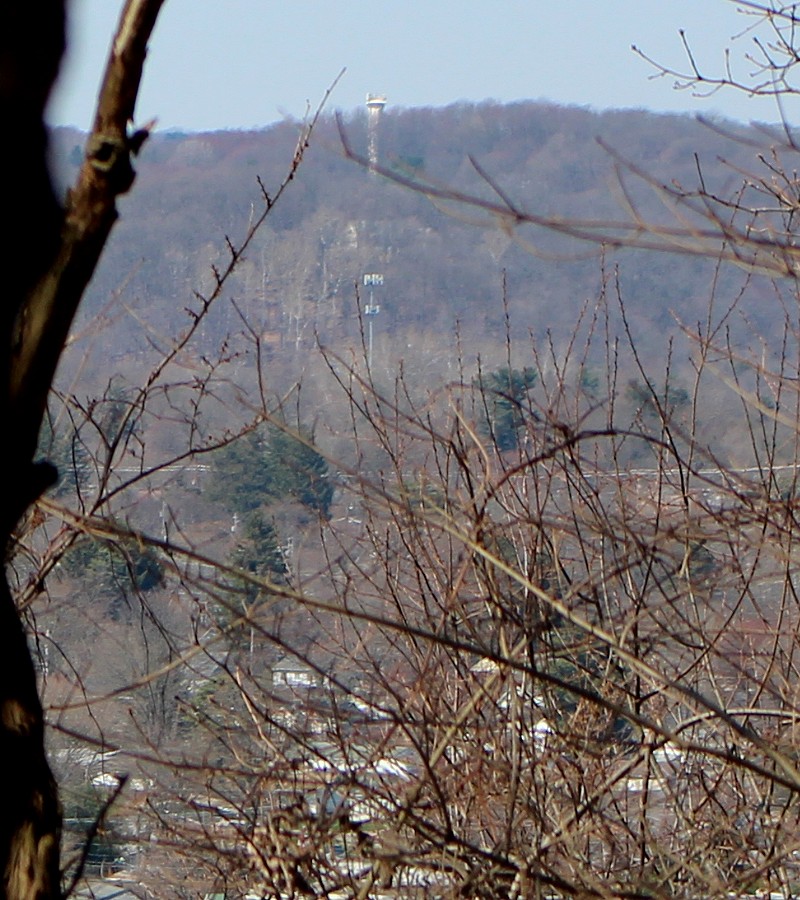
I'm pretty sure that the white strip that runs across the picture is Rte. 16. Observatory Circle and the Octagon are right below it, and this line of sight cuts through the corridor between them.
This is the view towards the Great Circle.
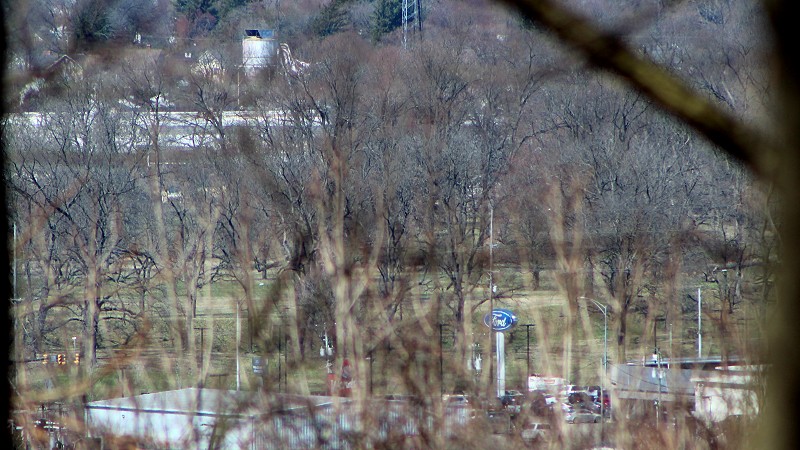
Many of you will recognize the Ford dealer at the corner of Rte. 79 and Hopewell Drive, and you can see the stop light in the lower left. The Great Circle is directly behind it, and you can see the large green space that it occupies.
It strikes me that part of the Newark World Heritage site ought to include Salisbury Hill with enough trees removed to be able to look across and down into the valley containing these incredible Earthworks. Based on these pictures, I think it is obvious that the Indigenous Tribes of the Hopewell would have kept the view from this hilltop enclosure unencumbered.
There is one more thing I want to highlight about Salisbury Hill. The view down its spine to the northeast aligns with the northernmost moonrise during the Major Standstill.
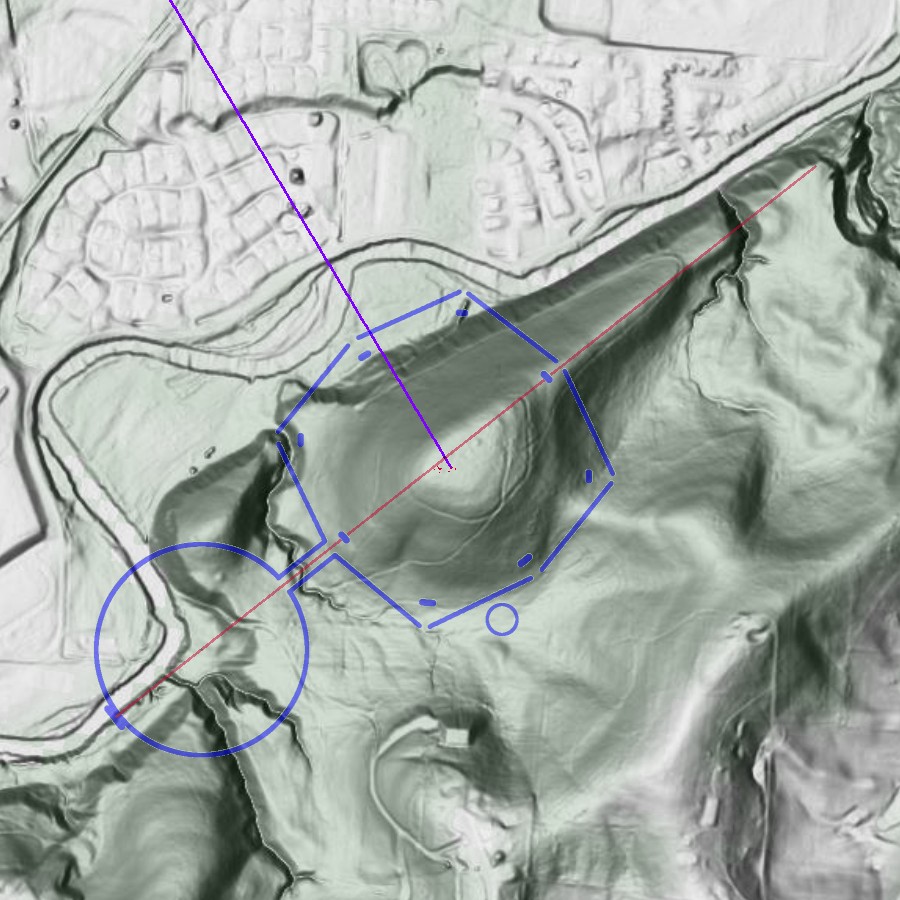
Here I've overlain the Octagon onto the Hill to illustrate that alignment: a perfect match. I don't see how this could have been "designed" into the Newark Earthworks. But I do see the people here seeing that and concluding that this was a valley sacred to the Moon, and that they had to honor that.
04/11/2023.
Tomorrow is another austral (southern) lunistice. As we approach summer, the moon is working its way to being full for the austral lunistices, and it rises when the sky is dark, at 2:32am. With the Major Standstill approaching, the moonrise is also working on aligning with the southeast leg of the Octagon, and also aligning with the line from Dugway Hill to the center of Observatory Circle to the Great Circle.
Since the austral lunistice is the lunar equivalent of the winter solstice, that means that the moon will not rise very high in the sky, and because of the approach of the Major Standstill, even at its highest point it is particularly low—lower than even the solstice. This picture shows the moon's path across the sky its lowest meridian, March 22, 2025; tomorrow's meridian, at 6:54am; and finally, how high the sun gets on the winter solstice.
04/24/2023.
As we head towards summer, the boreal (northern) lunistice moonrises get harder and harder to see, while the austral (southern) lunistices come to the fore. Tomorrow's boreal lunistice occurs near a new moon (the new moon was on the 20th). The moon will set at 1:27am, rise again at 10:15am. and hit its meridian at 6:17am (two hours before sunset). It is still making a slow advance to the Major Standstill alignment with the Octagon.
This time of the year, it is the boreal lunistice moonsets that are most visible. The picture shows how close the moonset is along the "proxy" leg, which can be observed from the golf course parking lot if you decide to get up in the middle of the night. Skies should be mostly clear.

05/05/2023.
This is a SUNWATCH and MOONWATCH together.
Today is the cross-quarter for the sun. That is, we are midway between the Spring Equinox and the Summer Solstice. This is what the Great Circle points at as a good time to start planting. The Celts call it Beltane.
You may have noticed that we had a full moon last night. That means that the moonset is directly opposite the sunrise. So, that further means, that this morning's moonset could be beautifully viewed by looking INTO the opening of the Great Circle, at 6:15am. That's this first picture.

I'm standing in front of the Visitor's Center.
The next picture is a close-up as the moon started to disappear behind the trees.

You can see the bump of Eagle Mound in the foreground.
Once the moon set, I had enough time to look for the 6:23am sunrise from Eagle Mound. That's this next picture, where the sun has just cleared the Visitor Center.

And this next picture is the close-up a minute later.


And finally, for the last picture, Jeff Gill really likes (and I concur) standing at the entrance to the Great Circle and letting his shadow point to the center and Eagle Mound with the barely-risen sun at his back. He couldn't be there today, so this is for him.

This was an awesome morning at the Newark Earthworks.
06/05/2023.
We're at the time of year (near the summer solstice) when the full moon lines up with the austral (southern) lunistice. The Lunistice is today, and you may recall that the full moon was two days ago (just before midnight). The sun is in the sky for its longest amount of time, and the moon is in the sky for its shortest. The sun gets very high in the sky while the moon, even at its highest, does not get too far above the horizon.
Moonrise this evening will be at 11:16pm. It will be at its highest point at around 3:38am tomorrow morning, and will only make it to 21.6° above the horizon. (It was even lower this morning, at 21.4°.) The moon will be in the sky for only 8 3/4 hours.
The picture shows how this moonrise is getting close to aligning with the Newark Earthworks as the Major Standstill of 2024/2025 approaches.

The alignment is with both the lower leg of the Octagon and, more impressively, the line from Dugway Hill through the centers of Observatory Mound and the Great Circle.
06/18/2023.
We are only 3 days away from the summer solstice, today is the boreal (northern) lunistice, we're approaching the 2024/2025 Major Lunar Standstill, and there's nothing to see. Let me explain why.
Today is also the new moon. The boreal lunistice nearest the summer solstice always "tries" to be a new moon, and this is true whether there is a Major Standstill happening or not. For a new moon, the moon will necessarily be on the same side of the earth as the sun. But the tilt of the earth that's creating the summer solstice is the same tilt that makes this a boreal lunistice.

What the approaching Major Standstill does, though, is make the boreal lunistice moreso. The sun rose this morning at 6:00am at 32.1° north of east; the moon rose at 5:57am even farther north, at 36.8° north of east. You just couldn't see it because of that great big burning ball of plasma in the sky. At 1:30pm, the sun will be within 16.6° of directly overhead; but (at 1:59pm) the moon will be moreso: within 12.4° of being directly overhead. Will you be able to see it? Nope. In addition, the sun will be in the sky for a total of 15 hours and 1 minute between rise and set. The moon? Moreso, at 16 hours and 4 minutes.
But you won't be able to see any of it. Go enjoy Father's Day instead!
07/15/2023.
Tomorrow is the boreal (northern) lunistice moonrise, at 4:48am. We have now arrived on the backside of the summer solstice and into the half-year period when the boreal lunistice moonrise occurs during the night, or, at least, during twilight. We are just barely into that period, so the lunistice occurs with just a thin sliver of a moon. The weather forecast at the moment suggest about 50% cloudy.
As we now head towards the fall equinox during a Major Standstill event, the moon hastens its approach to its northernmost moonrise, until its winter pause. At this time, the moonrise will now miss aligning perfectly with the Octagon by about 1.2° — that's a bit more than 2 moon widths.
Also, as fall approaches, the time of the moonrise will get earlier and earlier so that around the equinox we'll have a 3rd quarter moon rising near midnight.
This first picture shows where the moon is rising in relation to the Octagon.

This second picture shows the moon's risepoint "racing" north during the fall.
